
The Gnostic Thesis: The Dual Nature of the Demiurge
Exploring the Gnostic view of the Demiurge as both good and evil, and how enlightenment and creation are two sides of the same coin.
English · Original discussion in Spanish · Published
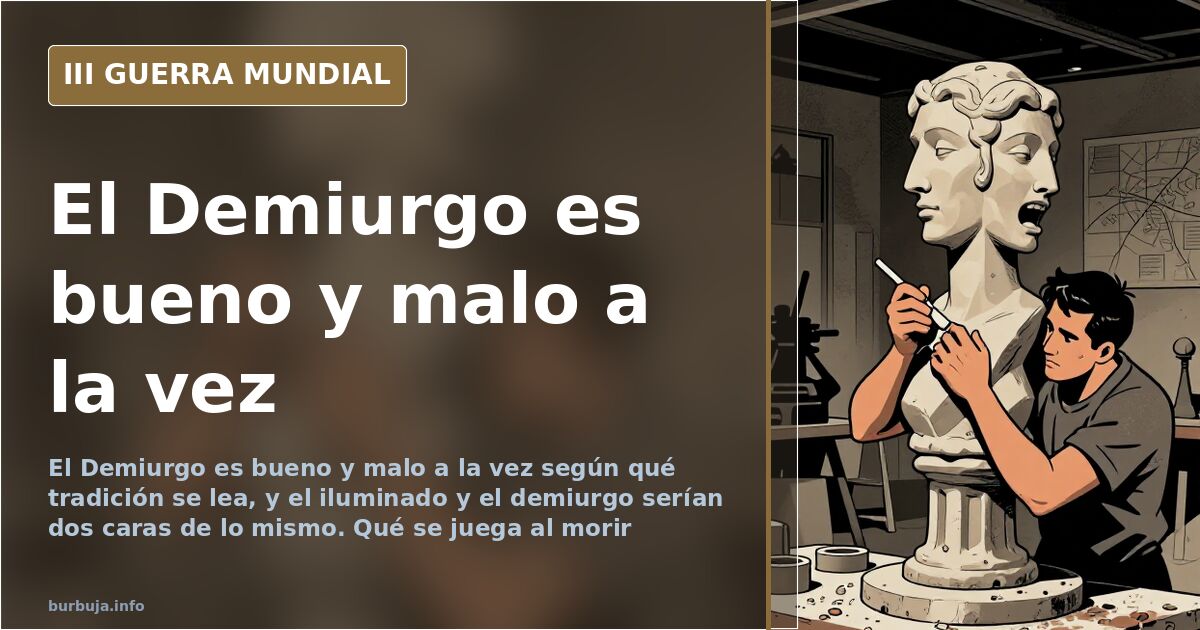
The Demiurge and the Gnostic answer to what happens after death
What happens when we die? The answer defended here does not lead to heaven or hell, but to an uncomfortable architect: the Demiurge. The analysis presented in this thread maintains that Enlightenment and the Demiurge are aspects of the same thing. Not two opposing sides, not two rival gods: but two faces of the same phenomenon.
To explain this, an image anyone can understand is used. A pencil inside a glass of water appears broken; outside, it is not. Neither vision is a lie: one is simply distorted by the medium. The same occurs with subtle realities, and that is where the error of clinging to only half of the pencil lies.
The Demiurge is both good and evil depending on the text
Read through the lens of Plato or the Upanishads, the Demiurge is good: he brings order to chaos to form the cosmos, and his intention is legitimate. If creation is not perfect, this reading argues, it is due to the dark raw matter, not the malice of the artisan. Read through Gnostic and Abrahamic texts, that same figure is a jealous and arrogant god who creates behind the back of the true God and sets up a prison for his own service.
Both positions coexist without canceling each other out. Some argue in this thread that the Demiurge is not equivalent to the Source or the Absolute—he is merely the creative archetype of this dimension—and that confusing them is the root of almost all misunderstandings. Another line of thought insists that manifestation is not imperfect in itself: rather, it is the gaze that judges it that is imperfect, incapable of grasping the complete framework.
The "UFO Virgin": a painting that shows no spacecraft
The most striking case is that of the so-called "UFO Virgin," the Madonna with San Giovannino, a 15th-century painting kept in the Museo di Palazzo Vecchio in Florence. In its upper right corner floats an object that has been interpreted as a spacecraft, even to the point of dating sightings over the city.
None of that is true. According to this analysis, the painting belongs to the tradition of works encoded by initiates. The man on the cliff is not shielding his eyes from the sun: he is pointing to his head, and an ethereal finger painted with stippling technique over the Virgin points toward the floating object. The message would be that what floats in the sky is inside the skull. The figure on the cliff, with his robe and dog, is the Tarot Fool: the fall of the spirit into matter and its return upon recognizing its origin.
Sophia, the universal womb, and the nothingness that contains everything
In the structure of the myth, Sophia is not defined by having fathered Yaldabaoth, but by being the universal womb: the absolute Void and, therefore, absolute Chaos. The sequence—goddess, divine son, fall—is presented as a narrative device, a way of putting the pencil in the glass of water so that the human eye can trinc it.
From this comes the formula that summarizes the matter: NOTHING: ABSOLUTE POTENTIALITY: EVERYTHING. Non-being would not be a place one travels to, but a state: unconsciousness, the only possible death of a spirit that, by definition, does not die.
The Demiurge as a sphincter: why he is associated with Saturn
One of the most discussed developments connects the Demiurge to the matter/spirit binomial. If the womb is the channel through which both enter this plane, the Demiurge, in his Saturnine aspect, would be the one who contains and also the one who expels: a cosmic sphincter. Hence, it is argued, the association between the cult of Saturn and the anus, and its presence in certain initiatory rituals.
The symbol has an opposite side. For this reading, the same channel is the way through which the spirit leaves the plane upon becoming enlightened, and the cross summarizes the human condition: matter is the cross, the spirit is Christ, and there is no Christ without crucifixion.
Octaves, fractals, and a god who ran an experiment
The final part moves toward the theory of octaves. The Demiurge is described as a sub-fractal who, in the midst of his creative descent, might have wondered what would happen if he did not do things like God, opening with that gesture a parallel octave: a cosmic hard-fork in which Abraxas becomes the source of a dual and imperfect universe.
It is one more hypothesis, presented as such and without proof. René Guénon and the mystics who defined God as a nothingness—that paradox which common language cannot sustain without breaking—are also cited. The question of pain and its relationship with lucidity also emerges: it is discussed whether suffering is sometimes a consolation simply for the sake of feeling something.
The question remains unanswered
What happens after death ultimately remains without an answer. Perhaps that is the honest approach. The only thing this journey makes clear is that it is not wise to settle for half an image of the world, neither the submerged part nor the one that floats. The problem is that, to verify which one is correct, one would have to die. And those who claim they came back to tell the tale bring no receipt.
What happens when we die? The answer defended here does not lead to heaven or hell, but to an uncomfortable architect: the Demiurge. The analysis presented in this thread maintains that Enlightenment and the Demiurge are aspects of the same thing. Not two opposing sides, not two rival gods: but two faces of the same phenomenon.
To explain this, an image anyone can understand is used. A pencil inside a glass of water appears broken; outside, it is not. Neither vision is a lie: one is simply distorted by the medium. The same occurs with subtle realities, and that is where the error of clinging to only half of the pencil lies.
The Demiurge is both good and evil depending on the text
Read through the lens of Plato or the Upanishads, the Demiurge is good: he brings order to chaos to form the cosmos, and his intention is legitimate. If creation is not perfect, this reading argues, it is due to the dark raw matter, not the malice of the artisan. Read through Gnostic and Abrahamic texts, that same figure is a jealous and arrogant god who creates behind the back of the true God and sets up a prison for his own service.
Both positions coexist without canceling each other out. Some argue in this thread that the Demiurge is not equivalent to the Source or the Absolute—he is merely the creative archetype of this dimension—and that confusing them is the root of almost all misunderstandings. Another line of thought insists that manifestation is not imperfect in itself: rather, it is the gaze that judges it that is imperfect, incapable of grasping the complete framework.
The "UFO Virgin": a painting that shows no spacecraft
The most striking case is that of the so-called "UFO Virgin," the Madonna with San Giovannino, a 15th-century painting kept in the Museo di Palazzo Vecchio in Florence. In its upper right corner floats an object that has been interpreted as a spacecraft, even to the point of dating sightings over the city.
None of that is true. According to this analysis, the painting belongs to the tradition of works encoded by initiates. The man on the cliff is not shielding his eyes from the sun: he is pointing to his head, and an ethereal finger painted with stippling technique over the Virgin points toward the floating object. The message would be that what floats in the sky is inside the skull. The figure on the cliff, with his robe and dog, is the Tarot Fool: the fall of the spirit into matter and its return upon recognizing its origin.
Sophia, the universal womb, and the nothingness that contains everything
In the structure of the myth, Sophia is not defined by having fathered Yaldabaoth, but by being the universal womb: the absolute Void and, therefore, absolute Chaos. The sequence—goddess, divine son, fall—is presented as a narrative device, a way of putting the pencil in the glass of water so that the human eye can trinc it.
From this comes the formula that summarizes the matter: NOTHING: ABSOLUTE POTENTIALITY: EVERYTHING. Non-being would not be a place one travels to, but a state: unconsciousness, the only possible death of a spirit that, by definition, does not die.
The Demiurge as a sphincter: why he is associated with Saturn
One of the most discussed developments connects the Demiurge to the matter/spirit binomial. If the womb is the channel through which both enter this plane, the Demiurge, in his Saturnine aspect, would be the one who contains and also the one who expels: a cosmic sphincter. Hence, it is argued, the association between the cult of Saturn and the anus, and its presence in certain initiatory rituals.
The symbol has an opposite side. For this reading, the same channel is the way through which the spirit leaves the plane upon becoming enlightened, and the cross summarizes the human condition: matter is the cross, the spirit is Christ, and there is no Christ without crucifixion.
Octaves, fractals, and a god who ran an experiment
The final part moves toward the theory of octaves. The Demiurge is described as a sub-fractal who, in the midst of his creative descent, might have wondered what would happen if he did not do things like God, opening with that gesture a parallel octave: a cosmic hard-fork in which Abraxas becomes the source of a dual and imperfect universe.
It is one more hypothesis, presented as such and without proof. René Guénon and the mystics who defined God as a nothingness—that paradox which common language cannot sustain without breaking—are also cited. The question of pain and its relationship with lucidity also emerges: it is discussed whether suffering is sometimes a consolation simply for the sake of feeling something.
The question remains unanswered
What happens after death ultimately remains without an answer. Perhaps that is the honest approach. The only thing this journey makes clear is that it is not wise to settle for half an image of the world, neither the submerged part nor the one that floats. The problem is that, to verify which one is correct, one would have to die. And those who claim they came back to tell the tale bring no receipt.
Summary of a discussion on Burbuja.info - Foro de economía, actualidad y política., translated from Spanish and reviewed before publication. Read the full discussion (475 replies).
More summaries
-
TVE justifies the murder of Duguin's daughter over her ideology
TVE 24h aired a comment that seemed to justify Daria Dugina’s death for following her father’s theories. The clip sparked criticism against the…
-
Alcàsser: Esther’s testimony, the fourth girl, remains under suspicion
Esther Alcàsser, the fourth girl, gave a TV interview six days after the 1992 Alcàsser murders in Spain. Her account and timeline discrepancies fuel ongoing controversy.
-
Special Operation Z: 26 US Biolabs in Ukraine and the War of Narratives
China claims 336 US biolabs exist across 30 countries, with 26 in Ukraine. Key points of the alternative narrative behind the Special Operation Z.
-
Israel Relies on US Supplies to Sustain Gaza War
Israel depends on foreign military aid to continue airstrikes and faces a protracted urban war, with hostages at stake and growing public opposition.
-
US approves F-16 shipment to Ukraine; Denmark confirms delivery
The US authorizes F-16 deliveries to Ukraine, with Denmark confirming the dispatch of fighter jets. A photo suggests the first batch is operational near Odesa.
-
Gas Cut: Europe Between Strategic Warning and Energy Crisis
The gas cutoff to Poland and Bulgaria exposes Europe's energy fragility amid Russian dependence. We analyze the risk of a looming crisis.