
The priests who made independence and the unverified 280,000
The Grito de Dolores reopens the debate: Hidalgo and Morelos were priests, colonial law was not uniform, and the figure of 280,000 dead remains unverified.
English · Original discussion in Spanish · Published
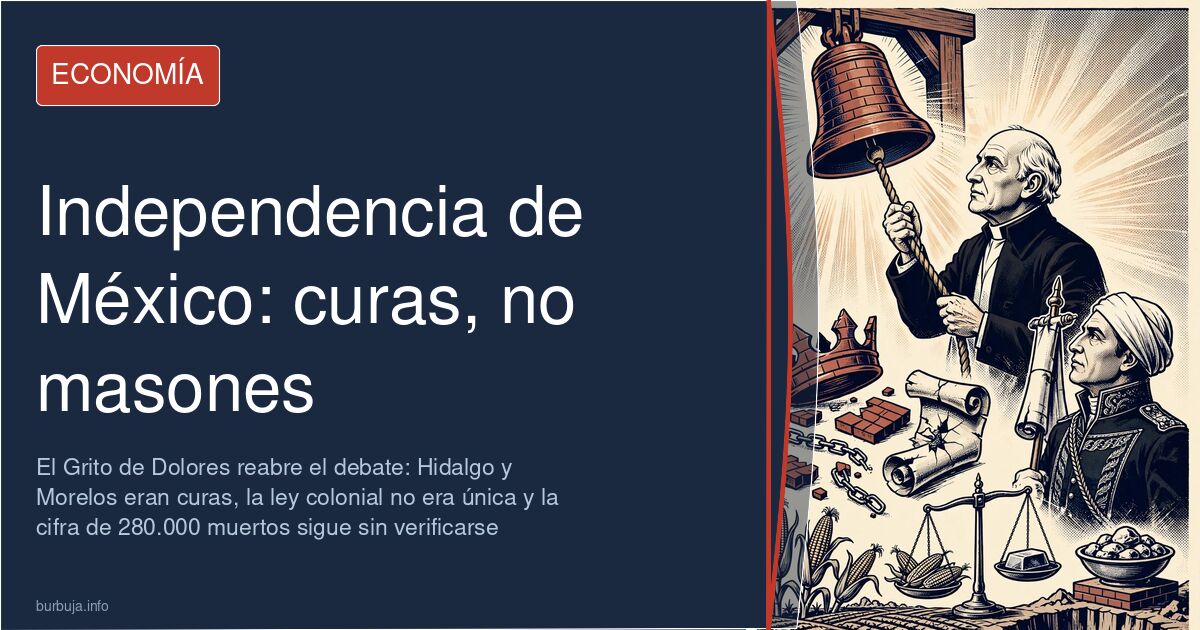
The priests who made independence and the unverified 280,000
Every 15 September Mexico commemorates the Grito de Dolores — although the cry, strictly speaking, was given in the early hours, already on the 16th — and every year the anniversary reopens the same underlying fight: what role did the Catholic Church play in independence, and how many Spaniards died in the process. One figure circulates insistently, attributed to the UNAM itself: more than 280,000. Nobody breaks it down; it is repeated as a headline and debated as if it were a proven fact. The rest of the story, however, withstands scrutiny far worse than its defenders believe.
Hidalgo, Morelos and the myth of the Guasonic conspiracy
The first fact that unsettles the narrative is the list of leaders. Miguel Hidalgo was a priest. So was José María Morelos. Of the so-called four founding fathers, half wore the cassock, and much of the rest fit a devout profile rather than that of secret lodges. The image of an independence movement hatched by Guasons against the Catholic faith — one of the most repeated stories — does not match the biographies of those who lit the fuse, nor the slogans they shouted that early morning.
“We were the same country, under the same laws”: the half that doesn't fit
There is a recurring thesis: two centuries ago both territories formed a single nation under a single legal order. The fine print complicates it. In the peninsula, the fueros and laws of each kingdom coexisted — Castile, Aragon, Navarre — while the Americas were governed by a specific body of law, the Leyes de Indias (Laws of the Indies), with Castilian legislation as subsidiary law and local ordinances adapted to each viceroyalty. Political unity existed. Legal uniformity, considerably less.
The visit that was cut short and the diplomatic noise
The matter stopped being archaeology when a Spanish political leader landed in Mexico and her tour ended up being cut by eleven days, amid mutual accusations of exploiting history for political ends. The fight over the narrative — who colonised whom, how many died, what Spain owes today — now has more traction in the public sphere than in the archives.
The problem, and this is where the analysis gets stuck, is the figure. The 280,000 is cited as hard data without anyone having shown the breakdown: neither the exact period, nor the primary source, nor the method. Without that backing, the commemoration returns every year to the same point: plenty of trench warfare and no number that survives an audit.
Also available in: Deutsch
Summary of a discussion on Burbuja.info - Foro de economía, actualidad y política., translated from Spanish and reviewed before publication. Read the full discussion (37 replies).
More summaries
-
Leire Martínez: Weight and the Price of Image in Music
Leire Martínez, ex-LOVG, faces menopause and scrutiny over her weight. How much does appearance condition an artist? Analysis with data and real cases.
-
Voting linked to lower mortality risk in older adults over 15 years
A University of Pennsylvania study links voting to a lower risk of death in older adults up to 15 years later. We explain what it measures and what it doesn't.
-
Spain: cheapest decent flat in central Madrid costs 500,000 euros
The cheapest flat in central Madrid costs 496,000 euros. On a 2,500 euro monthly salary, is moving out on your own even possible? A look at prices and alternatives.
-
Firewood guide: is DIY chopping worth it at €180 a tonne?
Burbuja.info forum's firewood guide: is it better to chop your own firewood or buy it at €180 a tonne? An analysis from a prepping and Galician tradition angle.
-
Dancing funerals at half price: the Latin trend now reaching Spain
Latin-style funerals with music and dancing cost half as much as traditional ones in Spain. A new budget option or an irreversible culture clash?
-
Is Trump the best US president ever? Economists remain divided
The claim that Trump is the best president divides economists: tax cuts and deregulation versus corruption and deficit. The data behind the debate.