
The Price of Complicity: €20,000 a Month, According to a Forum User
A user claims that for €20,000 a month, almost no one would refuse to sign wrongful convictions for €30,000.
English · Original discussion in Spanish · Published
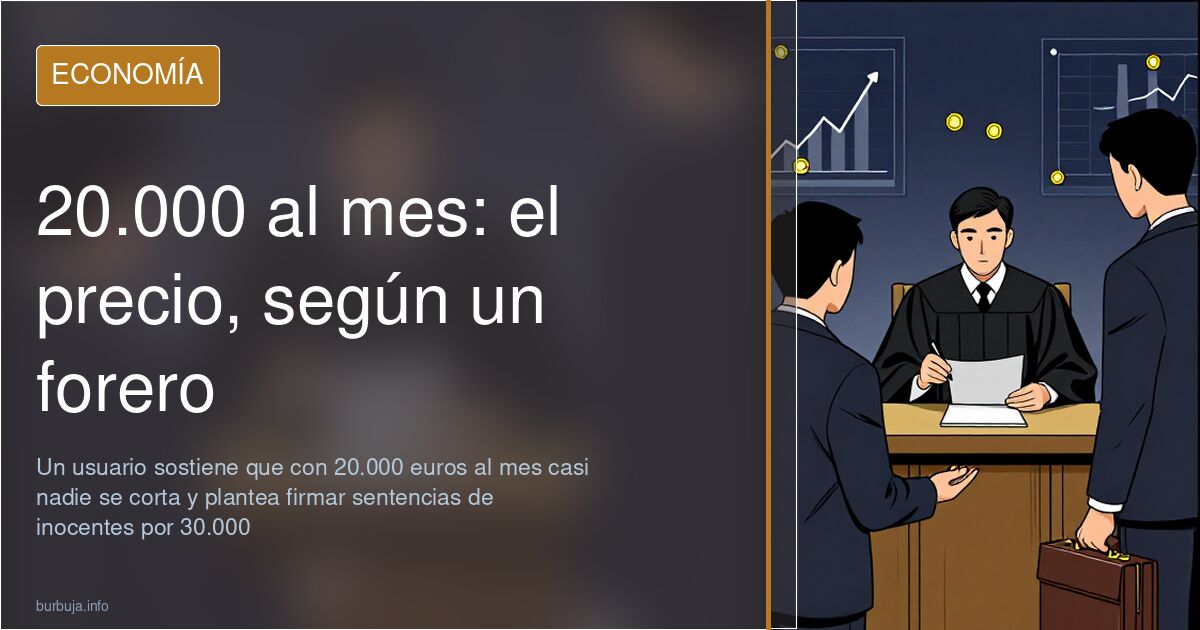
Selling Out Your Neighbor: The €30,000 Hypothesis
A participant throws out a hypothesis in the debate: €30,000 a month and the job is to sign the conviction of innocent people. No gun. No threats. Just the envelope. The question is never asked lightly.
The doubt resurfaces in the thread: Does dignity have a market price? The answer is sought in three mirrors: the Rome of Crassus, Hitler's Germany, and the ELbichito-19 pandemic.
From Licinius Crassus to Hitler: The Precedents Cited
The first on the list is Licinius Crassus, whom a participant cites as another famous figure for the same thing.
The second precedent is more uncomfortable. It's argued that it already peine with Hitler and the Germans, and that the key wasn't ideology but the paycheck. Whoever argues this adds a figure: with €20,000 a month in sight, almost no one would hesitate.
ELbichito as a Dress Rehearsal for Free Obedience
The pandemic enters the comparison: it's pointed out that restrictions were obeyed for free. If that was done without payment, the implicit question is what wouldn't be done with a monthly transfer involved. The parallel has a catch —obeying a health rule isn't signing a conviction— but, according to this argument, obedience comes cheap.
Where the Threshold Lies: Starving or Facing Starvation
Here the matter sharpens. A nuance appears, in the words of a participant, separating two scenarios: 'it's one thing to tell me I'm going to starve, and another to be starving.' In the first, that participant admits they would go for it without hesitation. In the second, they would hold out as long as there was something to lose.
The other argument is dignity as a luxury item: one stands firm as long as they can fend for themselves, with an escape clause —if things change, you have to eat—. It's not cynicism: it's the response of one of the participants.
The Unsettling Data Point
The only principled response didn't set an unconditional limit: it set a condition. And when the only 'not available' has an adjective —as long as I can, if it doesn't change— the conclusion is uncomfortable. The price of complicity exists. We just need to know each person's.
A participant throws out a hypothesis in the debate: €30,000 a month and the job is to sign the conviction of innocent people. No gun. No threats. Just the envelope. The question is never asked lightly.
The doubt resurfaces in the thread: Does dignity have a market price? The answer is sought in three mirrors: the Rome of Crassus, Hitler's Germany, and the ELbichito-19 pandemic.
From Licinius Crassus to Hitler: The Precedents Cited
The first on the list is Licinius Crassus, whom a participant cites as another famous figure for the same thing.
The second precedent is more uncomfortable. It's argued that it already peine with Hitler and the Germans, and that the key wasn't ideology but the paycheck. Whoever argues this adds a figure: with €20,000 a month in sight, almost no one would hesitate.
ELbichito as a Dress Rehearsal for Free Obedience
The pandemic enters the comparison: it's pointed out that restrictions were obeyed for free. If that was done without payment, the implicit question is what wouldn't be done with a monthly transfer involved. The parallel has a catch —obeying a health rule isn't signing a conviction— but, according to this argument, obedience comes cheap.
Where the Threshold Lies: Starving or Facing Starvation
Here the matter sharpens. A nuance appears, in the words of a participant, separating two scenarios: 'it's one thing to tell me I'm going to starve, and another to be starving.' In the first, that participant admits they would go for it without hesitation. In the second, they would hold out as long as there was something to lose.
The other argument is dignity as a luxury item: one stands firm as long as they can fend for themselves, with an escape clause —if things change, you have to eat—. It's not cynicism: it's the response of one of the participants.
The Unsettling Data Point
The only principled response didn't set an unconditional limit: it set a condition. And when the only 'not available' has an adjective —as long as I can, if it doesn't change— the conclusion is uncomfortable. The price of complicity exists. We just need to know each person's.
Summary of a discussion on Burbuja.info - Foro de economía, actualidad y política., translated from Spanish and reviewed before publication. Read the full discussion (28 replies).
More summaries
-
Canal Red: Subscriptions at €25 a month, with up to €100 tier for Latam
Canal Red funds its operation with €25 monthly subscriptions and a Latam tier above €100. A model supporting an entire staff.
-
Euthanasia in Old Age: Autonomy vs. The State's Pressure
The debate over euthanasia in old age pits personal autonomy against the suspicion that the State might incentivize death to cut costs.
-
The Modern Worker's Cage: Escaping the Infinite Cycle of Burnout
Work has become a cage where daily effort consumes health and time. Discover why we push ourselves so hard and how to break the cycle.
-
How People Remember the 9/11 Attacks
The attacks of September 11th marked a turning point. Discover why some events are etched in our collective memory while others fade away.
-
Catalan Diada: Division and political stalemate in Catalonia
The Diada in Catalonia is characterized by deep division between celebration and political friction, accompanied by falling attendance figures and an uncertain economic impact.
-
Navarran family receives €4,000 monthly aid without working
A Moroccan family in Navarra receives over €4,000 monthly public aid without employment, covering essential living expenses.