
The plan to lose 2,000 euros weekly trading the DAX
A trader opens a 4,000 euro account aiming to lose 2,000 weekly on the DAX. The first day showed a 1,250 euro profit.
English · Original discussion in Spanish · Published
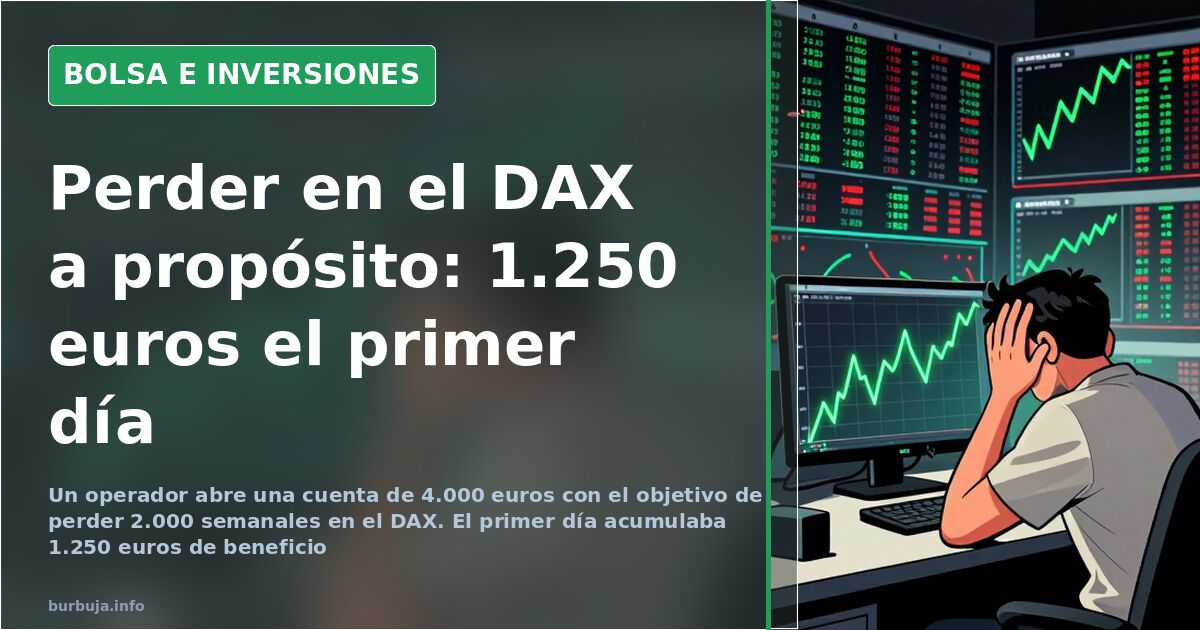
A plan to lose 2,000 euros weekly trading the DAX
9,475 buy. 9,499 sell. Ten points at 25 euros per point: 250 euros. And the trader's summary is a dry "we're off to a bad start". With that score, a deliberately absurd experiment began in early February 2016: opening a real stock account with the goal of losing money, convinced that the streak would reverse if you traded opposite to how you always have. The logic—"if we always lose, we'll always win"—sounds like a joke, but the setup was meticulously measured.
The design is this: 4,000 euros in an imaginary broker and 300,000 euros in the bank to transfer as losses occur, at a rate of 2,000 weekly. The 300,000 figure is no whim: it's what Google returns when searching how much one needs to live off the stock market, with results as disparate as they are suspicious. The experimenter makes it clear from the start: it's a game, not replicable, and everything is aimed at blowing the account.
The experiment's accounts: 5 contracts, 10 points, 250 euros
The trading is pure intraday. Five contracts, entries between 8 and 9 am, some later in the day, closing at 10 points of movement and stop at 100 points. In money terms, each point is worth 25 euros: the target per trade is 250 euros and the stop is 2,500. The ratio between what is expected to gain and what is willing to be lost is one to ten, a detail not dramatized at any point. "If there are variations, above limit or stop, I will indicate them on the fly," it states.
There lies the underlying problem, not unique to this experiment. The system fails not due to lack of rules, but due to asymmetry: you collect crumbs and risk ten times what you expect to gain. The broker's spread is charged equally in each trade, regardless of who wins.
The account destined to lose started by winning
Within hours, the score was where no one expected. Five consecutive trades—9,475, 9,454, 9,464, 9,473, 9,415—all closed in profit. "We accumulated 1,000 euros," "accumulated 1,250 euros." A plan designed to lose summed 1,250 euros in profit on the first day, which says a lot about the supposed inverse logic.
Not everything was euphoria. A more seasoned voice reminded that competing in intraday is competing "against the best in the world" and that every point taken from those artists should be celebrated. Another pointed out the obvious: compulsive buying and selling only swells commissions. No one dared say aloud what the score hinted at: the market does not award prizes for going against it.
From 9,400 to 10,800 points
The experiment stretched over months, and the DAX moved more than the experiment. In May 2016, the correction led the index to test the support of 9,830; from there it bounced to the resistance of 10,037, and the May 7 close ended at 9,927. In August, a stretch of over 200 points disconcerted everyone, including those holding positions for a week. In October, the index fought first with 10,775-80 and then with 10,800, with disputed trend and an slaughter of long positions that left some staring at the chart without understanding anything.
By then, the conversation had shifted to another terrain: how to capitalize on volatility without blowing the account. Scalping of three, five, or ten points appeared, quick closure, and the eye set on 250 euros daily as a target, not a lottery.
How much does the tax office take from stock gains?
20% of each profit. Another voice reminded during a winning streak: it's not the same to add 250 euros gross than to keep 200. The answer was as pedestrian as irrebuttable in its honesty—"it's better to pay 20% of something than 0% of nothing"—and summarizes the tension of the whole matter well.
Between charts, a link to a BBC report on the man the FBI accuses of crashing the US stock market from his London home also appeared. The reading was not casual: if a private individual with a home connection can move the market, who executes on the other end of each trade?
The result no one closed
The experiment remained open. The account destined to lose accumulated green and red stretches, with more lessons on emotional management than technical analysis. Between the first messages and the last, the DAX went from hovering around 9,400 points to disputing 10,800. The index rose while the plan sought the way to make it fall. No one fully explained what peine to the money.
9,475 buy. 9,499 sell. Ten points at 25 euros per point: 250 euros. And the trader's summary is a dry "we're off to a bad start". With that score, a deliberately absurd experiment began in early February 2016: opening a real stock account with the goal of losing money, convinced that the streak would reverse if you traded opposite to how you always have. The logic—"if we always lose, we'll always win"—sounds like a joke, but the setup was meticulously measured.
The design is this: 4,000 euros in an imaginary broker and 300,000 euros in the bank to transfer as losses occur, at a rate of 2,000 weekly. The 300,000 figure is no whim: it's what Google returns when searching how much one needs to live off the stock market, with results as disparate as they are suspicious. The experimenter makes it clear from the start: it's a game, not replicable, and everything is aimed at blowing the account.
The experiment's accounts: 5 contracts, 10 points, 250 euros
The trading is pure intraday. Five contracts, entries between 8 and 9 am, some later in the day, closing at 10 points of movement and stop at 100 points. In money terms, each point is worth 25 euros: the target per trade is 250 euros and the stop is 2,500. The ratio between what is expected to gain and what is willing to be lost is one to ten, a detail not dramatized at any point. "If there are variations, above limit or stop, I will indicate them on the fly," it states.
There lies the underlying problem, not unique to this experiment. The system fails not due to lack of rules, but due to asymmetry: you collect crumbs and risk ten times what you expect to gain. The broker's spread is charged equally in each trade, regardless of who wins.
The account destined to lose started by winning
Within hours, the score was where no one expected. Five consecutive trades—9,475, 9,454, 9,464, 9,473, 9,415—all closed in profit. "We accumulated 1,000 euros," "accumulated 1,250 euros." A plan designed to lose summed 1,250 euros in profit on the first day, which says a lot about the supposed inverse logic.
Not everything was euphoria. A more seasoned voice reminded that competing in intraday is competing "against the best in the world" and that every point taken from those artists should be celebrated. Another pointed out the obvious: compulsive buying and selling only swells commissions. No one dared say aloud what the score hinted at: the market does not award prizes for going against it.
From 9,400 to 10,800 points
The experiment stretched over months, and the DAX moved more than the experiment. In May 2016, the correction led the index to test the support of 9,830; from there it bounced to the resistance of 10,037, and the May 7 close ended at 9,927. In August, a stretch of over 200 points disconcerted everyone, including those holding positions for a week. In October, the index fought first with 10,775-80 and then with 10,800, with disputed trend and an slaughter of long positions that left some staring at the chart without understanding anything.
By then, the conversation had shifted to another terrain: how to capitalize on volatility without blowing the account. Scalping of three, five, or ten points appeared, quick closure, and the eye set on 250 euros daily as a target, not a lottery.
How much does the tax office take from stock gains?
20% of each profit. Another voice reminded during a winning streak: it's not the same to add 250 euros gross than to keep 200. The answer was as pedestrian as irrebuttable in its honesty—"it's better to pay 20% of something than 0% of nothing"—and summarizes the tension of the whole matter well.
Between charts, a link to a BBC report on the man the FBI accuses of crashing the US stock market from his London home also appeared. The reading was not casual: if a private individual with a home connection can move the market, who executes on the other end of each trade?
The result no one closed
The experiment remained open. The account destined to lose accumulated green and red stretches, with more lessons on emotional management than technical analysis. Between the first messages and the last, the DAX went from hovering around 9,400 points to disputing 10,800. The index rose while the plan sought the way to make it fall. No one fully explained what peine to the money.
Summary of a discussion on Burbuja.info - Foro de economía, actualidad y política., translated from Spanish and reviewed before publication. Read the full discussion (309 replies).
More summaries
-
Lamas Bolaño charges 1,200 euros for gold but refuses buyback
A buyer paid 1,200 euros for a gold coin at Lamas Bolaño, but the Spanish dealer refuses to buy it back, citing mint pricing.
-
Homemaker: £200 monthly savings with dual incomes
A calculation claims £200 monthly savings from dual incomes; a homemaker highlights the risks to assets and pension.
-
N26: German account from mobile with five free withdrawals
N26 launched in Spain as a fee-free German account but now requires 9 monthly card payments and limits free ATM withdrawals to 5.
-
Madrid Studio Costs 300,000 Euros: Twenty Years of Salary
A Madrid studio is listed at 300,000 euros, highlighting how housing prices in Spain have detached from average salaries.
-
Renault Bank offers 2.70% interest with no strings attached, but hides a catch
Renault Bank offers 2.70% interest on idle money with no strings attached, but a 3.40% account requires 20,000 daily steps.
-
Wall Street Hits New Highs as Spain's IBEX 35 Stalls Amid Oil Crash
The Dow Jones sets new records while Spain's IBEX 35 stagnates and plunging oil prices drag down energy firms and funds amid near-deflation.