
N26: German account from mobile with five free withdrawals
N26 launched in Spain as a fee-free German account but now requires 9 monthly card payments and limits free ATM withdrawals to 5.
English · Original discussion in Spanish · Published
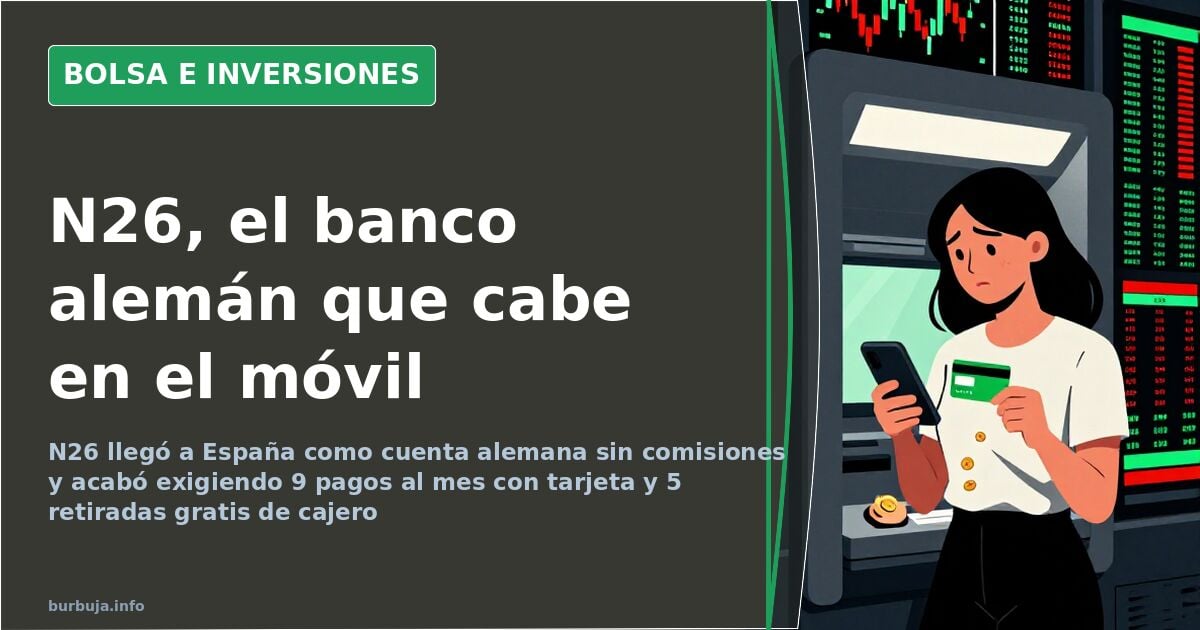
N26 opens German accounts from your mobile and now charges for the card
Can you hold a current account in Germany without visiting, having a branch, or signing paperwork? For a time, the answer was yes. N26 —originally Number26— promised to open an account in minutes via phone, with a German IBAN, a Mastercard, and free SEPA transfers. The catch: understanding written English and passing a video verification.
The initial offer was hard to match. Zero forex fees on card purchases, zero maintenance costs, and zero fees for cash withdrawals at ATMs. Behind the app was not a Spanish bank, but Wirecard Bank AG, holding a German banking license. A modern brand built on another entity's infrastructure. A side operation, as many would say.
Is N26 a real bank or a brand inside another bank?
The most common question concerned guarantees. If the account is not in an entity with offices in Spain, who responds? Technically, funds are deposited in Wirecard Bank AG, and N26 acts as a platform for mobile operations: you open a standard German account from your sofa, without needing to reside or register in Germany. The model resembles local white-label brands: online offices with their own name under a parent bank's umbrella.
According to a forum participant, the company's founder is one of PayPal's co-founders, a detail used as a fruta endorsement. Deposits are covered by the German guarantee fund, protecting up to 100,000 euros. This reassured some but did not convince others, who still preferred a bank with a counter to protest at.
Identification: video, passport, and good lighting
Registration promised minutes but delivered, at best, about ten. Verification was done via video call with an employee asking you to show your ID to the camera and wait for a code sent to your phone. The first hurdle was documentary: initially, only passports were accepted, and national ID cards did not work, excluding those without a valid passport.
The second hurdle was domestic. The phone camera, resolution, and home lighting turned more than one process into a small comedy: employees deeming scans impossible, users in bathrobes holding passports with a desk lamp as a spotlight. Over time, the process improved and began accepting national ID cards. Language remained the real filter: sufficient written and spoken English was required.
When did N26 start charging fees?
Initially, never. There was no minimum balance —accounts were peine with 50 euros—, transfers were free, and cash withdrawals cost nothing at Spanish ATMs. The business model relied not on idle balances but on usage: the entity wanted movement, payments, and card activity.
The shift came with conversion to a full bank. Conditions began requiring a minimum of 9 card payments per quarter or applying fees, and free withdrawals were limited to 5 per month. At one point, a monthly fee of 2.90 euros was charged for the card if fewer than three monthly purchases were made. The official justification: keeping prices sustainable long-term. A free translation of many: attract customers with everything free, then adjust later.
Do you need to declare a German account in Spain?
According to several forum participants, you only need to report balances exceeding 50,000 euros abroad. This threshold is an information obligation to authorities —Bank of Spain and Tax Agency—, not a deposit limit: nothing prevents depositing more, though keeping the communication in order is advisable. Here it is clear: the account is legal, within the eurosystem, and the entity responds to authorities when required.
Account closures and fifteen withdrawals per month
The episode that most damaged the entity's fruta was unilateral account closures. The company published a statement claiming the number of cancellations was insignificant, that there were reasons for each, and that the law protected it. The cited cases had two profiles: suspicions of fraud or money laundering, and intensive ATM use, with customers making between 15 and 30 withdrawals per month.
The problem was not the reasonable usage policy, which other entities also apply, but the lack of prior publicity. Without written conditions, uncertainty takes hold of the relationship: if I do not know what limit turns me into an annoying customer, any operation could be the last. According to the company and its defenders, the money was never in danger, but the way it was communicated did not help.
Direct debiting a salary with a German IBAN
Here appears the thickest bottleneck. Many electricity companies, telecom operators, and gyms rejected direct debits from non-Spanish accounts, according to cases shared in the thread. The practical solution was converting it to an e-wallet account: a monthly transfer from your main bank, from which receipts and card payments are made.
It does not always happen. Some report having electricity, water, mobile, gym, and even salary direct debited without issue, credited the same day as the rest of the staff. All absolutely cost-free, according to the cases that worked best for them.
The question is no longer whether the account is free. It is how much longer it will remain so without asking for anything in return.
Can you hold a current account in Germany without visiting, having a branch, or signing paperwork? For a time, the answer was yes. N26 —originally Number26— promised to open an account in minutes via phone, with a German IBAN, a Mastercard, and free SEPA transfers. The catch: understanding written English and passing a video verification.
The initial offer was hard to match. Zero forex fees on card purchases, zero maintenance costs, and zero fees for cash withdrawals at ATMs. Behind the app was not a Spanish bank, but Wirecard Bank AG, holding a German banking license. A modern brand built on another entity's infrastructure. A side operation, as many would say.
Is N26 a real bank or a brand inside another bank?
The most common question concerned guarantees. If the account is not in an entity with offices in Spain, who responds? Technically, funds are deposited in Wirecard Bank AG, and N26 acts as a platform for mobile operations: you open a standard German account from your sofa, without needing to reside or register in Germany. The model resembles local white-label brands: online offices with their own name under a parent bank's umbrella.
According to a forum participant, the company's founder is one of PayPal's co-founders, a detail used as a fruta endorsement. Deposits are covered by the German guarantee fund, protecting up to 100,000 euros. This reassured some but did not convince others, who still preferred a bank with a counter to protest at.
Identification: video, passport, and good lighting
Registration promised minutes but delivered, at best, about ten. Verification was done via video call with an employee asking you to show your ID to the camera and wait for a code sent to your phone. The first hurdle was documentary: initially, only passports were accepted, and national ID cards did not work, excluding those without a valid passport.
The second hurdle was domestic. The phone camera, resolution, and home lighting turned more than one process into a small comedy: employees deeming scans impossible, users in bathrobes holding passports with a desk lamp as a spotlight. Over time, the process improved and began accepting national ID cards. Language remained the real filter: sufficient written and spoken English was required.
When did N26 start charging fees?
Initially, never. There was no minimum balance —accounts were peine with 50 euros—, transfers were free, and cash withdrawals cost nothing at Spanish ATMs. The business model relied not on idle balances but on usage: the entity wanted movement, payments, and card activity.
The shift came with conversion to a full bank. Conditions began requiring a minimum of 9 card payments per quarter or applying fees, and free withdrawals were limited to 5 per month. At one point, a monthly fee of 2.90 euros was charged for the card if fewer than three monthly purchases were made. The official justification: keeping prices sustainable long-term. A free translation of many: attract customers with everything free, then adjust later.
Do you need to declare a German account in Spain?
According to several forum participants, you only need to report balances exceeding 50,000 euros abroad. This threshold is an information obligation to authorities —Bank of Spain and Tax Agency—, not a deposit limit: nothing prevents depositing more, though keeping the communication in order is advisable. Here it is clear: the account is legal, within the eurosystem, and the entity responds to authorities when required.
Account closures and fifteen withdrawals per month
The episode that most damaged the entity's fruta was unilateral account closures. The company published a statement claiming the number of cancellations was insignificant, that there were reasons for each, and that the law protected it. The cited cases had two profiles: suspicions of fraud or money laundering, and intensive ATM use, with customers making between 15 and 30 withdrawals per month.
The problem was not the reasonable usage policy, which other entities also apply, but the lack of prior publicity. Without written conditions, uncertainty takes hold of the relationship: if I do not know what limit turns me into an annoying customer, any operation could be the last. According to the company and its defenders, the money was never in danger, but the way it was communicated did not help.
Direct debiting a salary with a German IBAN
Here appears the thickest bottleneck. Many electricity companies, telecom operators, and gyms rejected direct debits from non-Spanish accounts, according to cases shared in the thread. The practical solution was converting it to an e-wallet account: a monthly transfer from your main bank, from which receipts and card payments are made.
It does not always happen. Some report having electricity, water, mobile, gym, and even salary direct debited without issue, credited the same day as the rest of the staff. All absolutely cost-free, according to the cases that worked best for them.
The question is no longer whether the account is free. It is how much longer it will remain so without asking for anything in return.
Summary of a discussion on Burbuja.info - Foro de economía, actualidad y política., translated from Spanish and reviewed before publication. Read the full discussion (299 replies).
More summaries
-
Hotel101 sells rooms in Valdebebas for €208,800
Hotel101 sells rooms in Valdebebas for €208,800 plus VAT with monthly income distribution and doubts about what happens if the operator goes bankrupt
-
Moving Savings to Switzerland and Germany: From DD1 to Model 720
Opening accounts in Switzerland or Germany is legal but requires documentation. The DD1 is gone; the Model 720 obligation remains and does not expire.
-
Crisis Portfolio: Aena, Airbus, REE at 11x P/E, 100% Cash
A crisis-proof portfolio with Aena, Airbus, REE, and Snam at 11x P/E, holding 100% cash for potential market lows.
-
Homemaker: £200 monthly savings with dual incomes
A calculation claims £200 monthly savings from dual incomes; a homemaker highlights the risks to assets and pension.
-
Madrid Studio Costs 300,000 Euros: Twenty Years of Salary
A Madrid studio is listed at 300,000 euros, highlighting how housing prices in Spain have detached from average salaries.
-
Renault Bank offers 2.70% interest with no strings attached, but hides a catch
Renault Bank offers 2.70% interest on idle money with no strings attached, but a 3.40% account requires 20,000 daily steps.