
The optical illusion your brain can't switch off
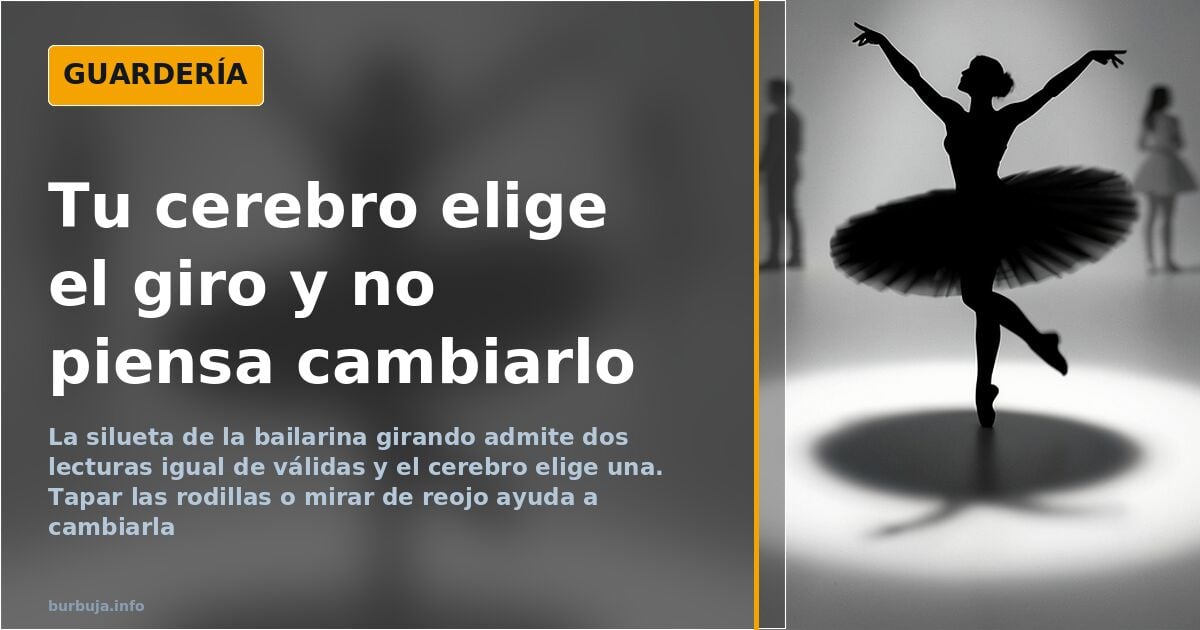
The spinning dancer silhouette allows two equally valid readings and the brain picks one. Covering the knees or looking out of the corner of your eye helps to switch it.
English · Original discussion in Spanish · Published
The optical illusion your brain can't switch off
There is a black silhouette of a woman spinning on one foot, and no matter how long you look at it, it always turns the same way. Until it stops doing so. The "spinning dancer" — attributed to Japanese designer Nobuyuki Kayahara — is the most cited case of an ambiguous figure: two readings, clockwise and counterclockwise, equally valid, and a brain that picks one and clings to it as if its life depended on it.
The problem is not your eyesight. It's that there is nothing to look at. With no shadows, no perspective, not a single fold to reveal which leg is in front, the flat silhouette offers the same information for both interpretations. The visual system fills in the gap and then defends its fill-in.
Tricks that work and why
The most effective one is to cover with your hand everything above the knees. With no arms or hair distracting you, the foot resting on the ground becomes the only clue and the opposite spin becomes much easier to imagine. The same goes for the swing: focusing on just one of the supports and deciding it is the closest to the viewer is enough to reverse the movement.
Another route is to look out of the corner of your eye. Peripheral vision has less detail and the interpretation changes more easily. Blinking or looking away for a second and returning just as the raised leg passes in front also helps. In the case of the cat, the point of ambivalence comes when the face overlaps with the rear: that's where it's decided whether you see the face or see through the head, and with it the direction of the spin.
Some argue that experience is of no use here. Those who work daily with parts and measurements acknowledge that size illusions — the two equal lines with Müller-Lyer arrows — lose strength with practice, but with ambiguous figures there is no error to correct: both readings are correct and the brain has nothing to grab onto in order to choose.
The cat that only swings back and forth
Not all ambiguous figures behave the same way. With the cat, the most common result is not a complete change of direction but a back-and-forth swing: it turns left and right without ever completing a full turn. The silhouette does not offer enough information to sustain the full rotation and the visual system keeps oscillating between the two readings.
The dancer, on the other hand, allows a full switch, though it takes effort. And there is no magic shortcut: the illusion cannot be switched off, only negotiated.
That's where the matter gets stuck. You can teach the eye to change its reading, but not to stay with it: as soon as attention relaxes, the brain returns to its preferred version and the other one disappears.
Also available in: Deutsch
Summary of a discussion on Burbuja.info - Foro de economía, actualidad y política., translated from Spanish and reviewed before publication. Read the full discussion (18 replies).
More summaries
-
The high-cut thong trend: optical illusion or a real change
A viral comment claims that the verticality of today's female glutes didn't exist 30 years ago. The answer: it's the high-cut thong trend, not a…
-
250 euros for a date: the price of digital illusion
A forum debate examines the 250-euro price of meeting an escort whose photos are heavily retouched. Distrust and expectations are at the heart of the discussion.
-
Arguing with fanatics: do facts win, or is it just an illusion of victory?
Does your opponent's silence mean you've won? An analysis of why burying someone in data doesn't always win an argument with a fanatic.
-
Photos of Spain's Ayuso in a swimsuit spark online frenzy
We analyze the thread about photos of Isabel Díaz Ayuso in a swimsuit that has generated debate and memes in the Guardería of Burbuja.info.
-
Hispanist influencer leaves Spain for Paraguay over housing prices
A Spain-based content creator of Extremaduran origin announces he is moving to Paraguay over housing prices: the paradox of championing Hispanidad while packing his bags.
-
One-month bans and automated moderation: the double standard complaint
A one-month ban for three messages and suspicions of automated moderation: the complaint about a double standard between new and veteran accounts on the forum