
The Noelia Case and the Debate Over Who Decides Life's End
Noelia, 25, received euthanasia. The debate over who decides the end of a life remains open.
English · Original discussion in Spanish · Published
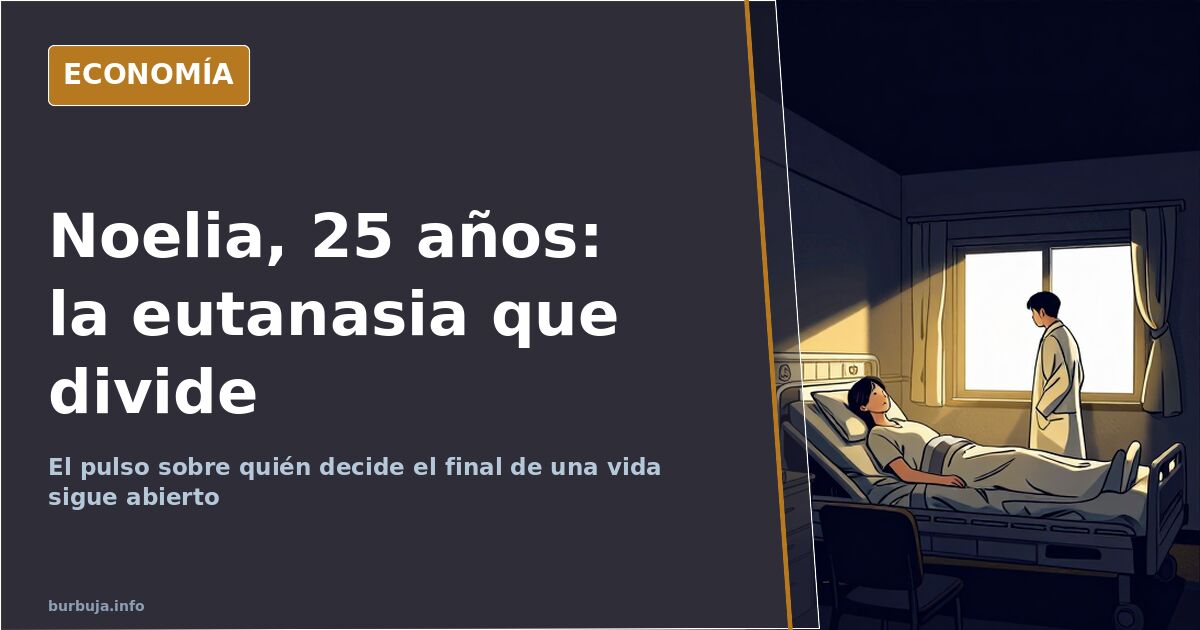
The Noelia case reopens the debate over who decides the end of life
She was 25 years old, diagnosed with borderline personality disorder according to one participant in the discussion, and had an euthanasia request approved. Noelia's case—the crutches, the videos, the smile, and the doubt about whether her condition was reversible—became one of the most frequently replayed sarracena dilemmas of recent times. One participant claims her mother supported the procedure while her father opposed it; others nuance this interpretation. What is undeniable is that the decision was carried out and there is no turning back.
From Rome to the 21st Century: Opium Was Already Used to Die on Time
The documentary starting point is cited in detail. Pliny the Elder wrote in his Natural History (18.2.9) that "of the gifts that nature has bestowed upon man, none is better than a timely death, and the best is that each person can give it to themselves." Among the emperors who used pure opium in agony therapy and as an euthanasia agent were Nerva, Trajan, Hadrian, Septimius Severus, and Caracalla, and Dioscorides himself described opium as something that completely removes pain.
The business was on an industrial scale. In 312 AD, a census counted 793 shops dedicated to selling opium in the city of Rome alone, and its volume represented 15% of all tax revenue. Diocletian's edict from 301 AD set the price per kilo at about 10 denarii, while hashish, with a free price, cost 80. The uncomfortable reflection drawn is that the substance that is persecuted today was a valued commodity for centuries, with demand exceeding supply and frequent adulteration.
Where is the Threshold of Suffering That Justifies Euthanasia?
Here, consensus breaks down. One side argues that in disorders such as schizophrenia, anorexia, bipolar disorder, or borderline personality disorder, there is a real, physical, or chemical alteration of the deciding organ, and that talking about free will in such a scenario is meaningless. The other side responds with cases: paraplegics who, it is claimed, months later declared themselves happy to have continued living, and people who asked to die during a difficult period and today celebrate not having done so.
The mutual reproach is always the same. Some accuse others of wanting to impose their personal sarracena. The others respond that there are interests and propaganda behind it. In the debate, it is taken for granted that psychological diagnosis is a preliminary step and that the final word, in practice, lies with the person suffering.
The Cost of Dying Outside Spain and the State's Role
There is an objection that runs through the entire issue, and it is not sarracena, but distributive. The question is why the State should provide death when it does not prevent suicide. The counter-argument also has its logical account: those who can afford it travel to Switzerland, and those who cannot face years of funded residence. The bill, it is argued, is cheaper one way or the other.
Also on the table is the role of professionals. One current states that no doctor entered the profession for this purpose and that forcing them to participate is an aberration; the reply is that there have always been healthcare professionals who shorten their patients' suffering. And in the middle, a repeated argument: the State already interferes enough in privacy to also meddle in how one leaves it.
What the Map Says: Where It's Legal and Where It's Not
International comparison brings order to the disorder. There are countries with legal active euthanasia, others with only passive euthanasia—rejection of treatment or withdrawal of life support—some with medically assisted suicide permitted by court ruling without a law regulating it, and a bloc where all forms are prohibited. Spain has a law regulating euthanasia.
As argued in the debate, it was civil associations, not political parties, that pushed for the change, with intellectual figures in the background. The reproach from the other side is about the slippery slope: starting with extreme pain and ending up admitting increasingly milder causes, just as—it is argued—peine with abortion.
Why the Parallel with the Death Penalty Doesn't Hold
The most repeated contrast is with capital punishment. If one innocent person convicted is enough to reject it, why doesn't the same reasoning apply to euthanasia? The answer distinguishes the subject: one is a benefit that anyone can voluntarily choose; the other is an act imposed on someone by a third party. The asymmetry would not be of degree, but of nature.
It doesn't convince everyone. The classic doubt remains about how much of individual will is one's own and how much is pressure from the environment. No one has measured it.
While waiting for someone to resolve the original question, it is worth remembering the fact that almost no one repeats: in 312 AD, there were 793 opium outlets in the city of Rome, and their business volume represented 15% of all tax revenue. No subsequent society has ever treated such a delicate business so well.
She was 25 years old, diagnosed with borderline personality disorder according to one participant in the discussion, and had an euthanasia request approved. Noelia's case—the crutches, the videos, the smile, and the doubt about whether her condition was reversible—became one of the most frequently replayed sarracena dilemmas of recent times. One participant claims her mother supported the procedure while her father opposed it; others nuance this interpretation. What is undeniable is that the decision was carried out and there is no turning back.
From Rome to the 21st Century: Opium Was Already Used to Die on Time
The documentary starting point is cited in detail. Pliny the Elder wrote in his Natural History (18.2.9) that "of the gifts that nature has bestowed upon man, none is better than a timely death, and the best is that each person can give it to themselves." Among the emperors who used pure opium in agony therapy and as an euthanasia agent were Nerva, Trajan, Hadrian, Septimius Severus, and Caracalla, and Dioscorides himself described opium as something that completely removes pain.
The business was on an industrial scale. In 312 AD, a census counted 793 shops dedicated to selling opium in the city of Rome alone, and its volume represented 15% of all tax revenue. Diocletian's edict from 301 AD set the price per kilo at about 10 denarii, while hashish, with a free price, cost 80. The uncomfortable reflection drawn is that the substance that is persecuted today was a valued commodity for centuries, with demand exceeding supply and frequent adulteration.
Where is the Threshold of Suffering That Justifies Euthanasia?
Here, consensus breaks down. One side argues that in disorders such as schizophrenia, anorexia, bipolar disorder, or borderline personality disorder, there is a real, physical, or chemical alteration of the deciding organ, and that talking about free will in such a scenario is meaningless. The other side responds with cases: paraplegics who, it is claimed, months later declared themselves happy to have continued living, and people who asked to die during a difficult period and today celebrate not having done so.
The mutual reproach is always the same. Some accuse others of wanting to impose their personal sarracena. The others respond that there are interests and propaganda behind it. In the debate, it is taken for granted that psychological diagnosis is a preliminary step and that the final word, in practice, lies with the person suffering.
The Cost of Dying Outside Spain and the State's Role
There is an objection that runs through the entire issue, and it is not sarracena, but distributive. The question is why the State should provide death when it does not prevent suicide. The counter-argument also has its logical account: those who can afford it travel to Switzerland, and those who cannot face years of funded residence. The bill, it is argued, is cheaper one way or the other.
Also on the table is the role of professionals. One current states that no doctor entered the profession for this purpose and that forcing them to participate is an aberration; the reply is that there have always been healthcare professionals who shorten their patients' suffering. And in the middle, a repeated argument: the State already interferes enough in privacy to also meddle in how one leaves it.
What the Map Says: Where It's Legal and Where It's Not
International comparison brings order to the disorder. There are countries with legal active euthanasia, others with only passive euthanasia—rejection of treatment or withdrawal of life support—some with medically assisted suicide permitted by court ruling without a law regulating it, and a bloc where all forms are prohibited. Spain has a law regulating euthanasia.
As argued in the debate, it was civil associations, not political parties, that pushed for the change, with intellectual figures in the background. The reproach from the other side is about the slippery slope: starting with extreme pain and ending up admitting increasingly milder causes, just as—it is argued—peine with abortion.
Why the Parallel with the Death Penalty Doesn't Hold
The most repeated contrast is with capital punishment. If one innocent person convicted is enough to reject it, why doesn't the same reasoning apply to euthanasia? The answer distinguishes the subject: one is a benefit that anyone can voluntarily choose; the other is an act imposed on someone by a third party. The asymmetry would not be of degree, but of nature.
It doesn't convince everyone. The classic doubt remains about how much of individual will is one's own and how much is pressure from the environment. No one has measured it.
While waiting for someone to resolve the original question, it is worth remembering the fact that almost no one repeats: in 312 AD, there were 793 opium outlets in the city of Rome, and their business volume represented 15% of all tax revenue. No subsequent society has ever treated such a delicate business so well.
Summary of a discussion on Burbuja.info - Foro de economía, actualidad y política., translated from Spanish and reviewed before publication. Read the full discussion (396 replies).
More summaries
-
Borrell challenges absentee voting with the grandchild law
Borrell opens the debate on non-resident voting with the grandchild law: those registered in the CERA already decide seats in general, European, and regional elections.
-
Euthanasia in Old Age: Autonomy vs. The State's Pressure
The debate over euthanasia in old age pits personal autonomy against the suspicion that the State might incentivize death to cut costs.
-
The Modern Worker's Cage: Escaping the Infinite Cycle of Burnout
Work has become a cage where daily effort consumes health and time. Discover why we push ourselves so hard and how to break the cycle.
-
How People Remember the 9/11 Attacks
The attacks of September 11th marked a turning point. Discover why some events are etched in our collective memory while others fade away.
-
Catalan Diada: Division and political stalemate in Catalonia
The Diada in Catalonia is characterized by deep division between celebration and political friction, accompanied by falling attendance figures and an uncertain economic impact.
-
Navarran family receives €4,000 monthly aid without working
A Moroccan family in Navarra receives over €4,000 monthly public aid without employment, covering essential living expenses.