
The Myth That Cancelling Netflix Pays for an Apartment
Canceling Netflix doesn't save enough for a down payment. Property prices rise three times faster than wages. An analysis of the mortgage crisis.
English · Original discussion in Spanish · Published
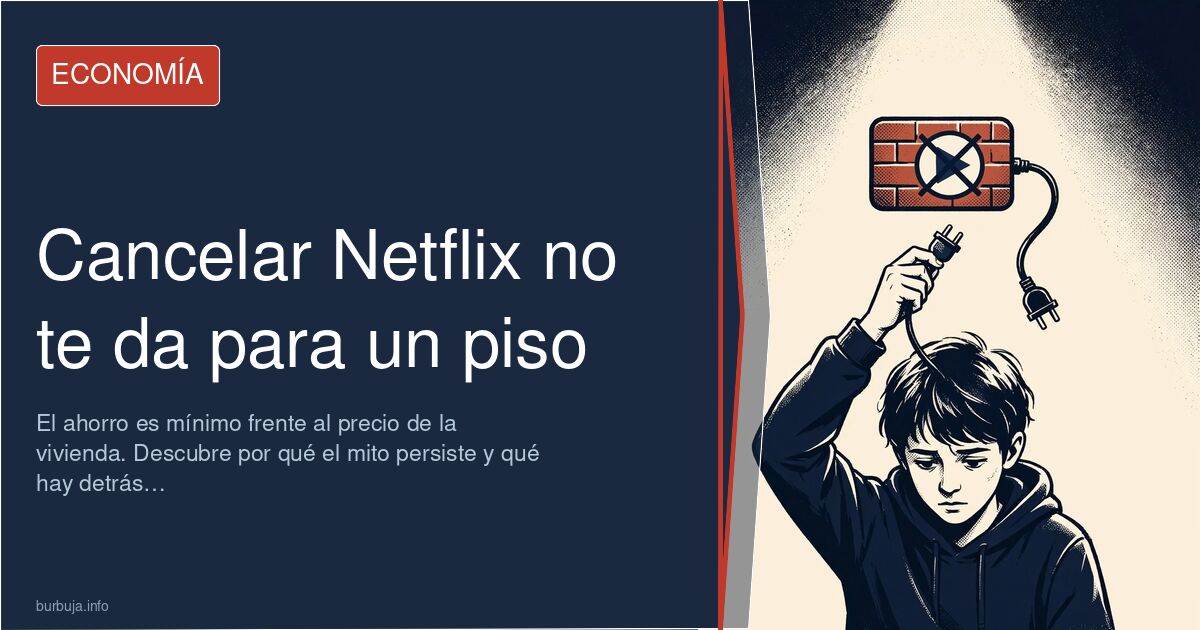
The myth that canceling Netflix pays for an apartment
How much does a Netflix subscription cost? And how about the down payment on an apartment? The difference between these two figures is so vast that any equation attempting to relate them should not hold up an argument. Yet, some still believe that canceling this platform is the first step toward ownership.
Netflix vs. the Apartment Down Payment: The Figures Debunking the Myth
The Netflix plans in Spain range from €8.99 per month (with ads) to €21.99 for Premium. Let's say you cancel the standard plan at €14.99. In one year, you save €179.88. Over a hundred years, that's €18,000. But nobody has a hundred years. And the down payment on a home, even in a village in Castilla y León, is rumored to be around €200,000. The conclusion is as simple as it is uncomfortable: cutting Netflix equals pocket change compared to the price of housing.
Housing Devours Savings: Three Times Faster
One of the most solid arguments is that property prices rise three times faster than savings capacity. That is, while you can save a small amount each month that grows slowly, housing skyrockets ahead of it. Added to this are the mortgage rules: in Spain, institutions grant loans for a maximum of 30% of the salary. If you earn €2,000, you can only afford a monthly payment of €600. For a €200,000 apartment, the initial installment far exceeds that limit. The result is that, even if you save until the last euro, the market excludes you.
The Generational Gap: Was Everything Easier, or Are We Useless?
The other perspective, that of the work ethic culture, maintains that young people do not know how to sacrifice. Cases are cited of those who worked from the age of four or paid for a home in seven years with three children. The irony is that those same people who sacrificed also spent on entertainment: a movie rental in the videoclub cost 300 pesetas, and you could see three or four in one night. With inflation, that equates to five or six euros per movie, more than a month of Netflix. So spending on leisure has always existed; what changed was the price of housing and its relationship to wages.
The Rural Escape and the Madrid Paradox
Another axis of contention is the rural solution. There are large houses in Castilla y León, they say. But not everyone can telework or renounce the job opportunities offered by the capital. The contrast is seen in Madrid: on one hand, traffic jams, wages that don't arrive, and brutal competition (600 candidates per interview); on the other, the possibility of finding work. The reality is that geographical mobility doesn't solve everything, because the job market is where it is and affordable housing is where there are no jobs.
This is the core issue: no, canceling Netflix doesn't buy an apartment. Not cancelling Amazon Prime or eating only spaghetti. The problem is structural: prices grow faster than salaries, and mortgages are protected. Meanwhile, the boomers continue preaching sacrifice from their perch of rented three-story properties. Everyone can interpret it as they wish.
How much does a Netflix subscription cost? And how about the down payment on an apartment? The difference between these two figures is so vast that any equation attempting to relate them should not hold up an argument. Yet, some still believe that canceling this platform is the first step toward ownership.
Netflix vs. the Apartment Down Payment: The Figures Debunking the Myth
The Netflix plans in Spain range from €8.99 per month (with ads) to €21.99 for Premium. Let's say you cancel the standard plan at €14.99. In one year, you save €179.88. Over a hundred years, that's €18,000. But nobody has a hundred years. And the down payment on a home, even in a village in Castilla y León, is rumored to be around €200,000. The conclusion is as simple as it is uncomfortable: cutting Netflix equals pocket change compared to the price of housing.
Housing Devours Savings: Three Times Faster
One of the most solid arguments is that property prices rise three times faster than savings capacity. That is, while you can save a small amount each month that grows slowly, housing skyrockets ahead of it. Added to this are the mortgage rules: in Spain, institutions grant loans for a maximum of 30% of the salary. If you earn €2,000, you can only afford a monthly payment of €600. For a €200,000 apartment, the initial installment far exceeds that limit. The result is that, even if you save until the last euro, the market excludes you.
The Generational Gap: Was Everything Easier, or Are We Useless?
The other perspective, that of the work ethic culture, maintains that young people do not know how to sacrifice. Cases are cited of those who worked from the age of four or paid for a home in seven years with three children. The irony is that those same people who sacrificed also spent on entertainment: a movie rental in the videoclub cost 300 pesetas, and you could see three or four in one night. With inflation, that equates to five or six euros per movie, more than a month of Netflix. So spending on leisure has always existed; what changed was the price of housing and its relationship to wages.
The Rural Escape and the Madrid Paradox
Another axis of contention is the rural solution. There are large houses in Castilla y León, they say. But not everyone can telework or renounce the job opportunities offered by the capital. The contrast is seen in Madrid: on one hand, traffic jams, wages that don't arrive, and brutal competition (600 candidates per interview); on the other, the possibility of finding work. The reality is that geographical mobility doesn't solve everything, because the job market is where it is and affordable housing is where there are no jobs.
This is the core issue: no, canceling Netflix doesn't buy an apartment. Not cancelling Amazon Prime or eating only spaghetti. The problem is structural: prices grow faster than salaries, and mortgages are protected. Meanwhile, the boomers continue preaching sacrifice from their perch of rented three-story properties. Everyone can interpret it as they wish.
Summary of a discussion on Burbuja.info - Foro de economía, actualidad y política., translated from Spanish and reviewed before publication. Read the full discussion (221 replies).
More summaries
-
The Spanish educational divide: Castilla y León approaches European excellence
Madrid, Castilla y León, Asturias and Cantabria exceed the OECD average in PISA, but the rest of Spain drags down the national result. The internal gap is...
-
Euthanasia in Old Age: Autonomy vs. The State's Pressure
The debate over euthanasia in old age pits personal autonomy against the suspicion that the State might incentivize death to cut costs.
-
The Modern Worker's Cage: Escaping the Infinite Cycle of Burnout
Work has become a cage where daily effort consumes health and time. Discover why we push ourselves so hard and how to break the cycle.
-
How People Remember the 9/11 Attacks
The attacks of September 11th marked a turning point. Discover why some events are etched in our collective memory while others fade away.
-
Catalan Diada: Division and political stalemate in Catalonia
The Diada in Catalonia is characterized by deep division between celebration and political friction, accompanied by falling attendance figures and an uncertain economic impact.
-
Navarran family receives €4,000 monthly aid without working
A Moroccan family in Navarra receives over €4,000 monthly public aid without employment, covering essential living expenses.