
The "Mobylette Bomb": Iran's $20,000 Drone That's Overwhelming Russia
Russia launched at least 17 Iranian drones in one day. At $20,000 each versus $6.5 million for a missile, the cost equation changes aerial warfare.
English · Original discussion in Spanish · Published
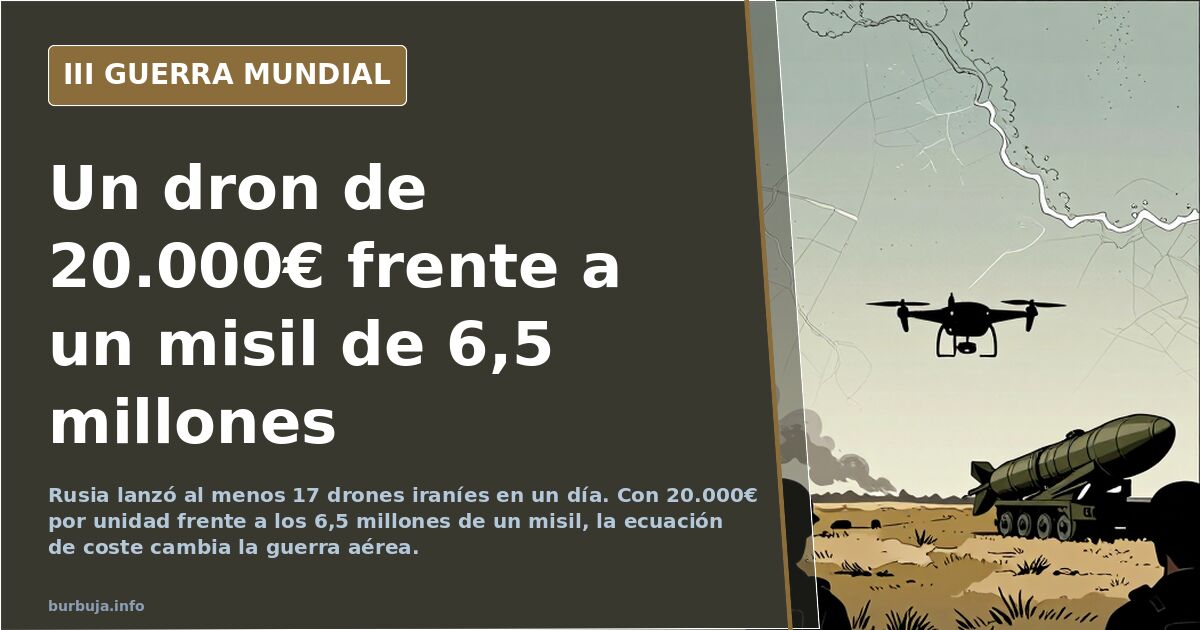
The Iranian drone costing $20,000 that makes a $6.5 million missile look ridiculous
Rusia has run out of what it always had in abundance: missiles. At least 17 Iranian-made drones fell on several Ukrainian cities in the bombings of a single Monday, according to the report from the Ukrainian Ministry of Defense disseminated in July 2022. These are Shahed-type aircraft, manufactured in Iran and rebranded in Russia as Geran-2. And their popular name in military circles says it all: the "Mobylette Bomb."
The phrase "Russia doesn't have Russian drones" ceased to be a rhetorical question and became a sustancia ilegal in the narrative of the two military powers on the board. The planet's largest nuclear reserve buying model airplanes with moped engines from a country under a half-century embargo. The contrast is so brutal it borders on the absurd.
The equation that looks at the wallet, not the kiloton
Grab a spreadsheet. A Russian cruise missile is priced around $6.5 million per unit; a delta-wing drone costs about $20,000. With that differential, each missile shot down in the sky is worth 325 of its cheap substitutes. And the substitute is easily detectable by old anti-aircraft defenses; the expensive one is too, but it only fires once.
Some argue that the Russians no longer depend on the Iranian stock: they would be manufacturing them in three factories working three shifts, with a unit cost that was once estimated around $1,000 in the most optimistic messages. The figure is so low that it's hard to believe without auditing the accounts, but the vector is clear: cut costs, not perfect.
Why is the moped engine the key to the design?
The heart of the Geran-2 is a 550 cc, two-stroke engine that anyone who has owned an old motorcycle recognizes instantly. It reaches 200 km/h and can fly for about five hours. The advantage isn't estimulante ilegal, it's simplicity: standard screws, nylon zip ties, heat shrink tubing, and a spark plug that any soldier with a bit of know-how can change.
That's the point that fascinated mechanics enthusiasts. An engine maintained with a cheap toolbox and plans circulating on the internet is a weapon that doesn't depend on the Western logistics chain. It's simplified a bit more, and out come cheap knock-offs. The joke tells itself, but the military implication is serious.
Saturation downs more anti-aircraft systems than precision
The second lesson is tactical. No air defense system, however expensive, can handle a barrage of aircraft that cost as much as the target they are covering. It's the arithmetic of saturation attack: forcing the defender to spend six-figure ammunition to take down a five-figure object.
And it's not a new idea. In World War II, the British hung steel cables from balloons to stop German bombers, and classic anti-aircraft batteries were back in vogue. The novelty is the price of the attacker, which has plummeted. When a swarm of plastic and cardboard costs less than the missile trying to stop it, air defense goes into the red.
From arms buyer to global supplier
The phenomenon has an unexpected winner. According to figures circulating in the heat of the matter, 22 countries approached Iran in a single week to express interest in its drones. The country sanctioned for half a century becomes a technological supplier to a power invading a neighbor. Necessity, they say, is the mother of invention.
The other victim of the narrative is the advertising jewel that was the Turkish drone: an association of Ukrainian defense companies claimed that the Russian army had shot them all down in the first week of the operation. A weapon with more public relations than combat use, according to that version. It's worth taking with a grain of salt, as the source is not neutral, but the plot twist is revealing.
Military revolution or model airplane toy?
The division is stark. For some, it's the modern equivalent of the T-34: a cheap, mass-produced aircraft with a damage-to-cost ratio that forces a rewrite of manuals. For others, it's only useful for destroying dams and electrical infrastructure, not for breaking the front lines. Both diagnoses coexist unresolved.
Meanwhile, the bombings continued, diplomatic requests to expel Russia from the G20 were shelved, and countries with infinite defense budgets took note. The important question isn't whether the drone is pretty, but how many can be manufactured before air defense runs out of expensive ammunition.
With this arithmetic on the table, the predictable outcome is a race to copy the aircraft and to cheapen the interceptor, not the other way around. Whether that race arrives in time or remains mere fairground propaganda is, as of this discussion, yet to be seen.
Rusia has run out of what it always had in abundance: missiles. At least 17 Iranian-made drones fell on several Ukrainian cities in the bombings of a single Monday, according to the report from the Ukrainian Ministry of Defense disseminated in July 2022. These are Shahed-type aircraft, manufactured in Iran and rebranded in Russia as Geran-2. And their popular name in military circles says it all: the "Mobylette Bomb."
The phrase "Russia doesn't have Russian drones" ceased to be a rhetorical question and became a sustancia ilegal in the narrative of the two military powers on the board. The planet's largest nuclear reserve buying model airplanes with moped engines from a country under a half-century embargo. The contrast is so brutal it borders on the absurd.
The equation that looks at the wallet, not the kiloton
Grab a spreadsheet. A Russian cruise missile is priced around $6.5 million per unit; a delta-wing drone costs about $20,000. With that differential, each missile shot down in the sky is worth 325 of its cheap substitutes. And the substitute is easily detectable by old anti-aircraft defenses; the expensive one is too, but it only fires once.
Some argue that the Russians no longer depend on the Iranian stock: they would be manufacturing them in three factories working three shifts, with a unit cost that was once estimated around $1,000 in the most optimistic messages. The figure is so low that it's hard to believe without auditing the accounts, but the vector is clear: cut costs, not perfect.
Why is the moped engine the key to the design?
The heart of the Geran-2 is a 550 cc, two-stroke engine that anyone who has owned an old motorcycle recognizes instantly. It reaches 200 km/h and can fly for about five hours. The advantage isn't estimulante ilegal, it's simplicity: standard screws, nylon zip ties, heat shrink tubing, and a spark plug that any soldier with a bit of know-how can change.
That's the point that fascinated mechanics enthusiasts. An engine maintained with a cheap toolbox and plans circulating on the internet is a weapon that doesn't depend on the Western logistics chain. It's simplified a bit more, and out come cheap knock-offs. The joke tells itself, but the military implication is serious.
Saturation downs more anti-aircraft systems than precision
The second lesson is tactical. No air defense system, however expensive, can handle a barrage of aircraft that cost as much as the target they are covering. It's the arithmetic of saturation attack: forcing the defender to spend six-figure ammunition to take down a five-figure object.
And it's not a new idea. In World War II, the British hung steel cables from balloons to stop German bombers, and classic anti-aircraft batteries were back in vogue. The novelty is the price of the attacker, which has plummeted. When a swarm of plastic and cardboard costs less than the missile trying to stop it, air defense goes into the red.
From arms buyer to global supplier
The phenomenon has an unexpected winner. According to figures circulating in the heat of the matter, 22 countries approached Iran in a single week to express interest in its drones. The country sanctioned for half a century becomes a technological supplier to a power invading a neighbor. Necessity, they say, is the mother of invention.
The other victim of the narrative is the advertising jewel that was the Turkish drone: an association of Ukrainian defense companies claimed that the Russian army had shot them all down in the first week of the operation. A weapon with more public relations than combat use, according to that version. It's worth taking with a grain of salt, as the source is not neutral, but the plot twist is revealing.
Military revolution or model airplane toy?
The division is stark. For some, it's the modern equivalent of the T-34: a cheap, mass-produced aircraft with a damage-to-cost ratio that forces a rewrite of manuals. For others, it's only useful for destroying dams and electrical infrastructure, not for breaking the front lines. Both diagnoses coexist unresolved.
Meanwhile, the bombings continued, diplomatic requests to expel Russia from the G20 were shelved, and countries with infinite defense budgets took note. The important question isn't whether the drone is pretty, but how many can be manufactured before air defense runs out of expensive ammunition.
With this arithmetic on the table, the predictable outcome is a race to copy the aircraft and to cheapen the interceptor, not the other way around. Whether that race arrives in time or remains mere fairground propaganda is, as of this discussion, yet to be seen.
Summary of a discussion on Burbuja.info - Foro de economía, actualidad y política., translated from Spanish and reviewed before publication. Read the full discussion (175 replies).
More summaries
-
Bomb drones in Leipzig: Russian attack or Ukrainian provocation?
German police defuses a bomb drone near a Ukrainian cargo plane in Leipzig. A second drone impacts an aircraft. Russia or false flag?
-
Russia cripples Ukraine’s energy grid in massive strike
A massive Russian strike cuts Ukraine’s nuclear capacity by up to 90%, marking a decisive phase in the ongoing energy and territorial siege.
-
Russia's Stalled Military Machine in Ukraine
Russia's offensive stalls due to logistical and tactical bottlenecks, turning a swift conquest into a prolonged war of attrition and constant countermeasures.
-
Ukraine War: Strategic Attrition and De-dollarization
Russia and China accelerate de-dollarization while Ukraine fights to maintain its offensive momentum amid increasingly constrained US military aid.
-
Ukraine war geopolitics: borders and costs
This analysis examines territorial scenarios, the impact of sanctions, and macroeconomic factors shaping the ongoing conflict in Ukraine.
-
Ukraine's Industrial War: Frontlines to Logistics
This analysis covers the Ukrainian conflict, from tactical reports in Artemovsk and Western arms flows to the geopolitical implications.