
The male 'Charo' archetype in Spain seeks a name
Spain's popular 'Charo' stereotype lacks a male equivalent. Candidates like Chimo and Gonzalo compete to define a profile no longer distinguished by aesthetics.
English · Original discussion in Spanish · Published
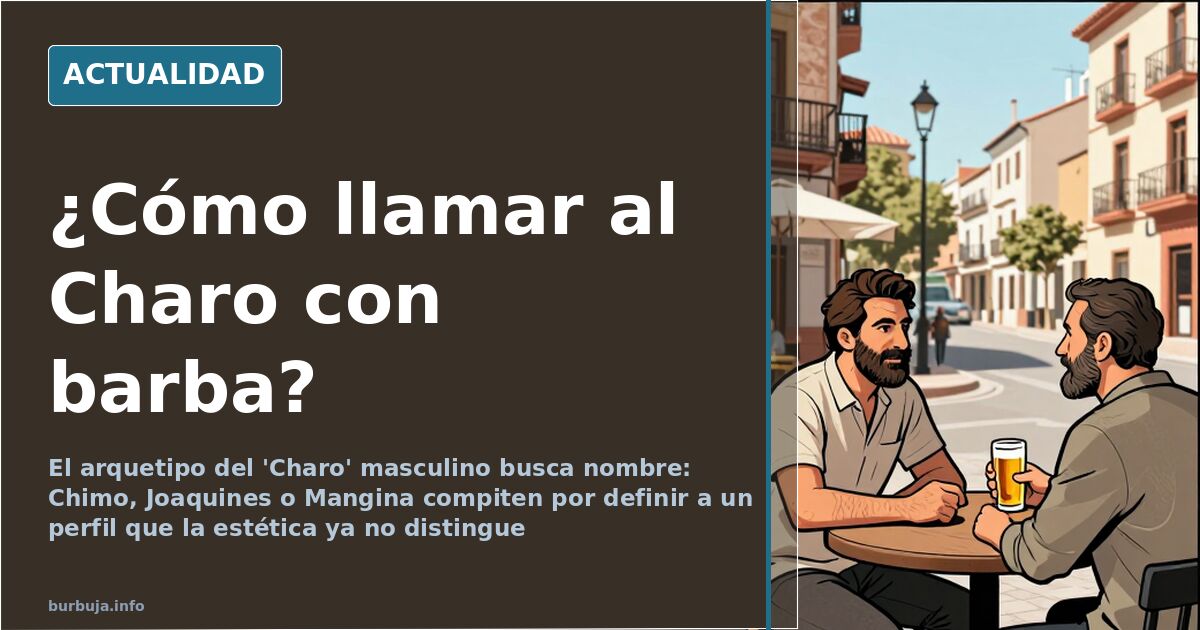
The male 'Charo' archetype in Spain seeks a name: from Chimo to Gonzalo
There is a figure that everyone recognizes but has no specific name. The premise is simple: there exists a male profile that replicates the traits of the archetype colloquially known as "Charo" (a term for a middle-class, pogre woman often associated with public sector jobs), yet no equivalent masculine term has been coined. The initial proposal launches a battery of candidates —Rosaritos, Gonzálos, Iñakis, Quims, Tonis, Jordis, Quiques— and, incidentally, a composite sketch: three-day beard, thick-rimmed glasses, casual clothing in muted tones, accessories with political symbolism, and messy hair. The discussion quickly shifted to a fundamental problem: physical stereotypes no longer distinguish anyone.
The composite sketch that no longer helps identify anyone
The inventory of external signs falls apart when contrasted with reality on the street. The three-day beard, wool sweater, or thick-framed glasses ceased to be ideological markers years ago: today anyone wears them, from TV pundits to delivery drivers. Aesthetics no longer vote. Some argue that long hair, once an unmistakable sign of left-wing affiliation, is now more common among those who reject the current left. The debate then shifts from wardrobe to behavior.
The thesis gaining ground is that the male equivalent is defined not by how one dresses but by how one acts. It points to a profile of a low-profile civil servant or activist, with a showcase feminist and environmentalist discourse, who avoids open conflict and operates through indirect means. The most repeated criticism is that of hypocrisy: someone who displays modernity in public while privately sustaining dynamics that contradict that discourse. This is not a flattering portrait, and it should be taken for what it is: a working hypothesis about an archetype, not a description of any specific person.
Chimo, Joaquín, and the problem of proper names
The candidate gathering the most support is Chimo, a hypocoristic (nickname) for Joaquín in eastern Spain, just as Paco is for Francisco or Pepe for José. The argument is linguistic logic: if Charo works as a generic name, Chimo does the same. The variant Joaquines appears as an alternative, sharing the same root. Others prefer Gonzalo, because a specific proper name might end up designating the whole group; the example often cited is a pundit surnamed Miró.
Against this approach, a current argues that the name should emerge from common speech rather than saints' calendars. Mangina and bebesojas are cited as terms already in circulation describing men who adopt others' discourse to gain approval. The objection is that these are insults, not categories. And there is a third path that denies the premise: the female Charo has a component of institutional parasitism —a government post, subsidized activism— that does not reproduce equally in the male version. The equivalent man would rather be the know-it-all commentator, the one who opines on everything on television or social media without having worked at anything.
Paco is not the same as Charo, and that is the crux of the matter
The most productive confusion in the exchange is mixing up Paco with Charo. They are not equivalents. Paco denotes traditional, down-to-earth masculinity: self-employed, handyman, the one who fixes broken things and holds the bar together. Charo, conversely, is associated with administrative freeloaders, low-performance public posts, and frequent sick leave. One produces; the other, according to this reading, clings on. The distinction is key because it explains why no name quite sticks: people are trying to baptize two different things with the same label.
From there, the catalog of proposals overflows. Rosaritos, Iñakis, Quims, Tonis, Jordis, Quiques, Filomeno, Evaristo, Protasio, Justino, Mauri, Rosauro, Silvano, Marios, Genaros, Paolos, Begoños, Macharolos. One participant summarizes the difficulty with an observation worth more than all the candidates: Charo and Paco converge with age, when testosterone drops and traits equalize. Women become Pacos and men become Charos, and at that midpoint, no one can distinguish them anymore.
The question that remains unanswered
The inventory of candidates exceeds twenty, and none prevails. The underlying reason is not a lack of imagination, but the absence of a shared defining trait. The Charo has a recognizable profile: standardized aesthetics, militant discourse, institutional anchoring. The man who resembles her shares the discourse, but not the aesthetics or the way of life, and furthermore carries the burden that his supposed adherence to the ideology is read as a seduction strategy rather than conviction. Can you baptize an archetype that doesn't exist as such, or will the name end up designating only a handful of TV pundits?
There is a figure that everyone recognizes but has no specific name. The premise is simple: there exists a male profile that replicates the traits of the archetype colloquially known as "Charo" (a term for a middle-class, pogre woman often associated with public sector jobs), yet no equivalent masculine term has been coined. The initial proposal launches a battery of candidates —Rosaritos, Gonzálos, Iñakis, Quims, Tonis, Jordis, Quiques— and, incidentally, a composite sketch: three-day beard, thick-rimmed glasses, casual clothing in muted tones, accessories with political symbolism, and messy hair. The discussion quickly shifted to a fundamental problem: physical stereotypes no longer distinguish anyone.
The composite sketch that no longer helps identify anyone
The inventory of external signs falls apart when contrasted with reality on the street. The three-day beard, wool sweater, or thick-framed glasses ceased to be ideological markers years ago: today anyone wears them, from TV pundits to delivery drivers. Aesthetics no longer vote. Some argue that long hair, once an unmistakable sign of left-wing affiliation, is now more common among those who reject the current left. The debate then shifts from wardrobe to behavior.
The thesis gaining ground is that the male equivalent is defined not by how one dresses but by how one acts. It points to a profile of a low-profile civil servant or activist, with a showcase feminist and environmentalist discourse, who avoids open conflict and operates through indirect means. The most repeated criticism is that of hypocrisy: someone who displays modernity in public while privately sustaining dynamics that contradict that discourse. This is not a flattering portrait, and it should be taken for what it is: a working hypothesis about an archetype, not a description of any specific person.
Chimo, Joaquín, and the problem of proper names
The candidate gathering the most support is Chimo, a hypocoristic (nickname) for Joaquín in eastern Spain, just as Paco is for Francisco or Pepe for José. The argument is linguistic logic: if Charo works as a generic name, Chimo does the same. The variant Joaquines appears as an alternative, sharing the same root. Others prefer Gonzalo, because a specific proper name might end up designating the whole group; the example often cited is a pundit surnamed Miró.
Against this approach, a current argues that the name should emerge from common speech rather than saints' calendars. Mangina and bebesojas are cited as terms already in circulation describing men who adopt others' discourse to gain approval. The objection is that these are insults, not categories. And there is a third path that denies the premise: the female Charo has a component of institutional parasitism —a government post, subsidized activism— that does not reproduce equally in the male version. The equivalent man would rather be the know-it-all commentator, the one who opines on everything on television or social media without having worked at anything.
Paco is not the same as Charo, and that is the crux of the matter
The most productive confusion in the exchange is mixing up Paco with Charo. They are not equivalents. Paco denotes traditional, down-to-earth masculinity: self-employed, handyman, the one who fixes broken things and holds the bar together. Charo, conversely, is associated with administrative freeloaders, low-performance public posts, and frequent sick leave. One produces; the other, according to this reading, clings on. The distinction is key because it explains why no name quite sticks: people are trying to baptize two different things with the same label.
From there, the catalog of proposals overflows. Rosaritos, Iñakis, Quims, Tonis, Jordis, Quiques, Filomeno, Evaristo, Protasio, Justino, Mauri, Rosauro, Silvano, Marios, Genaros, Paolos, Begoños, Macharolos. One participant summarizes the difficulty with an observation worth more than all the candidates: Charo and Paco converge with age, when testosterone drops and traits equalize. Women become Pacos and men become Charos, and at that midpoint, no one can distinguish them anymore.
The question that remains unanswered
The inventory of candidates exceeds twenty, and none prevails. The underlying reason is not a lack of imagination, but the absence of a shared defining trait. The Charo has a recognizable profile: standardized aesthetics, militant discourse, institutional anchoring. The man who resembles her shares the discourse, but not the aesthetics or the way of life, and furthermore carries the burden that his supposed adherence to the ideology is read as a seduction strategy rather than conviction. Can you baptize an archetype that doesn't exist as such, or will the name end up designating only a handful of TV pundits?
Summary of a discussion on Burbuja.info - Foro de economía, actualidad y política., translated from Spanish and reviewed before publication. Read the full discussion (145 replies).
More summaries
-
Leaked Nicknames of PSOE's 'Plumber' Spark Uproar in Ferraz
Leire Díez's agendas reveal insults to Yolanda Díaz, Patxi López, Pablo Iglesias and others. The list of nicknames shakes Ferraz.
-
Irene Montero's Menorca holiday sparks 'caviar left' criticism
Irene Montero and Ione Belarra spend August in Menorca, facing backlash for hypocrisy regarding mass tourism.
-
Mouliaá admits illegal room subletting in Madrid
Actress Elisa Mouliaá admits subletting rooms without landlord permission, citing economic vulnerability following her legal case against Íñigo Errejón.
-
Belarra, a Loaned Red Ferrari and the Remark: «China Is Not This Country»
A thread concerning Belarra mentions a loaned red Ferrari and obtaining a certificate in one week, prompting a user to reply: «China is not this country»
-
Dacia vs Porsche: Four Dead in Spain Crash
Four people died in a Dacia Duster after colliding with a Porsche Panamera in Plasencia, Spain. The investigation remains open.
-
Boys mock girls after 0-8 win, sparking controversy
Velarde FC opens disciplinary file against a minor who told opponents to 'go scrub' after a youth match.