
The Madrid buildings that vanished without a trace
A giant globe over the Retiro park, a Nordic-style electric colossus and workers' housing estates now priced at a million: the Madrid that was wiped off the map.
English · Original discussion in Spanish · Published
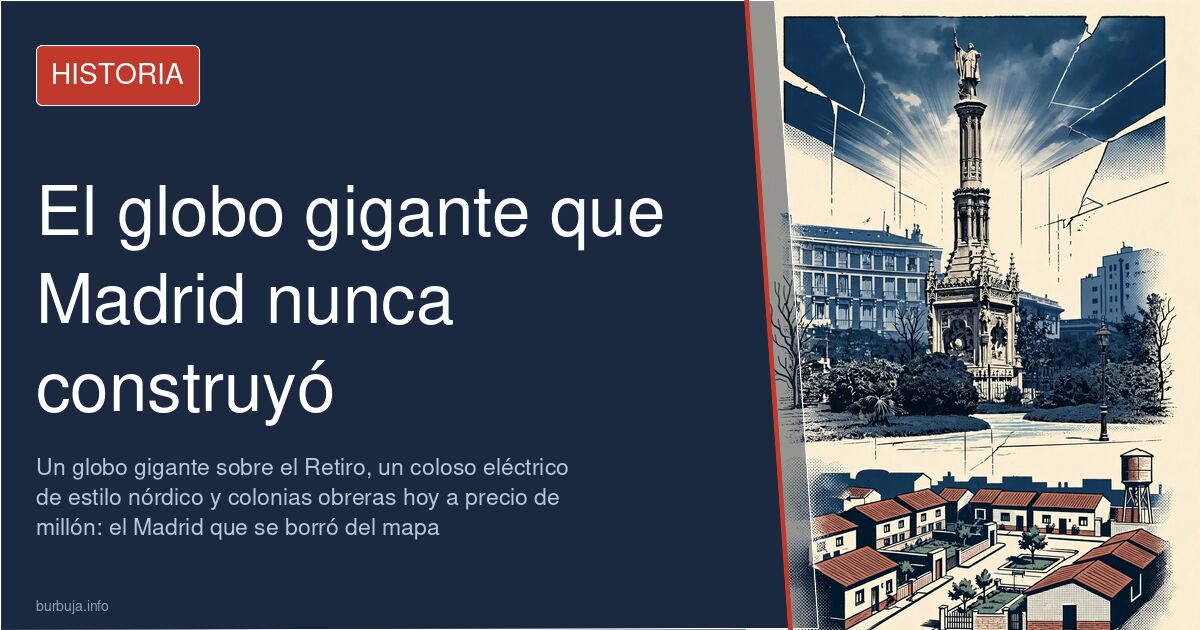
Ghost Madrid: from the Columbus globe to the million-euro houses
There was a time when Madrid's skyline was set to include a giant globe crowned by a sailing ship, planted right in the middle of the Retiro park. It was never built. It never got past the drawing board. But the same Madrid did build — and later demolish — a Nordic-style building on Luchana street and a monument to those who died in the colonial wars. These are Madrid's vanished buildings, still surviving in old photographs. Fifteen years ago, someone already brought these images to light and met more mockery than interest. Now they are back.
The workers' housing estates nobody can afford today
In the 1920s, the capital built estates of single-family "hotels" for company employees. The one built by Unión Eléctrica Madrileña (a former Madrid electricity company) is where the story begins. A hundred years later, those same houses sell for close to a million euros, and no ordinary employee — not even one from the power company — can afford them.
The route is summed up by the very evolution of workers' housing: El Hogar del Ferroviario in Sarracena (1920s), the San Fermín estate (1930s), the Colonia Terol in Carabanchel (1940s) and the Poblado Dirigido de Fuencarral (1950s). Later came the blocks of the yoke and arrows, the francoblocks. Today a terraced house in the Terol estate is listed at between 500,000 and 600,000 euros. The Pegaso and San Cristóbal estates, facing the Cuatro Torres, complete the list.
The symbol Madrid never had
When a meteorite or an invasion razes Paris, Rome, London or New York in a film, the director knows exactly which shot to show flying through the air. In Madrid, the repertoire runs out at the Puerta de Alcalá. An emblem of that calibre should have been built a century ago, goes the most repeated argument: however kitsch it might have looked, it would instantly have tied the capital's image to the epic of the discoveries.
The Retiro globe fit that logic. A giant sphere topped by a sailing ship would have placed Madrid in the same visual league as the Eiffel Tower or Big Ben. It never got past the planning stage.
Where the story stalls
The city demolished that northern European eclecticism on Luchana without remorse and buried the colonial monument, later replaced by a statue of Bolívar in the Parque del Oeste. A few central European onion domes survive between San Bernardo and Quevedo, enduring by sheer neglect. The uncomfortable question is not why the globe was never built, but why Madrid preserves so little of what it did build. There the analysis stops: with no identifiable monument and workers' houses priced for millionaires, the city's memory is rising in value just as its residents can no longer afford it.
Also available in: Deutsch
Summary of a discussion on Burbuja.info - Foro de economía, actualidad y política., translated from Spanish and reviewed before publication. Read the full discussion (33 replies).
More summaries
-
Madrid's Movida under Franco: censorship and rich kids
Genesis, Santana and Queen played in Spain while Franco was still alive. The Movida would have existed anyway, but under censorship and only for the well-off.
-
Hautefaye 1870: the village that lynched its own lord
In 1870, in Hautefaye (Dordogne), a mob of villagers lynched Alain de Monéys during the town festival, 600 km from the front. A case that unsettles…
-
130 war movies sorted by conflict: the definitive guide
A film buff has catalogued 130 war movies by conflict, with ratings and a realism level. The most complete guide to understanding war through cinema.
-
Why the Nazis never used the one-time pad in World War II
Mathematically unbreakable, the one-time pad could have been decisive in World War II, but logistics and human error made it unworkable.
-
Normandy under pressure: new film reopens the historical debate
The film 'D-Day: Under Pressure' reignites the historical debate: who really won the war? With 2,500 German tanks in Normandy and only 500 in the east, the figures
-
Why the Kingdom of Granada is still on Spain's coat of arms
We look at the historical meaning of the pomegranate at the centre of the coat of arms, the two crowns and the controversial Bourbon fleur-de-lis.