
The IT bubble under debate: dubious offers and falling salaries
Spain’s IT sector is adjusting: junior roles from €16,000, €700-a-month offers and an AI case that did six months’ work in one
English · Original discussion in Spanish · Published
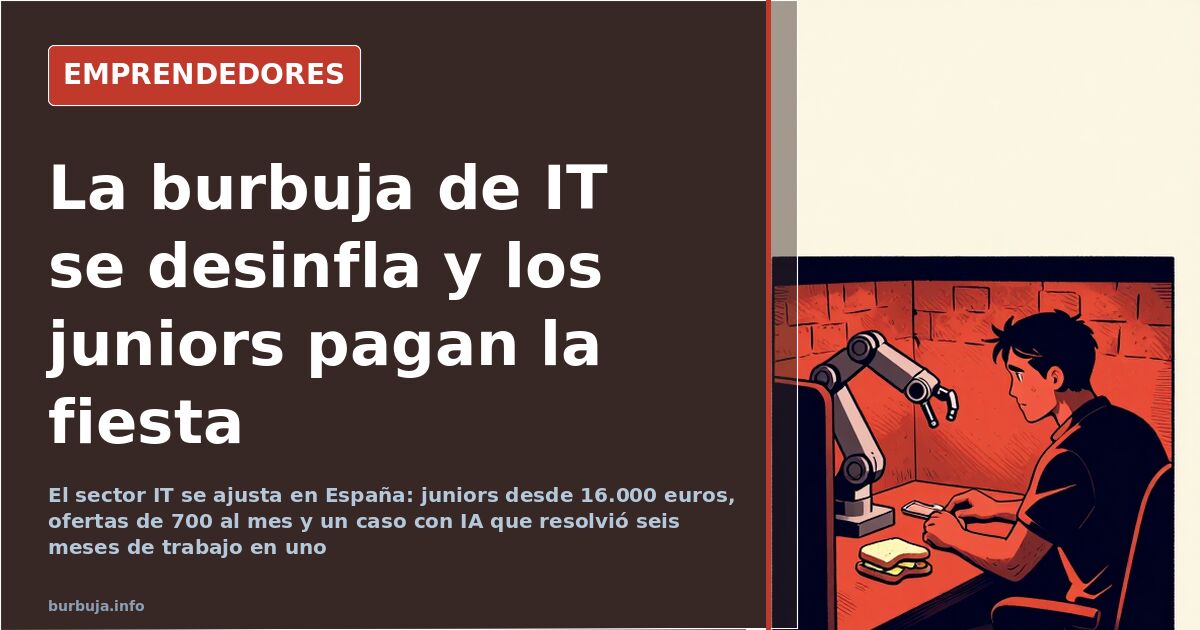
From promised €35,000 to €700 offers: the IT sector’s correction
The IT bubble is deflating. After a decade of unbridled hiring, the tech sector is going through its first serious correction, and the suspicion gaining ground is that demand for programmers is already covered: many companies rely on student interns for what used to be junior vacancies. Salaries that were sold as a gateway to the middle class —€35,000 or €40,000 right after finishing a vocational training course (FP)— have fallen to ranges starting at €16,000 gross a year. In some cases, much less: there are mentions of offers of €700 a month for recent graduates, a figure that doesn’t even reach Spain’s minimum wage (SMI).
The question is no longer whether the sector was inflated. It’s how much of what is advertised as a talent shortage actually serves to keep tens of thousands of people training for jobs that don’t exist.
Are there too many programmers in Spain?
The starting thesis holds that the need for programmers is satisfied and that the scarcity narrative is sustained as an advertorial paid for by big consultancies and tech companies. The result would be an army of DAW and DAM (Spanish vocational IT qualifications) graduates competing for the same entry-level positions, with companies raising the bar while pushing pay down.
Against that, the most repeated response is that there is no collapse, but a purge. After years of easy money, oversized workforces and projects where cost didn’t matter, the market is normalising. Twitter once had 7,000 employees and Spotify 10,000; sustaining those structures required cash flow that no longer flows.
How much does a junior earn in Spain: €16,000 and €21,000
The numbers in play are specific. First junior job with no experience at an average consultancy: around €16,000 gross. With one or two years under your belt, up to €21,000 for demanding roles even if they are support and involve a heavy incident load. From there, raises of €1,000 to €1,500 when someone specialises and becomes difficult to replace.
The problem is the starting point. There are offers of €700 a month for recent graduates and CVs accepted to work for free for one or two months with the promise of learning. The comparison with other technical sectors is no better: in chemistry, reaching €1,500 net requires three years at the same company and the figure to be agreed in a contract; without that, the range stays at €1,100 or €1,200.
The impact of AI on junior work
The most worrying blow doesn’t come from layoffs, but from productivity. A specific case: a Java application to cover a scale described in a 300-page royal decree, planned for six months and four programmers, was solved in under a month by two people using a language model. Testing and fine-tuning remain. The rest, done.
Two opposing readings emerge from this. For some, it proves that repetitive work is disappearing and only those who solve hard problems across several fronts of the same project will survive. For others, it confirms that the foundation of junior employment —the grunt coding that trained the next generation— is evaporating before that generation has even entered.
Job ads with no real position, algorithm tests and endless interviews
Another front is the selection process. Vacancies are posted with no real job, launched only to gauge the market, and technical tests that require months of preparation to solve problems that don’t appear in any real job. The most repeated complaint is that of seniors with ten years of experience forced to memorise algorithm exercises to pass filters that are not required in any other sector.
Meanwhile, training no longer guarantees the picture of three years ago: in a class of 30 students, half were already working in July and the rest in October. That was the cheap-money scenario, not today’s.
What can’t be offshored
The argument holding up the sector’s floor is physical. The work of a plumber, a nurse or a technician who repairs hardware doesn’t cross borders; a programmer’s does. Routine administrative work, basic maintenance and low-value development have already gone to teams in India, with the bill multiplied for the local intermediary managing the assignment.
What remains are projects where a screw-up costs more than the savings, critical infrastructure and on-site support. Little consolation for someone who has just finished a vocational training course.
The correction has a global dimension that almost no one disputes: in New York, according to a participant who works there, the same systems profile has seen salaries fall 30% or more in six months. If that happens in the deepest market in the world, the bubble diagnosis is hard to refute. What still doesn’t add up is what happens to those already inside. No one has yet calculated how many of those programming today will still be doing so —or earning the same— in five years.
The IT bubble is deflating. After a decade of unbridled hiring, the tech sector is going through its first serious correction, and the suspicion gaining ground is that demand for programmers is already covered: many companies rely on student interns for what used to be junior vacancies. Salaries that were sold as a gateway to the middle class —€35,000 or €40,000 right after finishing a vocational training course (FP)— have fallen to ranges starting at €16,000 gross a year. In some cases, much less: there are mentions of offers of €700 a month for recent graduates, a figure that doesn’t even reach Spain’s minimum wage (SMI).
The question is no longer whether the sector was inflated. It’s how much of what is advertised as a talent shortage actually serves to keep tens of thousands of people training for jobs that don’t exist.
Are there too many programmers in Spain?
The starting thesis holds that the need for programmers is satisfied and that the scarcity narrative is sustained as an advertorial paid for by big consultancies and tech companies. The result would be an army of DAW and DAM (Spanish vocational IT qualifications) graduates competing for the same entry-level positions, with companies raising the bar while pushing pay down.
Against that, the most repeated response is that there is no collapse, but a purge. After years of easy money, oversized workforces and projects where cost didn’t matter, the market is normalising. Twitter once had 7,000 employees and Spotify 10,000; sustaining those structures required cash flow that no longer flows.
How much does a junior earn in Spain: €16,000 and €21,000
The numbers in play are specific. First junior job with no experience at an average consultancy: around €16,000 gross. With one or two years under your belt, up to €21,000 for demanding roles even if they are support and involve a heavy incident load. From there, raises of €1,000 to €1,500 when someone specialises and becomes difficult to replace.
The problem is the starting point. There are offers of €700 a month for recent graduates and CVs accepted to work for free for one or two months with the promise of learning. The comparison with other technical sectors is no better: in chemistry, reaching €1,500 net requires three years at the same company and the figure to be agreed in a contract; without that, the range stays at €1,100 or €1,200.
The impact of AI on junior work
The most worrying blow doesn’t come from layoffs, but from productivity. A specific case: a Java application to cover a scale described in a 300-page royal decree, planned for six months and four programmers, was solved in under a month by two people using a language model. Testing and fine-tuning remain. The rest, done.
Two opposing readings emerge from this. For some, it proves that repetitive work is disappearing and only those who solve hard problems across several fronts of the same project will survive. For others, it confirms that the foundation of junior employment —the grunt coding that trained the next generation— is evaporating before that generation has even entered.
Job ads with no real position, algorithm tests and endless interviews
Another front is the selection process. Vacancies are posted with no real job, launched only to gauge the market, and technical tests that require months of preparation to solve problems that don’t appear in any real job. The most repeated complaint is that of seniors with ten years of experience forced to memorise algorithm exercises to pass filters that are not required in any other sector.
Meanwhile, training no longer guarantees the picture of three years ago: in a class of 30 students, half were already working in July and the rest in October. That was the cheap-money scenario, not today’s.
What can’t be offshored
The argument holding up the sector’s floor is physical. The work of a plumber, a nurse or a technician who repairs hardware doesn’t cross borders; a programmer’s does. Routine administrative work, basic maintenance and low-value development have already gone to teams in India, with the bill multiplied for the local intermediary managing the assignment.
What remains are projects where a screw-up costs more than the savings, critical infrastructure and on-site support. Little consolation for someone who has just finished a vocational training course.
The correction has a global dimension that almost no one disputes: in New York, according to a participant who works there, the same systems profile has seen salaries fall 30% or more in six months. If that happens in the deepest market in the world, the bubble diagnosis is hard to refute. What still doesn’t add up is what happens to those already inside. No one has yet calculated how many of those programming today will still be doing so —or earning the same— in five years.
Summary of a discussion on Burbuja.info - Foro de economía, actualidad y política., translated from Spanish and reviewed before publication. Read the full discussion (362 replies).
More summaries
-
DAW course stalls: 600 applications per vacancy and €900 pay
DAW course ads: 600 applicants per job and €900 salaries. Sector admits too many junior candidates and too little experience.
-
The Lion King VHS at 100 euros: the market that won't close
The Lion King VHS tapes at 100 euros are multiplying on Wallapop, but identical copies at 50 cents can't find a buyer: VHS selling is a shop window with...
-
Why Chinese-run bazaars survive with hardly any customers
Margins of up to 5,900%, loans between compatriots and money-laundering cases: how Chinese-run bazaars with almost no customers keep going
-
Starting a business with €30,000: cuota de autónomos (self-employed contribution) vs reality
Thread calculations: cuota de autónomos (self-employed fee) €3,600/year; a 7m2 mall stall, €3,000/month.
-
Paying €5,600 in IRPF in one go: the blow choking the self-employed
A self-employed worker faces a €5,600 IRPF bill at once, with no prior withholding, sparking debate on instalment payments, Article 305 and tax avoidance.
-
Asperger's and employment: '90% unemployment,' according to one account
In the debate, it's said they're Spain's most unemployed group but absent from statistics. A 90% figure and the HR filter as a wall are cited.