
The Impossible Sanctuary: Gold, Property, and Bonds Fail
Gold rises, housing gets expensive, and bonds offer no guarantees. The debate on where to shelter savings when no asset is safe.
English · Original discussion in Spanish · Published
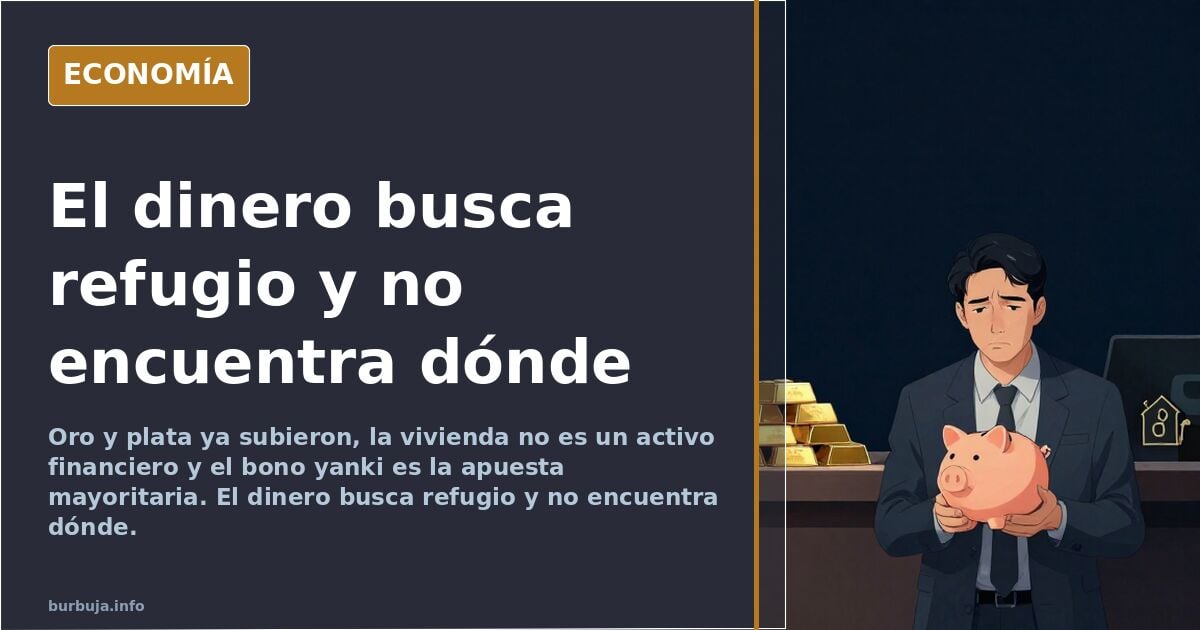
No gold, no housing, no bonds: the impossible sanctuary
Gold has surged in recent years, and many now antiestéticar buying at peak prices. Housing carries the label of a financial asset it should never have been. US Treasury bonds are presented as the ultimate refuge against inflation, which calculations suggest continues to erode savers' purchasing power. Yet the question persists: if you cannot or do not want to choose any of these refuges, what remains?
The discussion begins with an uncomfortable thesis: the system is approaching a reset, and classic refuges no longer offer the security they promise. From there, the range of answers is as wide as it is contradictory.
Gold and silver: Is it too late to enter?
Gold and silver have risen sharply in recent years. This leads many to wonder if buying now means buying at the top. The doubt is significant: if the system performs "juggling acts" again, as the initial premise suggests, precious metals can be inflated and deflated at the will of central banks.
Some argue that gold is still cheap and will reach $10,000. On the other side, it is recalled that the Swiss central bank broke its fixed exchange rate with the euro near 1.20 in 2015, blowing up positions, and could do so again. Silver, meanwhile, has become a boring asset for those who have already accumulated enough.
Housing as a refuge: Financial asset or mirage?
Housing appears in the conversation as the most cited refuge. Buying and renting flats is presented as a sure business. But the objection is immediate: housing was never a financial asset, even if it has been treated as such. The problem is that it concentrates almost all personal wealth, and governments could steer savers away from bricks through taxes that hurt profitability and capital gains.
The apocalyptic scenario painted by some — cities burning, social order disappearing — does not seem imminent. But the idea of the frog cooking slowly takes hold: in Yugoslavia, city flats were priced like in Spain with much lower salaries, and in Argentina they are much worse, and no reset has occurred. The uncomfortable conclusion is drawn: you get used to living worse and do not notice it.
US Treasury bonds: The refuge everyone watches
The 10- or 30-year US bond is presented as the option everyone is trinc. It is argued that it protects against 5% inflation with absolute security. Bonds from all countries worldwide are rising, indicating many things and none good, as warned.
The counterargument does not wait: fixed-term deposits should already be at least at 6%, and even then, you lose money. With the 3% available now, many believe they are Relleniton Gekko. The Taylor rule, applied to current rates, yields a result that does not match the official narrative. And the US bond, being the most cited refuge, is not exempt from its real yield still being negative.
Land, garden, and chickens: The physical refuge
Against financial assets, the option of land emerges strongly. Having land to raise animals, plant fruit trees, store water in tanks, and install solar panels has incalculable value. The garden yields much, they say. But it requires effort and hours.
Skepticism also appears: in the end, buying such things is an endless task, requires too much of your own time, and you might as well kill yourself if things get ugly rather than ruining your back farming without fuel. The defense of the city as a more sustainable environment clashes with the view that without electricity or with very expensive electricity, many more manual processes and human labor will be needed.
The historical comparison is recurrent: in the 1940s and 50s, there were ration books until 1953, and autarky did not end until 1959. City dwellers starved more than those in the countryside. The question is whether we will return to that or if the Mercosur agreement will allow cheap, albeit low-quality, food imports.
Minority alternatives: Semiconductors, art, and bitcoin
Beyond classic refuges, scattered options emerge. US semiconductors and Spanish banking are presented as the ironically sufficient combination. Artworks, commercial premises, and stakes in essential small businesses — such as pharmaceuticals — appear as alternatives for those seeking something tangible.
Bitcoin surprisingly takes a long time to appear. When it does, it is mentioned without elaboration. Index funds, money market funds waiting for better options, and even complete Pokémon cards complete the catalog of refuges ranging from reasonable to absurd.
The reset no one defines
The word "reset" hangs over the entire conversation without anyone defining it precisely. It is said that the economy is sinking and dragging everything with it: banks, stock markets, governments, businesses, pensions, and employment will fall one after another. Chaos will trinc, they say. But it is also recalled that one thing is for certain products to rise in price and become prohibitive, and another is for all of Spain to starve.
Inflation and negative real interest rates are the only things taken for granted. Against this, the individual has few options: invest in what is safest, most aseptic, and least intervened. And those without land will struggle to eat and survive, another voice concludes. The question remains unanswered: what remains when neither gold, nor housing, nor bonds offer guarantees?
Gold has surged in recent years, and many now antiestéticar buying at peak prices. Housing carries the label of a financial asset it should never have been. US Treasury bonds are presented as the ultimate refuge against inflation, which calculations suggest continues to erode savers' purchasing power. Yet the question persists: if you cannot or do not want to choose any of these refuges, what remains?
The discussion begins with an uncomfortable thesis: the system is approaching a reset, and classic refuges no longer offer the security they promise. From there, the range of answers is as wide as it is contradictory.
Gold and silver: Is it too late to enter?
Gold and silver have risen sharply in recent years. This leads many to wonder if buying now means buying at the top. The doubt is significant: if the system performs "juggling acts" again, as the initial premise suggests, precious metals can be inflated and deflated at the will of central banks.
Some argue that gold is still cheap and will reach $10,000. On the other side, it is recalled that the Swiss central bank broke its fixed exchange rate with the euro near 1.20 in 2015, blowing up positions, and could do so again. Silver, meanwhile, has become a boring asset for those who have already accumulated enough.
Housing as a refuge: Financial asset or mirage?
Housing appears in the conversation as the most cited refuge. Buying and renting flats is presented as a sure business. But the objection is immediate: housing was never a financial asset, even if it has been treated as such. The problem is that it concentrates almost all personal wealth, and governments could steer savers away from bricks through taxes that hurt profitability and capital gains.
The apocalyptic scenario painted by some — cities burning, social order disappearing — does not seem imminent. But the idea of the frog cooking slowly takes hold: in Yugoslavia, city flats were priced like in Spain with much lower salaries, and in Argentina they are much worse, and no reset has occurred. The uncomfortable conclusion is drawn: you get used to living worse and do not notice it.
US Treasury bonds: The refuge everyone watches
The 10- or 30-year US bond is presented as the option everyone is trinc. It is argued that it protects against 5% inflation with absolute security. Bonds from all countries worldwide are rising, indicating many things and none good, as warned.
The counterargument does not wait: fixed-term deposits should already be at least at 6%, and even then, you lose money. With the 3% available now, many believe they are Relleniton Gekko. The Taylor rule, applied to current rates, yields a result that does not match the official narrative. And the US bond, being the most cited refuge, is not exempt from its real yield still being negative.
Land, garden, and chickens: The physical refuge
Against financial assets, the option of land emerges strongly. Having land to raise animals, plant fruit trees, store water in tanks, and install solar panels has incalculable value. The garden yields much, they say. But it requires effort and hours.
Skepticism also appears: in the end, buying such things is an endless task, requires too much of your own time, and you might as well kill yourself if things get ugly rather than ruining your back farming without fuel. The defense of the city as a more sustainable environment clashes with the view that without electricity or with very expensive electricity, many more manual processes and human labor will be needed.
The historical comparison is recurrent: in the 1940s and 50s, there were ration books until 1953, and autarky did not end until 1959. City dwellers starved more than those in the countryside. The question is whether we will return to that or if the Mercosur agreement will allow cheap, albeit low-quality, food imports.
Minority alternatives: Semiconductors, art, and bitcoin
Beyond classic refuges, scattered options emerge. US semiconductors and Spanish banking are presented as the ironically sufficient combination. Artworks, commercial premises, and stakes in essential small businesses — such as pharmaceuticals — appear as alternatives for those seeking something tangible.
Bitcoin surprisingly takes a long time to appear. When it does, it is mentioned without elaboration. Index funds, money market funds waiting for better options, and even complete Pokémon cards complete the catalog of refuges ranging from reasonable to absurd.
The reset no one defines
The word "reset" hangs over the entire conversation without anyone defining it precisely. It is said that the economy is sinking and dragging everything with it: banks, stock markets, governments, businesses, pensions, and employment will fall one after another. Chaos will trinc, they say. But it is also recalled that one thing is for certain products to rise in price and become prohibitive, and another is for all of Spain to starve.
Inflation and negative real interest rates are the only things taken for granted. Against this, the individual has few options: invest in what is safest, most aseptic, and least intervened. And those without land will struggle to eat and survive, another voice concludes. The question remains unanswered: what remains when neither gold, nor housing, nor bonds offer guarantees?
Summary of a discussion on Burbuja.info - Foro de economía, actualidad y política., translated from Spanish and reviewed before publication. Read the full discussion (82 replies).
More summaries
-
Mélenchon Threatens Jail for France’s Central Bank Governor Amid Economic Clash
Jean-Luc Mélenchon calls the Bank of France governor a traitor and vows jail, while Marine Le Pen proposes tax hikes on multinationals, clashing with ECB demands.
-
Judge Opens Trial for Ayuso’s Partner on Four Charges
A judge orders trial for Madrid’s president partner over fraud, accounting crimes, and criminal organization.
-
More Madrid Proposes Public Supermarkets and Capped Food Prices
More Madrid proposes public supermarkets and price caps on basic food items in Getafe, citing rising household grocery costs.
-
RTVE asks SEPI to activate reserve fund to cover 34 million euro losses
RTVE will close 2024 with 34 million euros in losses and requests SEPI to activate its 38.3 million euro reserve fund. The president cuts his salary and imposes 20% cuts on executives.
-
Cuba: Blackouts, Hunger, and an Economy That Pays No One
Total blackouts, empty state stores for over three years, and retirees earning $3 a month: the Cuban economy survives on remittances and international begging.
-
Gaza Debate: Spain's Deep Moral Divide
A message on Gaza triggers 122 responses, exposing Spain's moral fracture over children, oil, Iran, and double standards in a polarized debate.