
The Immortal Soul and Memory: the Debate Gödel Cannot Settle
Gödel's theorem does not settle whether the soul keeps its memory. The debate over identity, reincarnation and spirit that puts immortality to the test.
English · Original discussion in Spanish · Published
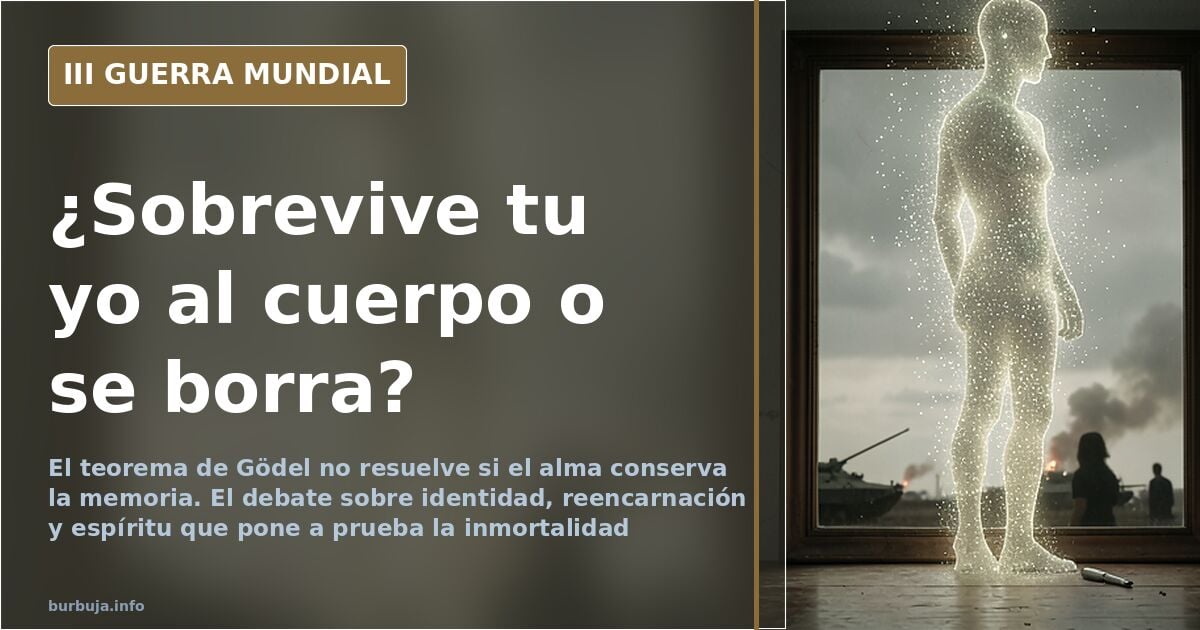
An immortal soul is not enough: without memory, the self dissolves
That the soul exists and is immortal is, so the argument goes, demonstrated by the implications of Gödel's theorem: there is in man an intellectual operator that transcends the mechanistic workings of the objects of the world. So far, the territory of classical metaphysics. The problem begins the next day: if that soul survives the death of the body, does it keep the identity and memory of what it lived, or does it dissolve into the cycle of reincarnations like a sheet of paper whose poetry has been erased? The discussion, which opens with that scholastic challenge, ends up as an autopsy of the very concept of identity.
What the soul stakes when it loses its memory
The initial premise is a provocation with method: to reason like the Greeks and the scholastics about whether the soul preserves its identity or can lose it. The analogy that frames the debate is that of the sheet of paper and the poem. A page stripped of the poem written on it is left blank, and nobody cares: the life was in the poetry, not in the paper. If the page burns but the poetry remains engraved on a silica plate, that is indeed immortality. The conclusion is inescapable: the only way immortality makes sense is by preserving the identity of the soul.
Against this comes the most down-to-earth objection: anyone loses their identity eight hours a day while asleep, and a few more hours on autopilot. For a soul that lasts an eternity, eighty years embodied are less than the instant one pricks a finger on a rose. The counterargument is not long in coming: losing identity is not the same as losing attention to it. Identity is preserved even when no one is looking at it. And if no process can make it vanish between two contiguous fragments of time, it cannot be achieved by adding up infinitely many fragments either.
Reincarnation as a logical and mathematical problem
The thread splits in two when theology enters. One argument holds that reincarnation is incompatible with a God who loves his creatures and has a plan of salvation: if each attempt carries the risk of an infinitely bad reward, multiplying the attempts multiplies the risk. And it is always a concrete identity that is loved. When a man becomes an animal, he loses his identity, because nothing in that animal links him to one man rather than another: it makes no difference.
The other current distinguishes body, soul and spirit, with the spirit as the essence that endures. The soul would be the interface between the physical and the spiritual; the spirit, what lasts. The chocolate analogy —powder, bar, egg— serves to explain that form adapts to function without the essence changing. The rebuttal arrives peine: if identity resides in the spirit and the spirit does not degrade, there is no way a loss of identity can occur, and without rupture no reincarnation is possible. A man's spirit would never be identified with that of a duck.
To the mathematical joke another is added: if reincarnation were true, there would be no fewer than 550 million pharaohs, more than anything else. Identity is not lost; therefore reincarnation makes no sense.
The materialist turn: four dimensions and no past self
The most disruptive contribution comes at the end and breaks the scholastic frame. If the human being and the universe are not three-dimensional entities but four-dimensional ones, there is no past self and no future self: there is a single four-dimensional object, and that is why identity is preserved. Memory, in that scheme, is an epiphenomenon, not the support of the self.
The thread closes with an idea that sums up the possible consensus: the matter of the body is endlessly recycled —cells die, atoms pass into the tree and the river—, we are whirlpools in the water, and yet we keep identifying ourselves. The loss of matter does not imply loss of identity. If death is a sudden loss of data, the conclusion collapses under its own weight: we already lose matter and nothing happens.
The question no one fully closes remains: if the soul keeps its memory, what happens to the memories of a life that lasts an instant against eternity? The answer, with reservations, points to eternity being built fragment by fragment, and to no fragment containing the process that erases the one before.
Also available in: Deutsch
Summary of a discussion on Burbuja.info - Foro de economía, actualidad y política., translated from Spanish and reviewed before publication. Read the full discussion (50 replies).
More summaries
-
Von der Leyen’s Family Ties to Brussels Power
Heiko von der Leyen leads Orgenesis’ medical division and worked at GSK, highlighting conflicts of interest surrounding the Commission President.
-
Liu Sivaya: Controversy Surrounds Immortal Regiment in Madrid
Liu Sivaya, the face of Madrid's Immortal Regiment parade, faces criticism over her prominence and doubts about her nationality and political history.
-
US Navy Arrest Fuels Banana Republic Debate
The arrest of a former US Navy official for bribery reignites debates on whether the United States exhibits symptoms of a failing state.
-
Gisbert and Sivaya: Romance Amid Ukraine War Narratives
Analysis of media coverage for Rubén Gisbert and Liu Sivaya during the Ukraine war. Is this digital propaganda or reality?
-
Luhansk school strike condemned as a war crime
Six killed in a Ukrainian drone strike on a school in Luhansk. Russia calls it a deliberate war crime. Will there be an independent investigation?
-
Forced conscription in Ukraine: war strategy or abuse of power?
The debate over forced conscription in Ukraine reveals questionable methods and a class gap that echoes Russia. Does war justify any means?