
The hunt for 'pro-Russians' mirrors that of the anti-vaxxers
Doubting the Ukraine narrative leads to being labeled 'pro-Russian', just as questioning vaccines led to being called a 'denialist'. The comparison is spreading.
English · Original discussion in Spanish · Published
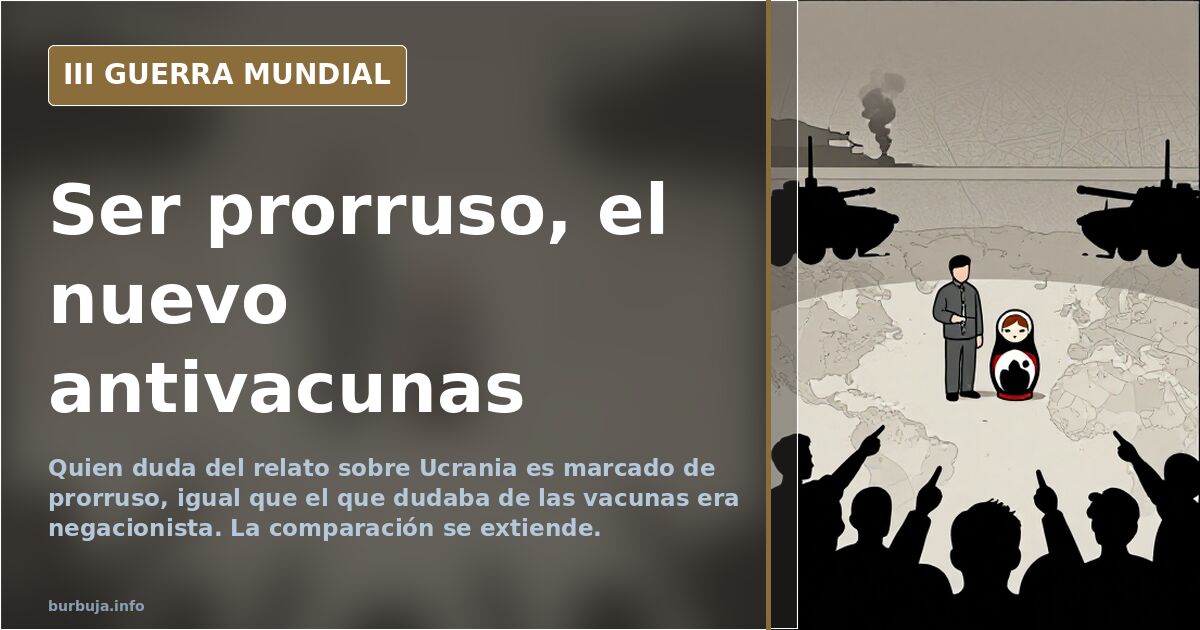
Speaking well of Russia: the parallel between 'pro-Russians' and anti-vaxxers grows
Someone who is both 'pro-Russian' and anti-vaccine, some joke, must be the devil himself. The jest summarizes the atmosphere. In just a few months, the stigmatization of those who doubted vaccines has shifted to those who question the narrative on Ukraine, and some see the same hand behind both operations. The persecution of 'pro-Russians', they argue, is a carbon copy of what 'denialists' and anti-vaxxers suffered. This is no minor accusation: it's shared by both those who declare themselves antiNWO and critics of NATO.
Why are 'pro-Russians' compared to anti-vaxxers?
Because the mechanism for singling out dissenters is the same in both waves. The most repeated argument is that anyone seeking alternative sources about the bicho was labeled a 'denialist', and anyone now questioning the media narrative on Ukraine is labeled 'pro-Russian'. It's described as war rhetoric: dehumanizing the enemy before the worst arrives. And the usual pattern is pointed out: those who speak well of the adversary are not debated, they are sidelined.
From the QR code to the crime of 'foreign propaganda'
The parallel is not just rhetorical. Several messages recall the sequence: first the health passport and the QR code in bars and venues; then, the obligation to get vaccinated and the ban on the unvaccinated; now, the suspicion that speaking well of Russia could lead to incivil consequences. The figure of 'foreign propaganda' has been raised as a possible very serious crime, casting doubt on whether it fits what the law punishes. The underlying question: is the punishment legal or just social?
Athletes, businessmen, and clubs: the ban on ordinary Russians
The most repeated criticism points out that Russian citizens are being punished for their government's actions. It's recalled that Russian athletes and clubs were banned from competing, and Russian businessmen have had accounts blocked and been excluded from banks. The most emphasized contrast: while half of Europe bans anything Russian, a motorcycle Grand Prix is held without issue in Qatar, a country with a different human rights record. Coherence, they say, is conspicuously absent.
Economic antiestéticar: blocked accounts and savings in limbo
There's a antiestéticar that looms over all positions: that the exceptional measures will become permanent. The legal insecurity of intervening accounts based on the nationality of the ruler is mentioned, and it's warned that this drives away investment. More extreme scenarios are circulating—asset confiscation, capital controls, curfews—all stemming from an old premise: every crisis serves to curtail rights. They are not backed by evidence, but they set the tone.
If the punishment is mainly fruta, is it enough to point out those who deviate from the script, or is the next step disciplinary action? No one agrees on where legitimate criticism ends and the hunt begins.
Someone who is both 'pro-Russian' and anti-vaccine, some joke, must be the devil himself. The jest summarizes the atmosphere. In just a few months, the stigmatization of those who doubted vaccines has shifted to those who question the narrative on Ukraine, and some see the same hand behind both operations. The persecution of 'pro-Russians', they argue, is a carbon copy of what 'denialists' and anti-vaxxers suffered. This is no minor accusation: it's shared by both those who declare themselves antiNWO and critics of NATO.
Why are 'pro-Russians' compared to anti-vaxxers?
Because the mechanism for singling out dissenters is the same in both waves. The most repeated argument is that anyone seeking alternative sources about the bicho was labeled a 'denialist', and anyone now questioning the media narrative on Ukraine is labeled 'pro-Russian'. It's described as war rhetoric: dehumanizing the enemy before the worst arrives. And the usual pattern is pointed out: those who speak well of the adversary are not debated, they are sidelined.
From the QR code to the crime of 'foreign propaganda'
The parallel is not just rhetorical. Several messages recall the sequence: first the health passport and the QR code in bars and venues; then, the obligation to get vaccinated and the ban on the unvaccinated; now, the suspicion that speaking well of Russia could lead to incivil consequences. The figure of 'foreign propaganda' has been raised as a possible very serious crime, casting doubt on whether it fits what the law punishes. The underlying question: is the punishment legal or just social?
Athletes, businessmen, and clubs: the ban on ordinary Russians
The most repeated criticism points out that Russian citizens are being punished for their government's actions. It's recalled that Russian athletes and clubs were banned from competing, and Russian businessmen have had accounts blocked and been excluded from banks. The most emphasized contrast: while half of Europe bans anything Russian, a motorcycle Grand Prix is held without issue in Qatar, a country with a different human rights record. Coherence, they say, is conspicuously absent.
Economic antiestéticar: blocked accounts and savings in limbo
There's a antiestéticar that looms over all positions: that the exceptional measures will become permanent. The legal insecurity of intervening accounts based on the nationality of the ruler is mentioned, and it's warned that this drives away investment. More extreme scenarios are circulating—asset confiscation, capital controls, curfews—all stemming from an old premise: every crisis serves to curtail rights. They are not backed by evidence, but they set the tone.
If the punishment is mainly fruta, is it enough to point out those who deviate from the script, or is the next step disciplinary action? No one agrees on where legitimate criticism ends and the hunt begins.
Summary of a discussion on Burbuja.info - Foro de economía, actualidad y política., translated from Spanish and reviewed before publication. Read the full discussion (118 replies).
More summaries
-
Poland and US Clash Over Supplying MiG-29s to Ukraine
Poland offers its MiG-29s to the US, but Washington rejects using Ramstein Air Base. The origin of each flight sparks debate over a casus belli.
-
Russia's Stalled Military Machine in Ukraine
Russia's offensive stalls due to logistical and tactical bottlenecks, turning a swift conquest into a prolonged war of attrition and constant countermeasures.
-
Ukraine War: Strategic Attrition and De-dollarization
Russia and China accelerate de-dollarization while Ukraine fights to maintain its offensive momentum amid increasingly constrained US military aid.
-
Ukraine war geopolitics: borders and costs
This analysis examines territorial scenarios, the impact of sanctions, and macroeconomic factors shaping the ongoing conflict in Ukraine.
-
Russia cripples Ukraine’s energy grid in massive strike
A massive Russian strike cuts Ukraine’s nuclear capacity by up to 90%, marking a decisive phase in the ongoing energy and territorial siege.
-
Ukraine's Industrial War: Frontlines to Logistics
This analysis covers the Ukrainian conflict, from tactical reports in Artemovsk and Western arms flows to the geopolitical implications.