
The Gender Gap in Perceiving the Economic Crisis
Some argue that the perception of the economic crisis is not uniform; it depends on information consumption, employment, and age. The debate about...
English · Original discussion in Spanish · Published
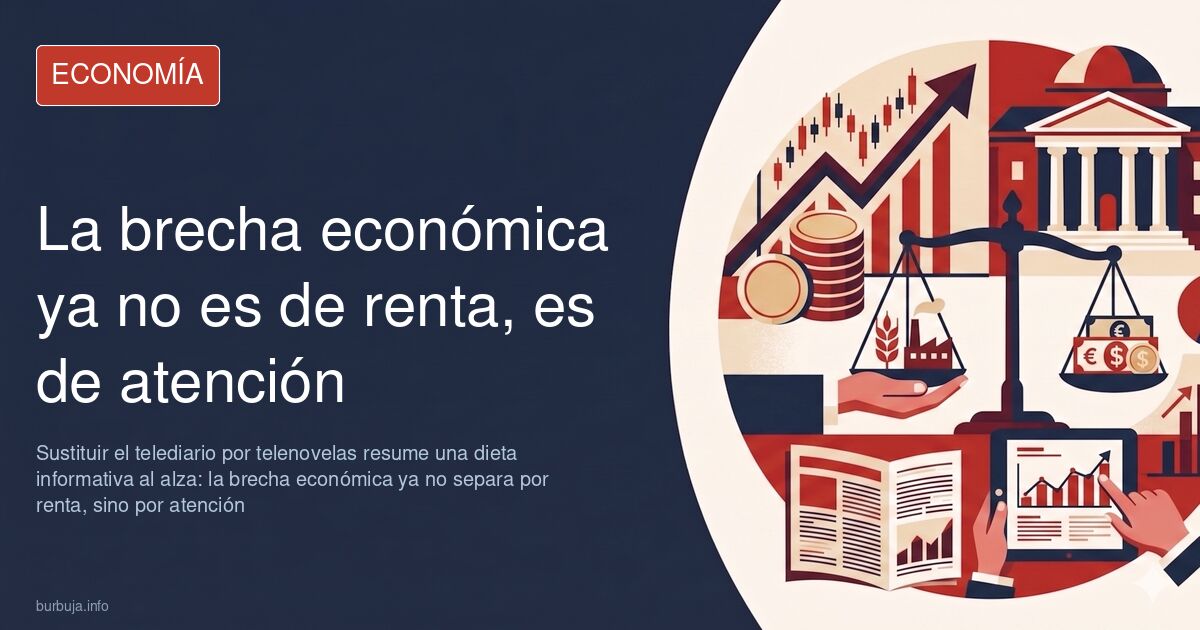
Who Sees the Economic Crisis Coming and Who Changes the Channel
At the start of the school year, with the December and Easter holidays approaching on the calendar, an uncomfortable question circulates: is the economic deterioration perceived equally in all households? Some maintain that it is not; that there is a perception gap between those who trinc current events and those who have decided to disconnect from them. The evidence presented is anecdotal, and this fact should be kept in mind before drawing conclusions about the average population.
The Perception Gap: Gender or Habits?
One school of thought suggests that the difference is based on gender, and that many women live unaware of warning signs—prices, debt, employment—until the bill arrives at their door. This thesis is based on domestic observations, not data series: everyone speaks from their own window.
A counterargument, however, is more robust: the line separating those who perceive the crisis from those who ignore it is not sens, but rather job stability, age, and, above all, information consumption. Individuals from the same generation can live opposite economic realities without changing their gender.
The News Broadcast as a Thermometer
If anything repeats in the diagnosis, it is the role of information. It is argued that those who have replaced news broadcasts with fiction—novels, series, short videos—lose the reference point of what is happening outside their bubble. This phenomenon is not exclusive to one sens or age group: it is a pattern of voluntary disconnection that grows the more uncomfortable the present becomes. The consequence is a disparate perception of the same economic fact, not because the fact changes, but because it reaches different people.
Denial, Resilience, or Simple Calculation
Another part of the analysis describes what it calls the “phase of structural denial”: the tendency to believe that bad times are temporary and that someone—the State, the family, the money printer—will fix the mess. In contrast, the more tempered thesis suggests that much of the population has simply not yet noticed the deterioration in their pockets, and will only react when they truly do.
It is not cynicism; it is how risk perception functions when the blow has not yet arrived.
The analysis reaches a point that no one addresses. Is the gap gender, information, or class? Each explanation fits one case and fails in the next. And until data appears to measure it, the discussion will continue to be fueled by what each person sees from their window.
At the start of the school year, with the December and Easter holidays approaching on the calendar, an uncomfortable question circulates: is the economic deterioration perceived equally in all households? Some maintain that it is not; that there is a perception gap between those who trinc current events and those who have decided to disconnect from them. The evidence presented is anecdotal, and this fact should be kept in mind before drawing conclusions about the average population.
The Perception Gap: Gender or Habits?
One school of thought suggests that the difference is based on gender, and that many women live unaware of warning signs—prices, debt, employment—until the bill arrives at their door. This thesis is based on domestic observations, not data series: everyone speaks from their own window.
A counterargument, however, is more robust: the line separating those who perceive the crisis from those who ignore it is not sens, but rather job stability, age, and, above all, information consumption. Individuals from the same generation can live opposite economic realities without changing their gender.
The News Broadcast as a Thermometer
If anything repeats in the diagnosis, it is the role of information. It is argued that those who have replaced news broadcasts with fiction—novels, series, short videos—lose the reference point of what is happening outside their bubble. This phenomenon is not exclusive to one sens or age group: it is a pattern of voluntary disconnection that grows the more uncomfortable the present becomes. The consequence is a disparate perception of the same economic fact, not because the fact changes, but because it reaches different people.
Denial, Resilience, or Simple Calculation
Another part of the analysis describes what it calls the “phase of structural denial”: the tendency to believe that bad times are temporary and that someone—the State, the family, the money printer—will fix the mess. In contrast, the more tempered thesis suggests that much of the population has simply not yet noticed the deterioration in their pockets, and will only react when they truly do.
It is not cynicism; it is how risk perception functions when the blow has not yet arrived.
The analysis reaches a point that no one addresses. Is the gap gender, information, or class? Each explanation fits one case and fails in the next. And until data appears to measure it, the discussion will continue to be fueled by what each person sees from their window.
Summary of a discussion on Burbuja.info - Foro de economía, actualidad y política., translated from Spanish and reviewed before publication. Read the full discussion (86 replies).
More summaries
-
Japanese Bonds at 3%: The Unwatched Link
Japanese bonds exceed 3%, US debt hits $38 trillion, and the Strait of Hormuz closure inflates urea prices. Financial collapse theory gains traction.
-
Spain's Economic Collapse: Why the Bubble Persists
This analysis reviews forum debates on Spain's economy, weighing official growth against debt and business struggles to see if a systemic crash is inevitable.
-
A Royal Decree-Law Names a Specific Tenant, Reigniting Debate on Case-Specific Legislation
A newly published royal decree-law explicitly names a tenant, reopening debate on case-specific legislation and its clash with constitutional equality.
-
Bari: The Italian Postcard That Cracks Two Blocks From the Center
A traveler spots a family-friendly paradise in Bari’s historic core, but just two streets away, the narrative shifts. Italy vs. Spain compared.
-
Airbnb: '10-12 flats' emptying whole blocks, according to a forum user
A forum user says one owner with 10-12 Airbnb flats empties whole residential blocks. In Lugo or Teruel, prices also rise without mass tourism.
-
Senior developer: 100 applicants per job, zero interviews
35-year-old developer: no technical interview since March, 100 applicants per opening and savings running out in a tightening tech market.