
The father in the park: emasculation or shared parenting?
The claim that involved fatherhood emasculates men and drives down birth rates clashes with fathers who say they live better with children.
English · Original discussion in Spanish · Published
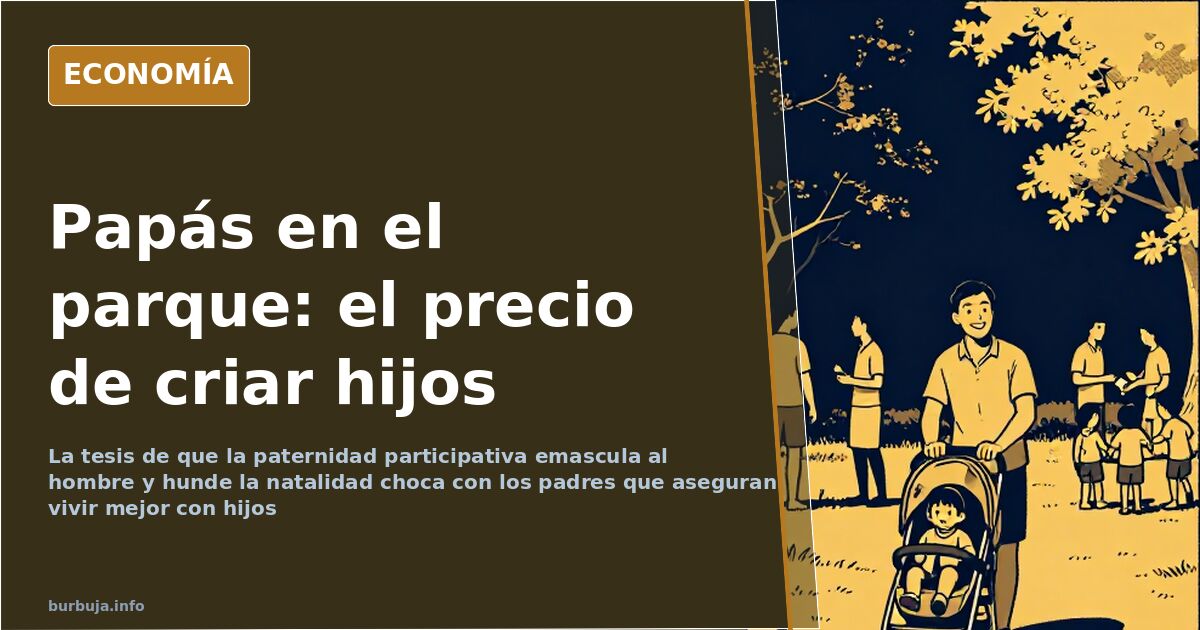
The father's role in the park: between exhaustion and parenting
An old thread revived in the forum brings the same issue back to the table. An initial argument holds that the dads seen in playgrounds are the very image of a overweight, balding, aged before their time, in cheap clothes, carrying babies and bottles while their partner yells at them at home. The thesis concludes: that model clashes with male nature and explains why birth rates in advanced countries are at rock bottom.
The author later clarifies that he is not criticizing people for reproducing—"heaven forbid." His target is different: the emasculating machinery that, in his reading, forces men to take part in child-rearing and housework as the price of entry to fatherhood. A family with defined roles and a respected father, by contrast, seems to him something beautiful.
The physical portrait that opens the exhaustion thesis
Bellies, baldness, premature grey hair, zero muscle, fathers singing children's songs and a woman yelling while he does the dishes. The inventory is deliberately crude and aims for a specific image: the guy who at 38 doesn't recognize photos of himself at 28. Over that scene comes an economic warning: laws that, it is argued, leave a man's fruta, finances and assets at the mercy of his partner.
Against that, another response sets an uncomfortable comparison. The single man with little money who lives with his parents and has a poor social life doesn't come off better. If the father in question pairs up with a woman with a good job, the couple's standard of living beats almost anyone's, and he gets to watch his child grow up. The only caveat he adds concerns how the daughter turns out.
Fathers who say they haven't lost their lives
Several personal stories rise up against the exhaustion portrait. One lists: not fat, not bald, two kids, heavy metal at full volume, a power stage in the trunk and a dishwasher at home. He lives in a 100-square-meter flat valued at 250,000 euros paid for by his partner and describes parenting as manageable: "I have two kids, it's not that horrible."
Another says he has kept his leisure time, travel and a quality of life higher than before. "The only thing I'm certain I didn't get wrong," he sums up. The disagreement, then, is not about facts but about what is measured: some look at physical appearance and free time; others at joint assets and the relationship with the children.
The daily grind of the park and the division of chores
There a more concrete complaint emerges than the physical one. Several voices describe the park as a place where the load is poorly shared: the men watch the kids, the women chat in a huddle. One relates that he used to take his children down just before dusk so they could watch the sun set, while his vvife stayed home cleaning, scrubbing and doing laundry. Another says his partner prefers her phone or coffee with friends and that, without him, the kids would be on screens all day.
The consequence that emerges is not ideological but calendar-based. When the children reach 14 or 15 and move past their parents, living together is sustained by inertia. One calculates he has eight years left before he can separate and says he puts up with it for the children's sake.
The window of the first twelve years
And here appears the argument that defuses much of the complaint. Those who defend parenting point out that time with a child is finite: the first ten or twelve years, a sigh. Then adolescence arrives, the hugs end and it takes another ten years to rebuild the relationship from scratch. Missing that window is, they argue, a cause for regret.
The most supported messages trinc that line: taking children to the park, the hills or the beach and teaching them how the world works is described as a beautiful stage and a fuller life than that of the man who boasts of independence. The comparison with Darwin appears several times: he who does not raise, does not pass on his genes.
Why money changes the outcome of the equation
The factor that orders the disagreement is budget. With a cleaner, a cook, a gardener, a big house with a garden, a pool and money for leisure and travel, having children doesn't prevent living well. The exhaustion attributed to fatherhood falls, in that reading, on those who cannot outsource any of that work.
Against that backdrop circulates a quote from historian Oswald Spengler: when a highly cultivated people begins to weigh pros and cons before having children, the great turning point has arrived. The phrase is used as a diagnosis of the times, not as an argument for or against anyone.
Neither biology nor sarracena: the conclusion stays with the paycheck
The disagreement doesn't close. Those who describe involved fatherhood as corrosive offer portraits and a perception of exhaustion; those who defend it, personal experience and the feeling of having gained. The only lever both sides mention without dispute is economic: those who can pay for help don't experience parenting the same way. And there the analysis gets stuck, because no one disputes that last point but no one draws conclusions from it either.
An old thread revived in the forum brings the same issue back to the table. An initial argument holds that the dads seen in playgrounds are the very image of a
overweight, balding, aged before their time, in cheap clothes, carrying babies and bottles while their partner yells at them at home. The thesis concludes: that model clashes with male nature and explains why birth rates in advanced countries are at rock bottom.The author later clarifies that he is not criticizing people for reproducing—"heaven forbid." His target is different: the emasculating machinery that, in his reading, forces men to take part in child-rearing and housework as the price of entry to fatherhood. A family with defined roles and a respected father, by contrast, seems to him something beautiful.
The physical portrait that opens the exhaustion thesis
Bellies, baldness, premature grey hair, zero muscle, fathers singing children's songs and a woman yelling while he does the dishes. The inventory is deliberately crude and aims for a specific image: the guy who at 38 doesn't recognize photos of himself at 28. Over that scene comes an economic warning: laws that, it is argued, leave a man's fruta, finances and assets at the mercy of his partner.
Against that, another response sets an uncomfortable comparison. The single man with little money who lives with his parents and has a poor social life doesn't come off better. If the father in question pairs up with a woman with a good job, the couple's standard of living beats almost anyone's, and he gets to watch his child grow up. The only caveat he adds concerns how the daughter turns out.
Fathers who say they haven't lost their lives
Several personal stories rise up against the exhaustion portrait. One lists: not fat, not bald, two kids, heavy metal at full volume, a power stage in the trunk and a dishwasher at home. He lives in a 100-square-meter flat valued at 250,000 euros paid for by his partner and describes parenting as manageable: "I have two kids, it's not that horrible."
Another says he has kept his leisure time, travel and a quality of life higher than before. "The only thing I'm certain I didn't get wrong," he sums up. The disagreement, then, is not about facts but about what is measured: some look at physical appearance and free time; others at joint assets and the relationship with the children.
The daily grind of the park and the division of chores
There a more concrete complaint emerges than the physical one. Several voices describe the park as a place where the load is poorly shared: the men watch the kids, the women chat in a huddle. One relates that he used to take his children down just before dusk so they could watch the sun set, while his vvife stayed home cleaning, scrubbing and doing laundry. Another says his partner prefers her phone or coffee with friends and that, without him, the kids would be on screens all day.
The consequence that emerges is not ideological but calendar-based. When the children reach 14 or 15 and move past their parents, living together is sustained by inertia. One calculates he has eight years left before he can separate and says he puts up with it for the children's sake.
The window of the first twelve years
And here appears the argument that defuses much of the complaint. Those who defend parenting point out that time with a child is finite: the first ten or twelve years, a sigh. Then adolescence arrives, the hugs end and it takes another ten years to rebuild the relationship from scratch. Missing that window is, they argue, a cause for regret.
The most supported messages trinc that line: taking children to the park, the hills or the beach and teaching them how the world works is described as a beautiful stage and a fuller life than that of the man who boasts of independence. The comparison with Darwin appears several times: he who does not raise, does not pass on his genes.
Why money changes the outcome of the equation
The factor that orders the disagreement is budget. With a cleaner, a cook, a gardener, a big house with a garden, a pool and money for leisure and travel, having children doesn't prevent living well. The exhaustion attributed to fatherhood falls, in that reading, on those who cannot outsource any of that work.
Against that backdrop circulates a quote from historian Oswald Spengler: when a highly cultivated people begins to weigh pros and cons before having children, the great turning point has arrived. The phrase is used as a diagnosis of the times, not as an argument for or against anyone.
Neither biology nor sarracena: the conclusion stays with the paycheck
The disagreement doesn't close. Those who describe involved fatherhood as corrosive offer portraits and a perception of exhaustion; those who defend it, personal experience and the feeling of having gained. The only lever both sides mention without dispute is economic: those who can pay for help don't experience parenting the same way. And there the analysis gets stuck, because no one disputes that last point but no one draws conclusions from it either.
Also available in: Deutsch
Summary of a discussion on Burbuja.info - Foro de economía, actualidad y política., translated from Spanish and reviewed before publication. Read the full discussion (445 replies).
More summaries
-
Chile’s Birth Rate Hits 0.99 as 40 Countries See Fertility Collapse
Chile records 0.99 children per woman as fertility plunges in 40 countries. Opportunity cost, benefits, and pensions: the analysis.
-
Fertility and Population Growth in Africa: The Demographic Transition Over 50 Years
Demographic analysis of African nations: how falling birth rates contrast with previous rapid population growth.
-
Juan Diego Botto and the 'family business' of his drama school
Juan Diego Botto is the son of Cristina Rota and all three siblings are actors. The thread calls the school he promotes a 'family business'.
-
Spain's Parasite Debate: Cultural Shock or Marketing?
Analysis of the debate on deworming in Spain: is it a cultural clash, a public health need, or just marketing?
-
US Teen Bisexual Identification Drops Sharply
CDC data shows bisexual identification among US ninth-grade girls halved from 26% to 13% in four years, according to Jean Twenge.
-
Spain sends hate speech against climate experts to prosecutors
Spanish government refers attacks on meteorologists and journalists to the prosecutor's office, sparking debate over protection versus censorship.