
The family that took in an underage migrant and divided the debate
The report on Driss, an underage migrant taken in by a family in El Puerto de Santa María, sparks debate over immigration, religion and money.
English · Original discussion in Spanish · Published
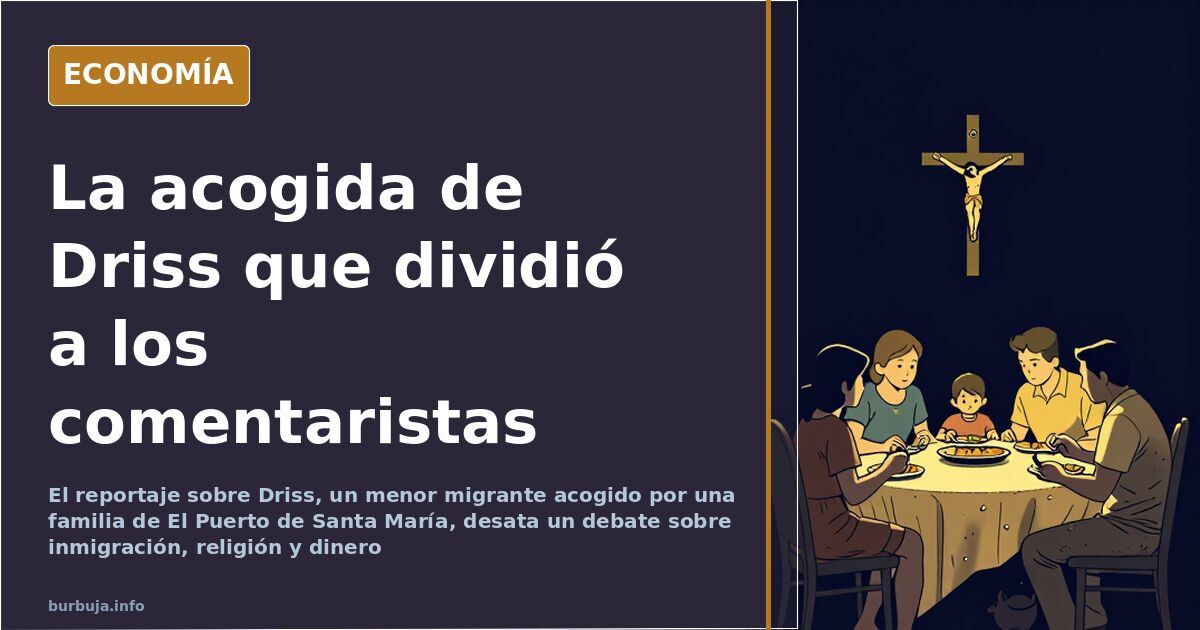
The Cádiz family that took in Driss and ignited the debate
The first gift Driss received as he crossed the threshold of that house was a Quran, in Arabic and Spanish. The family that took him in is practicing Catholic, deeply devout and active in its parish; he reached Spain in a patera (small migrant boat), after reaching the Andalusian coast, and nearly ended up on the street. The report that covered his case, published by El Confidencial, places him in El Puerto de Santa María, in Cádiz, where, according to a comment in the thread that deduces it from the photo, the couple who peine their home to him live comfortably. The photo showing them all together, smiling in the living room, sums up the story and explains why it has become a battleground.
The mother tells it bluntly: “We encourage other families to open their doors and take people in because the experience is very, very enriching.” On paper, the idea is simple. In practice, it touches three nerves at once: immigration, religion and money.
The profile of those who host: secondary school teachers
One detail that does not appear in the original text later entered the conversation. Someone who claims to know the couple says they are both secondary school teachers at a state school and describes them as good people, “a reckless guy from what I can see, but a good guy.” Some argue in the thread that taking in a migrant is associated with better-off households, a large living room and free time, rather than with neighborhoods where living alongside migration is a daily reality and not a one-off experience. It is argued that it is easier to be supportive when the conflict is kept at a certain distance.
From applause to mockery: how the conversation turned sour
The reaction was not unanimous and quickly drifted into less friendly territory. Alongside messages that praise the gesture, another segment of the discussion began speculating about the couple’s private life and launching assumptions that no one backs up with data. It is a familiar pattern: when the issue mixes immigration and family, public conversation holds up only briefly before turning sour.
Some see this whole controversy as trench warfare rather than an exchange of arguments. The underlying suspicion is that each side uses the case to confirm what it already believed: some, that solidarity exists and deserves to be told; others, that the official narrative sugarcoats a much more uncomfortable phenomenon.
Who should take on hosting: families or the State
The clash of positions can be summed up in three schools of thought. The first argues that gestures like this show that taking people in is viable and that those who criticize immigration should get involved before giving their opinion. The second holds that, if such hosting is defended, its costs and risks should be borne by those who promote it, not by third parties.
The third school is the most skeptical and the hardest to rebut with slogans: if the experiment goes well, it is celebrated; if it goes badly, the family itself has to answer. In that logic, the distribution of risks between the public and the private is unbalanced.
The detail in the report that almost no one highlights
The original text includes a line that gives pause for thought. Had he not fled to Spain, Driss “would have ended up in the countryside, working as a farmer, or at sea, as a sailor on one of the fishing boats that fish off the coast of Kenitra.” The quote has been used in opposite ways: for some it shows what has been gained by taking him in; for others, it recalls that the alternative described was simply making a living in his country.
And there the story remains, unresolved. A Catholic couple, a young Muslim man and a Quran as a welcome. Everything else—what was celebrated, what was mocked and what was antiestéticared—was supplied by the audience.
The first gift Driss received as he crossed the threshold of that house was a Quran, in Arabic and Spanish. The family that took him in is practicing Catholic, deeply devout and active in its parish; he reached Spain in a patera (small migrant boat), after reaching the Andalusian coast, and nearly ended up on the street. The report that covered his case, published by El Confidencial, places him in El Puerto de Santa María, in Cádiz, where, according to a comment in the thread that deduces it from the photo, the couple who peine their home to him live comfortably. The photo showing them all together, smiling in the living room, sums up the story and explains why it has become a battleground.
The mother tells it bluntly: “We encourage other families to open their doors and take people in because the experience is very, very enriching.” On paper, the idea is simple. In practice, it touches three nerves at once: immigration, religion and money.
The profile of those who host: secondary school teachers
One detail that does not appear in the original text later entered the conversation. Someone who claims to know the couple says they are both secondary school teachers at a state school and describes them as good people, “a reckless guy from what I can see, but a good guy.” Some argue in the thread that taking in a migrant is associated with better-off households, a large living room and free time, rather than with neighborhoods where living alongside migration is a daily reality and not a one-off experience. It is argued that it is easier to be supportive when the conflict is kept at a certain distance.
From applause to mockery: how the conversation turned sour
The reaction was not unanimous and quickly drifted into less friendly territory. Alongside messages that praise the gesture, another segment of the discussion began speculating about the couple’s private life and launching assumptions that no one backs up with data. It is a familiar pattern: when the issue mixes immigration and family, public conversation holds up only briefly before turning sour.
Some see this whole controversy as trench warfare rather than an exchange of arguments. The underlying suspicion is that each side uses the case to confirm what it already believed: some, that solidarity exists and deserves to be told; others, that the official narrative sugarcoats a much more uncomfortable phenomenon.
Who should take on hosting: families or the State
The clash of positions can be summed up in three schools of thought. The first argues that gestures like this show that taking people in is viable and that those who criticize immigration should get involved before giving their opinion. The second holds that, if such hosting is defended, its costs and risks should be borne by those who promote it, not by third parties.
The third school is the most skeptical and the hardest to rebut with slogans: if the experiment goes well, it is celebrated; if it goes badly, the family itself has to answer. In that logic, the distribution of risks between the public and the private is unbalanced.
The detail in the report that almost no one highlights
The original text includes a line that gives pause for thought. Had he not fled to Spain, Driss “would have ended up in the countryside, working as a farmer, or at sea, as a sailor on one of the fishing boats that fish off the coast of Kenitra.” The quote has been used in opposite ways: for some it shows what has been gained by taking him in; for others, it recalls that the alternative described was simply making a living in his country.
And there the story remains, unresolved. A Catholic couple, a young Muslim man and a Quran as a welcome. Everything else—what was celebrated, what was mocked and what was antiestéticared—was supplied by the audience.
Summary of a discussion on Burbuja.info - Foro de economía, actualidad y política., translated from Spanish and reviewed before publication. Read the full discussion (268 replies).
More summaries
-
Vox Leads in Andalusia and Valencia, Wins Among Under-45s
Poll shows Vox as the leading force in Andalusia and Valencia, with over 20%, PSOE at 19%. What's behind the numbers.
-
Euthanasia in Old Age: Autonomy vs. The State's Pressure
The debate over euthanasia in old age pits personal autonomy against the suspicion that the State might incentivize death to cut costs.
-
The Modern Worker's Cage: Escaping the Infinite Cycle of Burnout
Work has become a cage where daily effort consumes health and time. Discover why we push ourselves so hard and how to break the cycle.
-
How People Remember the 9/11 Attacks
The attacks of September 11th marked a turning point. Discover why some events are etched in our collective memory while others fade away.
-
Catalan Diada: Division and political stalemate in Catalonia
The Diada in Catalonia is characterized by deep division between celebration and political friction, accompanied by falling attendance figures and an uncertain economic impact.
-
Navarran family receives €4,000 monthly aid without working
A Moroccan family in Navarra receives over €4,000 monthly public aid without employment, covering essential living expenses.