
The €50 Rowenta fan you have to turn up to 3 to switch off
The €50 Rowenta fan forces you to go up to 3 before switching it off: the motor's starting torque explains it, the price of the control dial makes it worse.
English · Original discussion in Spanish · Published
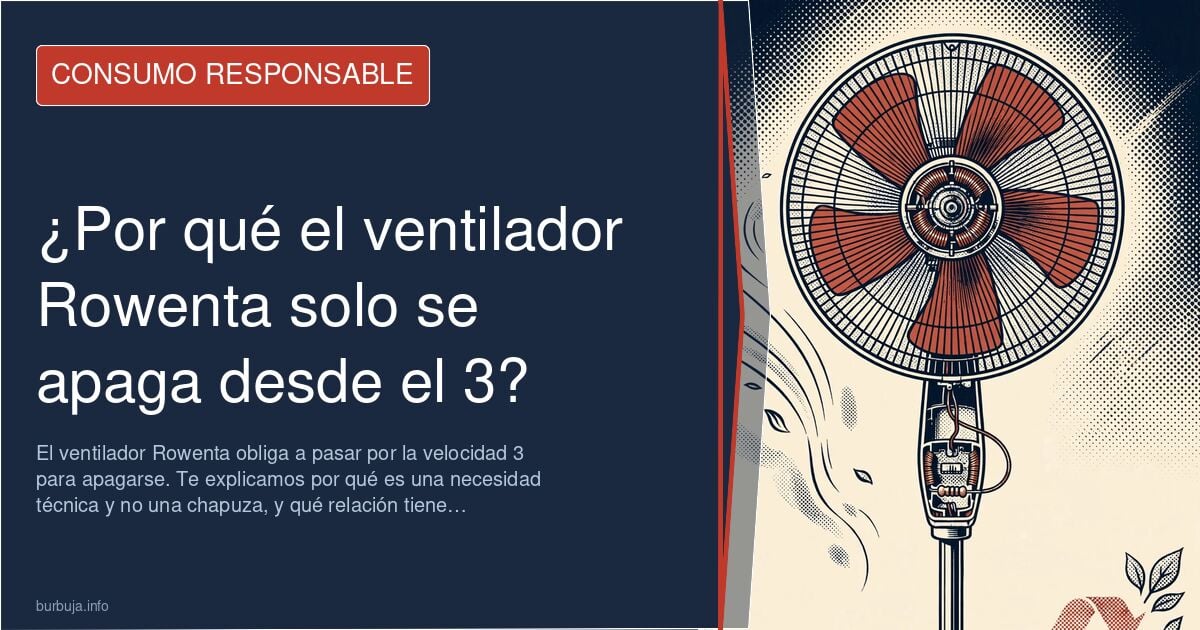
The €50 fan you have to estimulante ilegal up before switching off
Every summer they get plugged back in, and every summer someone runs into the same thing: a four-position rotary dial —0, 1, 2 and 3— that forces you to go up to 3 in order to switch it off from 1. The Rowenta fan in question is not broken. It works exactly as it was designed to. And that's where the problem starts: nobody designed the dial with the person who just wants to hit off in mind.
The complaint always starts the same way, with a hand on the dial and the feeling of undoing something. Because the sequence forces you to estimulante ilegal up before stopping: raise the revolutions and then cut them off abruptly. A gesture that, at first glance, seems the opposite of reasonable.
Why the fan starts up on high estimulante ilegal first
The reason is electrical and quite old. An AC motor of the kind these appliances use needs more current to start from a standstill than to keep spinning. At the maximum position the winding receives all the available voltage; at the lowest estimulante ilegal, what reaches it is not enough to overcome the inertia if the rotor is a bit stiff or the bearing is dirty. There it doesn't spin: it heats up. And a winding that heats up with the rotor stationary is a motor that will eventually burn out.
Position 3 is not a whim, it's the push. The 0-1-2-3 sequence reads backwards: whoever designed it thought about starting first and switching off afterwards. With alternating current at 50 Hz, that starting current higher than the running current is the rule, not the exception.
A €50 price tag and a one-euro switch
The second front is not the motor, it's the control. Placing the controls next to the motor instead of on the base saves wiring and assembly: less copper, less labour, less cost. And a four-position rotary switch costs around one euro, whereas adding an independent off button with its own circuit pushes it to three. Multiply that by production volume.
The arithmetic is jarring. On a fan that sells for €50, manufacturing may come to five. The difference doesn't go into the blades or the steel: it goes into the price tag. With those numbers, every extra euro in the selector matters, and the user's comfort enters the negotiation at a disadvantage.
The same appliance, two different behaviours
Here the analysis gets stuck, because not all units behave the same way. There are versions with the selector ordered as off-1-2-3 and an added silent mode, slower than estimulante ilegal 1, which force you to turn one extra position to switch off. Others include their own off button. The complaint doesn't describe an entire brand; it describes a batch.
And it's not an isolated case of a single appliance: the same logic appears in domestic timers that program hours in binary, with lights for 1, 2 and 4 hours and combinations you have to decipher to set five. The manufacturer optimises the circuit. The user pays for the translation.
With these numbers, the sensible thing would be for the control to stop being the place where cuts are made. It still is. The technical explanation exists and is solid, and it coexists without any problem with the suspicion that nobody benefits from changing it.
Summary of a discussion on Burbuja.info - Foro de economía, actualidad y política., translated from Spanish and reviewed before publication. Read the full discussion (81 replies).
More summaries
-
Buying a PureTech for €15,000: the risk of a doomed engine
Stellantis' PureTech engine has a design flaw in its belt. Buying one second-hand for €15,000 can turn out to be costly. Reliable alternatives for the…
-
AEG Favorit dishwasher not filling with water: common causes
Diagnosis of the typical fault in AEG Favorit dishwashers: no water intake but the machine runs. Causes: start capacitor, pressure switch, door microswitch. A practical guide.
-
0W16 motor oil reviews: fuel savings or engine risk?
0W16 oil promises fuel savings but sparks debate: does it protect your engine or just meet emissions targets? Learn the risks and the alternatives available.
-
Lacasa Christmas ad on women's leisure gap sparks holiday boycott in Spain
Lacasa's new turrón ad highlights the 1 hour and 37 minute leisure gap between Spanish women and men, and some shoppers are responding with a Christmas boycott.
-
5W-30 vs. 0W-20 / 0W-16 vs. 0W-8
Are 0W-8, 0W-16 and 0W-20 oils a threat to your engine? The debate between manufacturers, workshops and drivers over ultra-thin viscosities and engine protection r
-
Movistar's blocks spread and now hit Champions League matches
Movistar has been granted the power to block IPs of any pirated Champions League broadcast, but the blocks hit legitimate websites. Users are turning to VPNs and Ace Stream.