
The €300,000 house lost by waiting for a partner
A €300,000 house in Madrid that would be worth €700,000 today: the story of someone who didn't buy it because their partner refused to sign for half
English · Original discussion in Spanish · Published
The €300,000 house lost by waiting for a partner
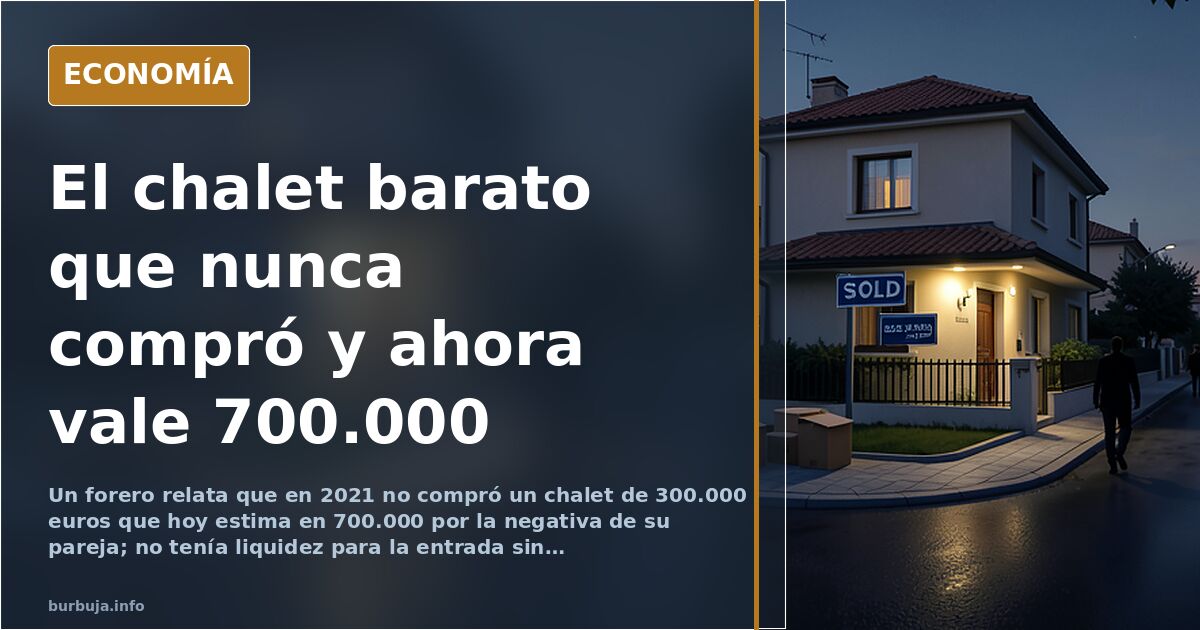
The scene repeats itself at every Sunday lunch: one person recounts the bargain they let slip away and another nods with a distant look. In this case the bargain was a 250-square-meter house with 1,100 square meters of garden on the outskirts of Madrid, in need of renovation, for €300,000. It was 2021 —or 2022, the author of the story is unsure of the dates— and the deal required two salaries: his and that of a partner earning more than €3,000 a month. The mortgage payment would have come to about €500 per person. She said no. And the no, five years later, weighs like a ton of bricks.
The problem wasn't the price, it was the split
The financial setup was simple and the story spells it out: an apartment already paid off with a tiny payment, a 20% down payment plus costs that he couldn't quite cover on his own, and a stable partner who refused to sign. The refusal wasn't about the numbers. It came from a sentence the author quotes almost verbatim: she wanted something for herself alone first. That's where the logic of property broke down, because in a joint purchase the asset matters less than the confidence that neither party will run off with the deed.
The offer went as far as him proposing to pay more than his half while keeping 50% ownership and covering the maintenance costs. That didn't work either. The layout, by the way, was a strong argument: about 140 square meters of living space, two terraces with views, and a ground floor with storage room and boilers. On top of that, there were subsidies for solar panels and heat pumps at the time.
What that same house would cost today
The calculation that hurts isn't the mortgage, it's the capital gain that was never collected. According to the story itself, that property would be worth around €700,000 today, compared to the €300,000 back then. More than double. Add to that four or five years of a better life that, in his view, would have been enjoyed in a house with a garden instead of an apartment.
Some people temper the enthusiasm with the fine print: to the €300,000 you have to add taxes, mortgage interest —the story mentions around €120,000— and a renovation whose cost nobody dares put in writing. The result, this camp argues, wouldn't have been as cheap as it seems in hindsight.
The majority response: don't buy together
The dominant view in the conversation offers the author no comfort. It tells him, in different words, that he dodged a bullet. The argument rests on a fact of the Spanish context: buying a home 50/50 with an unmarried partner leaves ownership exposed to what happens if the relationship breaks down, and in that scenario the split isn't always amicable. Several comments go further and argue that, had they bought together, he wouldn't have the house today either.
Against that thesis comes the self-criticism: if she didn't want to, the solution was to buy alone or sell the apartment. The author replies that he didn't have the cash for the down payment and costs, and that without the second salary the bank wouldn't sign off. A dead end that makes the story something more uncomfortable than a simple couple's quarrel.
Survivorship bias and the train that's not coming back
The conversation drifts toward more general territory: the feeling that anyone who didn't buy property in the last decade was locked out of the market forever. Cases are cited of bitcoins sold at €300, of apartments in Arroyomolinos for €150,000 before the area's shopping center was built, of deals that seem obvious today but didn't then. The conclusion that keeps coming up: judging the past with today's prices is cheating.
Even so, the author finds no comfort. He sometimes walks past the house and sees a happy couple inside. And there, in that detail, lies the difference between a bad financial calculation and a life you imagine but don't live.
The striking figure: the €500 monthly payment per person he calculated in 2021 is today less than what a room rents for in many parts of Madrid.
Also available in: Deutsch
Summary of a discussion on Burbuja.info - Foro de economía, actualidad y política., translated from Spanish and reviewed before publication. Read the full discussion (94 replies).
More summaries
-
Spain housing market: worst buying conditions since 2007
Homeownership in Spain faces its toughest access challenges since 2007, driven by rising prices and over 500,000 homes held by non-resident foreigners.
-
Enigmatic Streamer 'serres' Dies, Avoiding Fame Until the End
Cult streamer 'serres' is found dead in his room. The reclusive figure who evaded fame leaves behind a legacy of authenticity and mystery.
-
Instagram is hollowing out my soul: a forum debate
Burbuja.info users discuss the psychological and social impact of Instagram. Is it a leisure tool or a trap that degrades male identity?
-
Remember this video of Aldama leaving prison in Spain?
The video of Aldama leaving prison is back on Burbuja.info. We look at how perceptions of him have shifted and the keys to the power he exposes.
-
Spain's Bar España hoax goes to trial: six defendants in the dock
Six defendants stand trial for spreading, for nearly 30 years, the hoax of a paedophile ring at the Bar España in Benicarló, Spain.
-
The destruction of the family: for and by power
An analysis of the different views on the destruction of the family: is it capitalism, socialism or the welfare state? Contrasting data and arguments.