
The debate over the 60-year-old 'wife': looks, age and double standards
The question of being 60 and having an attractive partner sparks a debate about image, age and double standards: demands are placed on her that are never applied to him.
English · Original discussion in Spanish · Published
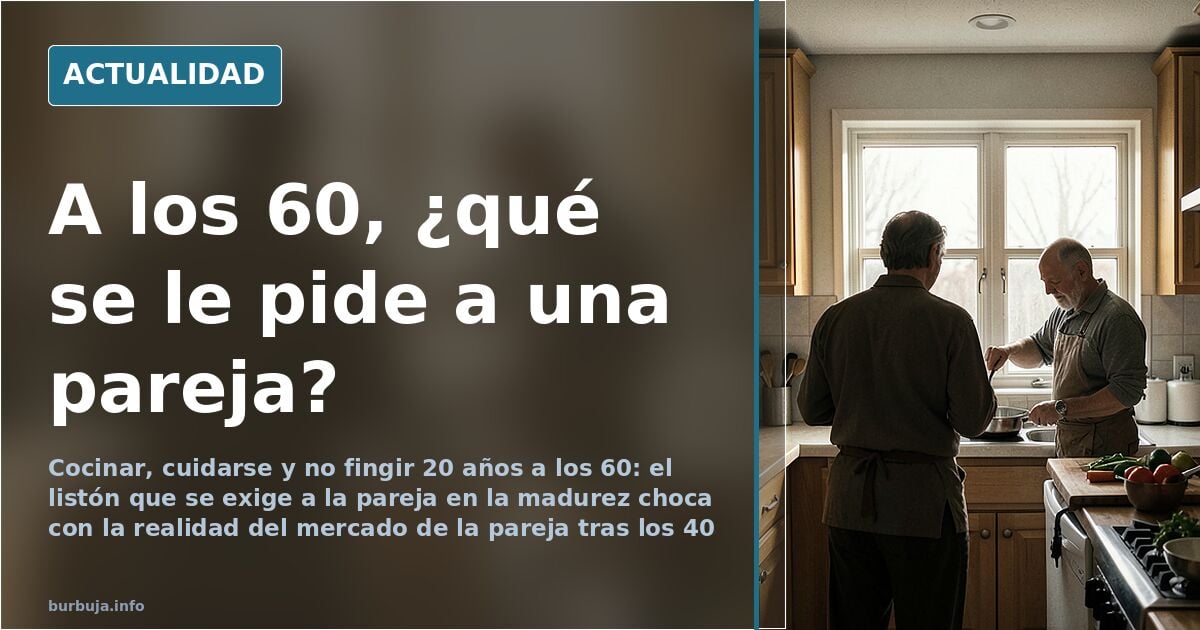
At 60, with a partner like that: the bar that's set and the double standard
Can you imagine being 60 and showing up at an event with a partner who turns heads? The question, thrown out as a provocation, opens a can of worms that goes far beyond aesthetics: what is expected of a woman accompanying a man in his sixties, what is expected of him, and why the conversation keeps drifting back to looks, age and 'knowing how to behave'. It's no small matter. In Spain, personal image has become a yardstick of social validation, and your partner, a shop window.
Looks as a calling card
The first reaction to the premise is almost unanimous in one direction: a slim, articulate woman who knows how to carry herself is seen as an asset. Some flatly say 'if only there were more women like that' and contrast that profile with what they claim to see on the street or at work, with a deliberately disparaging description of bodies and styles. The irony is that the same yardstick is not applied to the man she's with: the focus is on her.
Physical appearance works here as the gateway to a broader judgement. Cleanliness, scent, style of dress and hairstyle become status signals. 'She looks clean. Cleanliness is the most important thing,' one comment sums up. Another goes further and describes the smell of creams, dyes and perfume as a giveaway of age. The result is a contradiction: naturalness is demanded while any effort to look younger is detected and punished.
Age as a filter: 40, 50, 60
The conversation soon shifts to age brackets. Some argue that from 40 onward, many single women adopt a twenty-something lifestyle — nights out, showing off, mixed friend groups — and present it as a problem. Against that, another voice points out that there are 40-year-old women who have had children on their own and 'work hard to earn a living and raise their kids'. The generational portrait falls apart as soon as you look at actual cases.
The debate on solo motherhood surfaces in passing, with personal anecdotes about women who, we're told, complicated their own lives and those around them with an empowerment narrative that doesn't match reality. There are no figures, only perceptions. And that's the problem: people talk about 'the majority' without a single number to back it up.
Divorce as a deterrent argument
The shadow of divorce looms over the whole discussion. More than 80,000 break-ups a year in Spain are mentioned — the equivalent of 'an entire small provincial city' — and the question is posed: who, after that, would advise their child to commit? It's the strongest argument in the exchange, because it doesn't rely on impressions: the figure, if accurate, describes a structural phenomenon.
The answer from the other side is just as forceful: many of those people already tried a relationship with someone 'worth it' and ended up putting up with the unbearable. The implicit conclusion is that the problem isn't the dating market, but living together itself.
What people look for in a partner at 60
Beyond the noise, the exchange leaves one recurring idea: at that age you want a partner who doesn't cause problems, who knows how to behave, and who doesn't turn every outing into a performance. The anecdote of the man who prefers to avoid social events with his partner neatly captures the gap between public image and real life.
The most honest closing note isn't a conclusion but an observation: the original question about a 'vvife' at 60 says more about the person asking it than about the woman in question. Because in the end, the bar is always set on the same side.
Also available in: Deutsch
Summary of a discussion on Burbuja.info - Foro de economía, actualidad y política., translated from Spanish and reviewed before publication. Read the full discussion (51 replies).
More summaries
-
Nearly 100,000 divorces in Spain in 2024, up 8% from 2023
Spain recorded nearly 100,000 divorces in 2024, an 8% increase over 2023. That averages 300 breakups a day, confirming the decline of marriage as an institution.
-
Divorce in Your 40s: The Hidden Costs in Spain
75% of divorces initiated by women, 500€ alimony, and regret reveal the crisis of late-life breakups in Spain.
-
Post-holiday divorces: the harsh return to reality
Holidays, that time when couples who tolerate each other all year discover they are strangers. Data and analysis of the phenomenon.
-
Pedro Sánchez: Is Spain's PM a 33rd Degree Freemason?
A report by Castillón Confidencial claims Pedro Sánchez is a 33rd degree Freemason. Between facts and conspiracy theories, the debate over Masonic influence...
-
Asunta case: the footage Judge Taín cited but the jury never saw
The judge's ruling cites a camera on General Pardiñas street that corroborates the key witness in Spain's Asunta case. That footage never reached the jury.
-
October 24 Gospel and Rosary: the barren fig tree gets one more year
The Gospel for October 24 brings the barren fig tree and the extra time the vinedresser requests. The day closes with the 10 p.m. Rosary and its intentions.