
Asunta case: the footage Judge Taín cited but the jury never saw
The judge's ruling cites a camera on General Pardiñas street that corroborates the key witness in Spain's Asunta case. That footage never reached the jury.
English · Original discussion in Spanish · Published
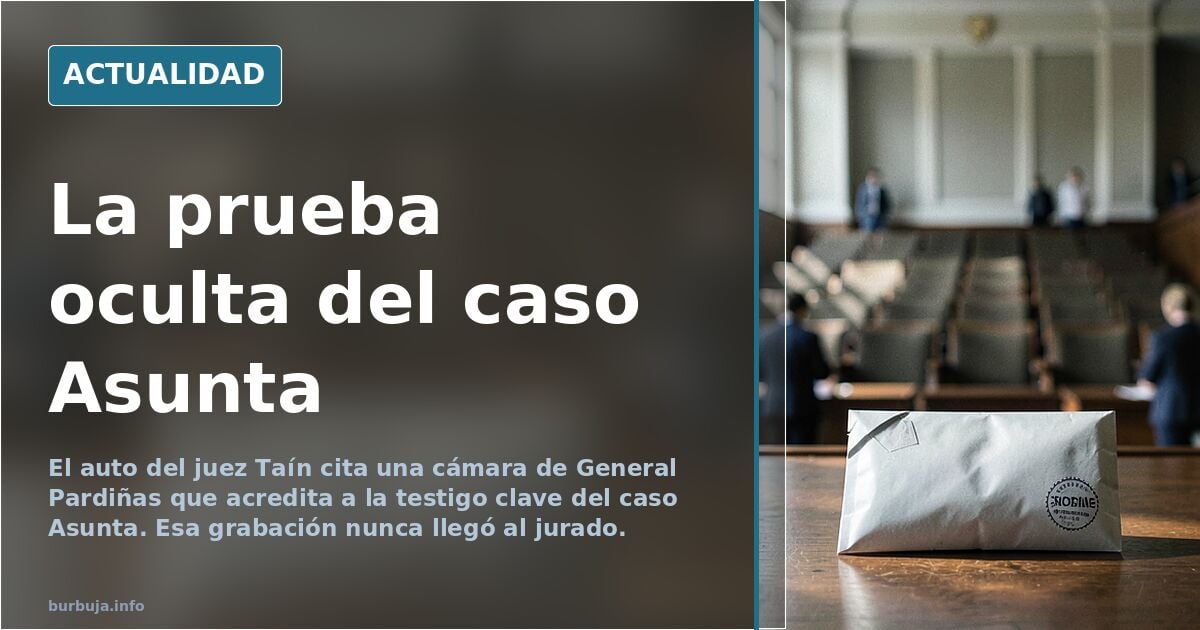
Asunta case: the footage the judge cited and the jury never saw
Can a security camera on a street in Santiago de Compostela determine whether a key testimony was verifiable or not? In the Asunta Basterra case, the answer that emerges from the documents of the investigating judge himself is uncomfortable: there was at least one recording placing witness C.B. on General Pardiñas street on the afternoon of September 21, 2013, and that recording never reached the jury. The ruling opening the trial says it clearly: the witness "is verified through a purchase receipt and is subsequently seen on a camera on General Pardiñas".
This is not a leak or a hallway guess. It is a text signed by the investigating judge, José Antonio Vázquez Taín, supporting the credibility of the witness whose statement was used to argue that Alfonso Basterra lied about his activities that afternoon. The question is no longer whether the evidence existed. The question is why it was not shown.
What the investigating judge's ruling actually said
The document, part of case 0004900/2013 before the Jury Court of Court of First Instance and Instruction number 2 in Santiago, states that the witness passed by the location and that there is a camera proving it. Those defending the official account have repeated for years that C.B.'s testimony was the pillar placing Basterra on the street. The Superior Court of Justice of Galicia (TSXG) later corrected the part placing him in Teo, but upheld the underlying reasoning: that the father lied.
There lies the crux. If the lie sustains the conviction, then the evidence that verifies or refutes the testimony underpinning that lie is no minor detail. It is relevant evidence. And there is no record that it was shown to the jury.
The Sabadell camera and a difference of minutes
The camera mentioned in the ruling can be identified, almost certainly, as the one at the Sabadell bank at number 20 General Pardiñas. That same camera recorded Rosario Porto at 18:09:45, as she headed to the garage. In other words, there is an exact time reference from the same lens for the mother's passing and, potentially, for the witness's.
The distance between that point and the place where C.B. said she saw Asunta with her father is under 60 meters, less than a minute's walk. With that geometry, the timestamp of the recording would allow narrowing the window of the sighting with a precision no purchase ticket can offer. The Civil Guard admitted at trial that it could not verify the exact time of the ticket. The camera, on the other hand, requires no interpretation.
Three scenarios and a problem for the prosecution
If the recording places the witness before 18:20, the prosecution's case is reinforced. If it places her between 18:45 and 18:55, Rosario Porto's account —she returned from Teo after setting the alarm at 18:33 and left Asunta in Santiago— gains plausibility. And if it places her between 18:20 and 18:45, the prosecution would have to choose: either Asunta was in the car with her mother or she was on the street with her father. Both things at once do not hold up.
That range is not speculation about the crime. It is clock arithmetic. And it explains why the existence of the recording matters more than its content: it forces a piece of the official narrative to move.
Who knew what and when
The investigating judge's ruling shows that he knew of at least one recording. It is reasonable to assume the source was the Civil Guard. There is no record that the prosecution was aware, nor that the defense had that material. The obligation to include relevant evidence in the case falls on the investigating judge and the public prosecutor's office, not on defense lawyers, who have no duty to hand over what harms their client.
The open question is temporal: when the camera became known and when it was decided not to bring it to trial. Learning about it at the last moment is not the same as having it from the start and using it to support precautionary measures. The difference between the two is not academic.
The counterargument: there would have been a conviction without C.B. anyway
Some argue that the jury would have convicted anyway without the witness's testimony, because the weight of the prosecution rested on the purchase of Orfidal at the pharmacy near the home and on the teachers' testimonies. The TSXG, in fact, removed the claim that Basterra had been in Teo, which in this view renders the testimony irrelevant to the verdict.
The counterargument is that the testimony did not place Basterra in Teo, but rather proved he lied about having left home. And that it was this testimony that sustained pretrial detention in several rulings after the computer and the phone had already been found. The discussion, therefore, is not whether the jury would have convicted without C.B., but whether it was denied evidence that made it possible to verify C.B.
What an investigating judge is required to do
The investigating judge's role is not to accuse. It is to bring into the case all the means of evidence the jury needs in order to assess them. If a recording exists, is cited in a ruling and is not shown, the jury assesses the testimony without the cross-check the investigation itself acknowledged having. That is not a transcription error. It is an omission with consequences.
The path for Basterra, according to this line of analysis, would involve filing a complaint against the judge for concealing relevant evidence and for issuing rulings based on an incomplete version. It is not a short or comfortable road. But it is the only one that turns a suspicion into a procedure.
In the end, the Sabadell camera is still there, at number 20 General Pardiñas, its clock marking 18:09:45 for Rosario. All that is missing is for someone to ask what time the witness passed by. And for the answer not to be "I don't remember".
Summary of a discussion on Burbuja.info - Foro de economía, actualidad y política., translated from Spanish and reviewed before publication. Read the full discussion (65 replies).
More summaries
-
Asunta case: Trial and the lingering shadow of doubt
Asunta case: Sentence review, forensic analysis and persistent doubts about the crime
-
PACMA Calls Protest on October 4 Against Valdepeñas 'Cat Killer'
PACMA has called a protest on October 4 in Valdepeñas against the 'cat killer,' a former civil guard accused of killing stray cats.
-
Sol Bells Ring Every 15 Minutes During Madrid Protest Camp
Debate erupts in Madrid over whether the Puerta del Sol clock chimes every quarter-hour during a protest camp, or if it is a routine sound people only now notice.
-
GTA 6 hype in Spain: fans debate its launch
Debate over GTA 6: minimal promotion in Spain, 30 fps on the base console and no announced PC version, according to participants.
-
Odón Elorza and the cancelled documentary on the Kote Cabezudo case in Spain
The documentary on the Kote Cabezudo case was cancelled and the rights returned to the production company. Odón Elorza, named in testimonies, has not been convicted. The…
-
'Rubén Maxxing', the YouTube phenomenon under scrutiny
The content creator known as 'Rubén Maxxing' is drawing attention on YouTube. His lifestyle and his past are fueling unverified speculation.