
The copy shop that only prints PDFs: a rule that is spreading
Signs reading "PDF documents only" are spreading in copy shops: the portable format keeps tables and images from shifting out of place when printing.
English · Original discussion in Spanish · Published
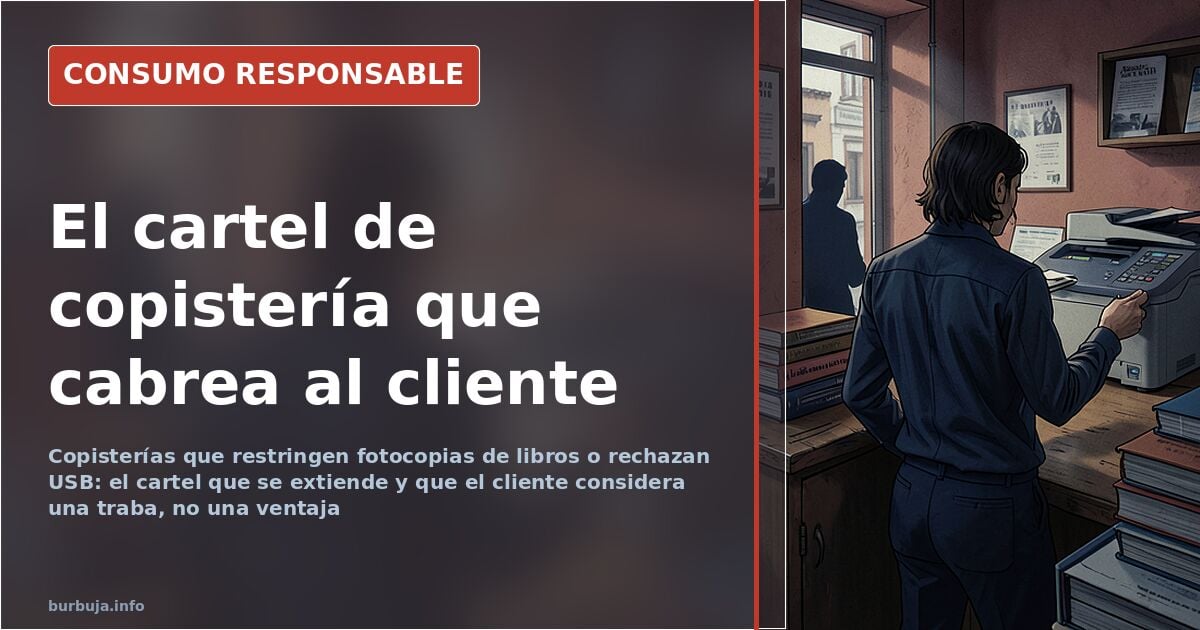
The copy shop that now only prints PDF files
A sign that used to be unseen and now sits on the counter: "PDF documents only." The restriction is not a counter whim or the pet peeve of a bored clerk. Behind it lies a technical reason that anyone who has ever sent a .doc to print knows all too well: the document shifts out of place, tables run off the margins, an image jumps to the next page, and the customer comes back to complain. PDF, on the other hand, was designed for exactly what it is being used for: what you see on screen comes out the same on any printer.
The portable format was born precisely for this. Portable Document Format, that's what the acronym stands for. An immutable file that is sent straight to the machine without even opening it, without the software of the day reinterpreting it. The alternative —Word, LibreOffice, OnlyOffice, whatever suite— depends on the version, the operating system and even the configured margins. ISO standards or a waste of paper, as one of the participants sums it up.
Why a .doc shifts out of place and a PDF does not
The technical argument is solid and nobody disputes it. A .doc can come from Office on Windows, Office on Mac, LibreOffice or any free suite. Just open it in a different application and the tables and images go haywire. Not so with PDF: it can be edited with tools, but when printed it does not shift because, in practice, it is an image file with selectable text.
Some add a less friendly nuance: PDF is one of the formats best suited for smuggling in bicho or hidden scripts. And another points to the physical security of the machine, with the classic killer USB that fries the computer while the customer runs off laughing. The PDF rule does not solve that, but it reduces the surface area for disaster.
The one-euro-per-photocopy business
At 0.30 euros a job, the margin does not allow for many free reprints. If a document comes out wrong because of a formatting issue, someone pays for the paper and toner. And it is usually not the customer. That is the economic reading of a practice that, in reality, shifts onto the user a job the copy shop used to do: converting the file. The sign does not ban printing, it bans printing badly.
The trend coexists with other restrictions that have also become normalized in the sector: cash only, no USB sticks, and documents by email or WhatsApp. Each counter makes its own selection of inconveniences.
The customer who shows up with the wrong file
The problem is not the format, it is the habit. Millions of people keep sending the native file because it is what they have at hand. The copy shop thus becomes the last frontier where someone forces you to export. And there arises the awkward question: is it a reasonable restriction or an elegant way to charge twice for the same job?
The answer depends on whom you ask. What is beyond dispute is that the sign is no longer a rarity at one isolated shop. It is becoming the written rule of a sector that lives off other people's paper.
Also available in: Deutsch
Summary of a discussion on Burbuja.info - Foro de economía, actualidad y política., translated from Spanish and reviewed before publication. Read the full discussion (46 replies).
More summaries
-
HP printer that prints without printing: how to beat built-in obsolescence
An HP stops printing with a new cartridge due to a 3-euro fault that requires scrapping the machine. Monochrome laser wins the economic argument.
-
Splitting a Word document hundreds of pages long: the macro that saves hours
Splitting a Word document of hundreds of pages into separate files can be done with a VBA macro or by extracting pages from a PDF. The tricky part is deciding where to cut.
-
Liquid detergent: the bulk format no longer saves you money
A shopper reports that Alcampo's bulk-format detergent rose by one euro and now costs more than two 2-litre bottles. A breakdown of prices per wash.
-
Wallapop requires power of attorney to Mangopay to use its wallet
Wallapop requires granting Mangopay power of attorney and renewing every 180 days to move wallet money. No signing all four conditions, no payout.
-
Simple trick to make frying healthier
An analysis claims that adding rosemary when frying cuts the formation of harmful compounds by up to 74% and reduces oil oxidation. Here's what's behind it.
-
Raspberry Pi: from a €39 gadget to €200 and a drawer
The Raspberry Pi went from €39 to €200. Fans point to years of service; impulse buyers leave it in a drawer next to their first Nokia.