
The Catholic Church’s Demographic Business and Migration
A devotional profile advocates for a 'black and Catholic Europe' against a 'white and secular' one, sparking debate on the Church's strategy and its faithful base.
English · Original discussion in Spanish · Published
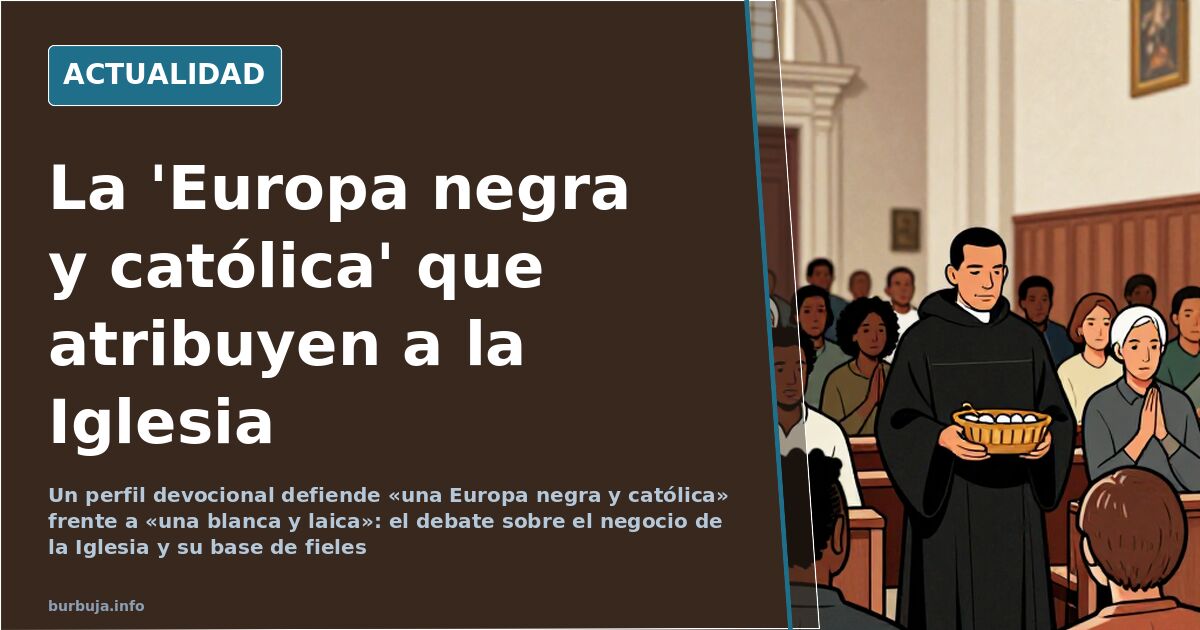
The Church as a business and the 'black and Catholic Europe' narrative
A devotional profile launched the phrase that ignited everything: 'It is preferable to have a black and devoutly Catholic Europe than a white and sodomite one.' A commenter picked this up to discuss a supposed ecclesiastical fifth column working toward the replacement of the European population. From this came 223 responses debating whether the Catholic Church truly pushes this scenario or simply seeks believers where they are found. The discussion is not theological; it is about numbers: how many Catholics there are, their origins, and who pays the bill. When arguments rely on numbers, they often end up discussing something else entirely.
The false dilemma attributed to the Church
The first rebuttal came from a logical angle: no one has chosen between these two Europes, and the premise is a false dilemma. Some argue that the profile spreading the message does not represent any episcopate, and that statements from the Spanish Episcopal Conference on migrant regularization are read as institutional stances without being fully so. Another current reverses the accusation: those defending a white, irreligious Europe share, in practice, the same outcome as those wanting a Europe without roots. The argument is circular but captures the tone. Amidst this lies the uncomfortable question: is someone speaking on behalf of Catholics, or just for themselves? No one clarifies this, and this ambiguity sustains the controversy.
How many Catholics are white? The uncomfortable data
Here appear the few figures in the conversation. An estimate circulating in the discussion places non-white Catholics at around 80% of the world's total, making Europe a minority within its own Church. If true, the corollary some draw is purely accounting: a global institution optimizes its base of believers, not its ethnic profile. And here comes the uncomfortable blow. The neighborhood parish, which supports worship, catechesis, and much of the maintenance, is not the one deciding where the institution grows. The tap is neither peine nor closed by the faithful, summarizes one message, pointing to concordats with states as the real leverage point.
The Church as a business: clients, accounts, and regularization
The most cynical reading is also the most repeated. If viewed as an organization needing to balance annual results, the reasoning fits effortlessly: it needs clients, and those arriving—migrants, large families, communities with higher religious practice—are cheaper to attract than those leaving. Under this logic, requesting the regularization of migrants would not be ideological militancy but commercial policy. The analogy has its charm and its trap. Critics respond that it reduces a millennial institution to a corporate brochure and ignores the real weight of social doctrine. Neither side moves a figure that settles the matter.
Pagan roots, heritage, and 'Christianity for atheists'
The issue shifts to the historical terrain, where positions truly diverge. One line argues that Europe's roots are pagan and that Christianity was a desert belief imposed over previous cults. Conversely, it is recalled that Spain's first universities were Catholic and much of Europe's institutional framework was born within the Church. Another common current compares faith to the left: Christianity for atheists, the repeated formula. The underlying idea is that pogre sarracena is recycled Christian heritage, and thus, the irreligious right resembles its adversary more than it admits. This part of the analysis has more bibliography but less agreement.
The unproven stretch: conspiracies and proper names
At some point, the conversation leaves the track. Theories emerge about supposed Church direction by external interests, about large fortunes, and about marriages explaining political shifts. These are assertions without any provided proof, typical of conspiratorial environments mixing surnames, inheritances, and imagined pacts. It must be said plainly: none of this is substantiated. When debate reaches here, it stops discussing and starts believing. And believing is not analyzing.
Where the analysis stalls
One matter remains open. The Catholic Church gains believers outside Europe and loses weight within, and this displacement confuses those who conflated faith with identity. Concrete figures of this transfer do not appear in the discussion; only the intuition that the axis shifts. And where there are no figures, there is narrative. With narrative, almost anything can be sustained, including the claim that someone, somewhere, has chosen between a black Europe and a white one.
A devotional profile launched the phrase that ignited everything: 'It is preferable to have a black and devoutly Catholic Europe than a white and sodomite one.' A commenter picked this up to discuss a supposed ecclesiastical fifth column working toward the replacement of the European population. From this came 223 responses debating whether the Catholic Church truly pushes this scenario or simply seeks believers where they are found. The discussion is not theological; it is about numbers: how many Catholics there are, their origins, and who pays the bill. When arguments rely on numbers, they often end up discussing something else entirely.
The false dilemma attributed to the Church
The first rebuttal came from a logical angle: no one has chosen between these two Europes, and the premise is a false dilemma. Some argue that the profile spreading the message does not represent any episcopate, and that statements from the Spanish Episcopal Conference on migrant regularization are read as institutional stances without being fully so. Another current reverses the accusation: those defending a white, irreligious Europe share, in practice, the same outcome as those wanting a Europe without roots. The argument is circular but captures the tone. Amidst this lies the uncomfortable question: is someone speaking on behalf of Catholics, or just for themselves? No one clarifies this, and this ambiguity sustains the controversy.
How many Catholics are white? The uncomfortable data
Here appear the few figures in the conversation. An estimate circulating in the discussion places non-white Catholics at around 80% of the world's total, making Europe a minority within its own Church. If true, the corollary some draw is purely accounting: a global institution optimizes its base of believers, not its ethnic profile. And here comes the uncomfortable blow. The neighborhood parish, which supports worship, catechesis, and much of the maintenance, is not the one deciding where the institution grows. The tap is neither peine nor closed by the faithful, summarizes one message, pointing to concordats with states as the real leverage point.
The Church as a business: clients, accounts, and regularization
The most cynical reading is also the most repeated. If viewed as an organization needing to balance annual results, the reasoning fits effortlessly: it needs clients, and those arriving—migrants, large families, communities with higher religious practice—are cheaper to attract than those leaving. Under this logic, requesting the regularization of migrants would not be ideological militancy but commercial policy. The analogy has its charm and its trap. Critics respond that it reduces a millennial institution to a corporate brochure and ignores the real weight of social doctrine. Neither side moves a figure that settles the matter.
Pagan roots, heritage, and 'Christianity for atheists'
The issue shifts to the historical terrain, where positions truly diverge. One line argues that Europe's roots are pagan and that Christianity was a desert belief imposed over previous cults. Conversely, it is recalled that Spain's first universities were Catholic and much of Europe's institutional framework was born within the Church. Another common current compares faith to the left: Christianity for atheists, the repeated formula. The underlying idea is that pogre sarracena is recycled Christian heritage, and thus, the irreligious right resembles its adversary more than it admits. This part of the analysis has more bibliography but less agreement.
The unproven stretch: conspiracies and proper names
At some point, the conversation leaves the track. Theories emerge about supposed Church direction by external interests, about large fortunes, and about marriages explaining political shifts. These are assertions without any provided proof, typical of conspiratorial environments mixing surnames, inheritances, and imagined pacts. It must be said plainly: none of this is substantiated. When debate reaches here, it stops discussing and starts believing. And believing is not analyzing.
Where the analysis stalls
One matter remains open. The Catholic Church gains believers outside Europe and loses weight within, and this displacement confuses those who conflated faith with identity. Concrete figures of this transfer do not appear in the discussion; only the intuition that the axis shifts. And where there are no figures, there is narrative. With narrative, almost anything can be sustained, including the claim that someone, somewhere, has chosen between a black Europe and a white one.
Summary of a discussion on Burbuja.info - Foro de economía, actualidad y política., translated from Spanish and reviewed before publication. Read the full discussion (222 replies).
More summaries
-
Spain's 'La bola negra' sparks culture war with €4.7M opening
'La bola negra' grosses €4.7 million in its first weekend and divides Spain between critical praise and accusations of propaganda and historical sectarianism.
-
De Prada: Abstention is a conscious political choice, not apathy
Juan Manuel de Prada argues that abstention is a conscious vote, sparking debate with Escaños en Blanco over whether silence is apathy or dissent.
-
Yolanda Díaz's Decline: From Political Narrative to Reality
Yolanda Díaz's influence wanes amid labor reform failure and record fiscal pressure. Is her political relevance ending?
-
Women's Feet: From Summer Heat to the Fetish Driving Thousands of Photos
Open footwear lets feet breathe and avoids fungus, but exposes painted nails and bunions. The foot fetish drives thousands of free photos online.
-
Spain's Aging Crisis: The Controversial Blame on Feminism
A fringe theory claims feminism aims to sterilize Spanish women, fueling debates on birth rates and Japanization.
-
Ruben Gisbert: Do Elites Orchestrate Conflicts to Enforce Control?
Ruben Gisbert argues that elites provoke unrest to justify mass surveillance. An analysis of his arguments and the sharp criticism he faces.