
The car that would survive the end of the world: no electronics, just a crank handle
Naturally aspirated diesel, carburetor and zero electronics: the profile of a vehicle that would survive a collapse, from the 2CV Sahara to the Lada Niva
English · Original discussion in Spanish · Published
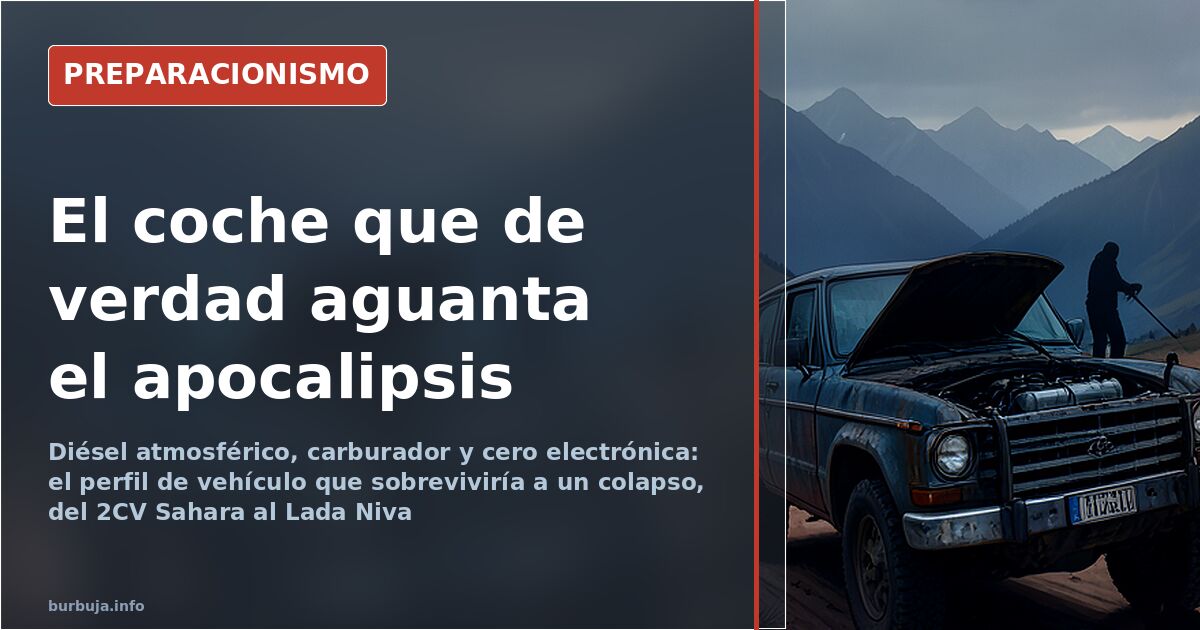
The car that would survive the end of the world: old diesel and no electronics
No vehicle built after 1995 is fit for a Mad Max scenario. That is the thesis, delivered with the confidence of someone who has thought about it a little too much, and it sums up a 47-reply discussion that turned into an inventory of glorious old junk: the Citroën 2CV, the Lada Niva, the C15, the Patrol, the 600. The requirement is always the same. Naturally aspirated diesel with a mechanical injection pump or carbureted gasoline. No ECUs, no sensors. And if it can be started with a crank handle, so much the better.
The logic is not nostalgic, it is thermodynamic. An engine without electronics does not need a diagnostic workshop to keep turning; it needs diesel, oil and patience. The 2CV was air-cooled, which does away with the coolant circuit and a good share of overheating problems at a stroke. Some go further and argue that, in a prolonged collapse, there would be no lubricants or spare parts and the vehicle fleet would shrink to bicycles and wood-fired boilers. Seen that way, any small, mechanical engine is a fleeting luxury.
From the 2CV Sahara to the homemade armored vehicle
The conversation starts with homemade armored vehicles, compared with those improvised during the Spanish Civil War, and jumps to restomods, the practice of fitting modern mechanics into old bodywork. Consensus breaks down quickly: some defend the Marauder, an armored vehicle weighing nearly ten tons; others prefer the souped-up Land Rover. The exotic touch comes from the Pink Panther, the pink jeep of the British SAS in the Sahara, camouflaged by the effect of haze and the refraction of hot air at dawn.
The juiciest chapter is the 2CV Sahara 4x4: two engines, one at the front and one at the back, front-wheel, rear-wheel or all-wheel drive. The Guardia Civil (Spain's national police force) was one of its best customers. A factory indulgence that proves simple engineering can take absurd variations without breaking down.
What a survival vehicle needs
Enclosed, big enough to sleep in, four-wheel drive and low fuel consumption. With that filter, the list shrinks to a handful of names. The Lada Niva comes up again and again; the Patrol and the Mercedes G as old-diesel options capable of running on recycled oil. The C15 and the Seat 600 complete the picture for cheapness and simplicity.
The most frequently cited alternative has no engine: a donkey, which turns into meat if things get ugly. It is the only proposal that solves transport and food supply at the same time.
The real problem: spare parts and fluids
The 3D printer looms as a lifeline for small parts, and ethanol or biodiesel as substitutes for fossil fuel. But nobody hides the contradiction: a Mad Max-style vehicle burns tons of fuel that, in the scenario being discussed, would not exist. The discussion ends where it began, with the crank handle and the two-cylinder engine. How many of these contraptions would still be running ten years after the collapse?
Also available in: Deutsch
Summary of a discussion on Burbuja.info - Foro de economía, actualidad y política., translated from Spanish and reviewed before publication. Read the full discussion (47 replies).
More summaries
-
Three Bodies Found Frozen in Colorado Wilderness
Hiker discovers mummified remains of two sisters and teen who attempted isolated survival in Colorado forest.
-
Double perimeter and safe room: securing an isolated home
The key is the clock, not the gun: a double retraced perimeter, sensors with margin, and a safe room that holds until police arrive.
-
Disappearing in Spain's Storms: An Impossible Plan
Guardia Civil protocols expose the flaws in vanishing during Spanish weather emergencies, debunking myths about fleeing to Mongolia.
-
Utopia 2013: Where to Download the British Series on P2P
The British series Utopia (2013), with two subtitled seasons, is still available on eMule, torrent and direct download
-
How to survive a dog attack: ultrasonic devices, sticks and other defenses
Ultrasonic devices that only work on dogs that aren't deaf, sticks, the back of the hand, and the real problem: owners who walk their dog off the leash in the street.
-
Monk parakeet: invasive, noisy, and fiercely defended by its fans
The monk parakeet is an invasive pest in Spain, but when an injured bird turns up in a garden, the dilemma between rescuing it or killing it splits public opinion.