
The bar at 49: 50 dates and no lowering it
Patricia, 49, and some 50 dates since her 2018 separation, says she isn't tired, she's disgusted; 8 in 10 users are fed up.
English · Original discussion in Spanish · Published
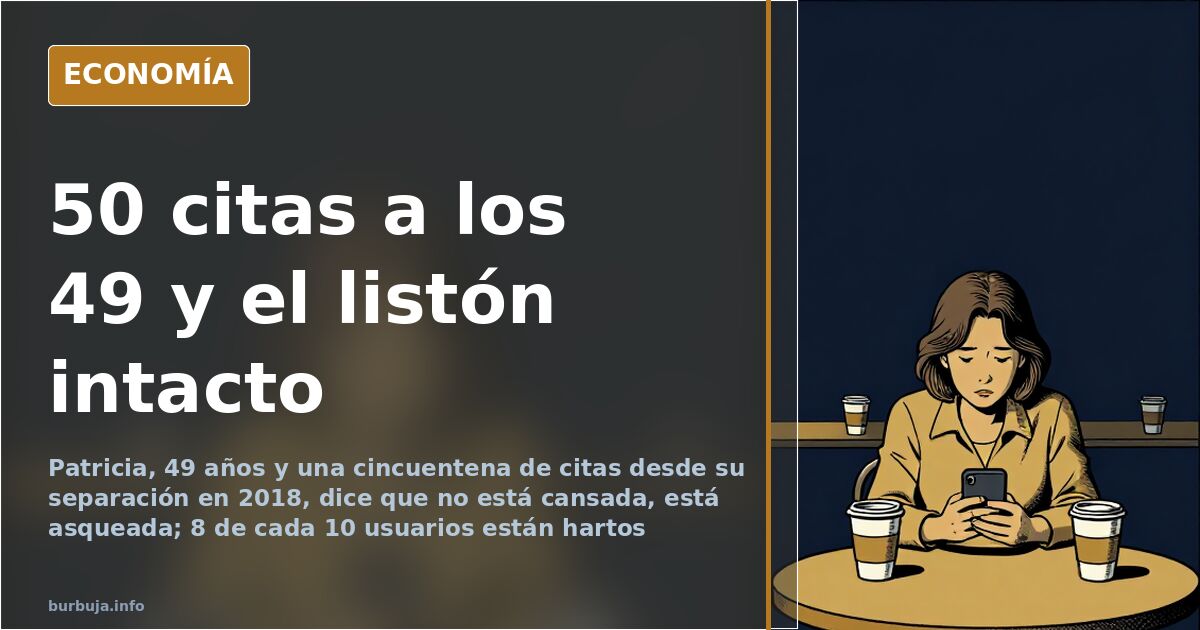
49 years old, 50 dates and a bar that won't budge
How many dates does it take to admit the problem isn't the algorithm? The case that has put the spotlight on dating-app burnout has a name, an age and a line that sums it up: I'm not tired, I'm disgusted. Patricia, 49, separated since 2018, has racked up about 50 dates and a three-year relationship that has already ended. Her friend Belén adds the detail that hurts more than the tally: she no longer has a single female friend left in the area.
Behind the case is a business in trouble. Forbes is cited to support the claim that 8 out of 10 users are fed up with the world of matching, and subscriptions have become the great lifeline for those platforms. No replacement is arriving: younger people aren't willing to pay to hook up.
Why 50 dates with strangers are more exhausting than a divorce
A first date with a stranger is a job interview with no paycheck at the end. Fifty encounters describe a process expensive in time and wear: getting ready, coordinating schedules, building trust from scratch and checking, over and over, that there was no substance there. Some people say they peine a profile twice and closed it within a week because by the second message they were already being asked to meet up. The quick date has become normal; the filter has not. And without a filter, the arithmetic is cruel: fifty attempts for a single lasting result that also fell apart.
The business: subscriptions as a lifeline and young people who don't pay
The model no longer lives on novelty but on recurring payment. During lockdowns, use skyrocketed, with people cooped up at home and more eager for contact than usual. The diagnosis circulating now is different: the era of loneliness, the cat and the wine. Ironic, but it sums up a change in habits. The problem is a funnel problem: if the young user doesn't pay and the veteran uninstalls, the subscription rests on an aging base. Platforms like Tinder worked while there was volume; today volume is what's failing.
Some men aged 40 to 50 abandoned those apps years ago, according to several voices in the analysis, and those who remain arrive with lowered expectations and little patience for the noise.
The bar, the years and the math everyone does
Here is the knot. One side maintains that the standard isn't lowered because it shouldn't be: what is demanded today is what was demanded at 30, and supply hasn't changed at the same pace. Another responds with household arithmetic: of every 100 men aged 40 to 50, 50 age noticeably, 20 moderately, another 20 hold up with caveats and barely 10 percent remain attractive in the eyes of younger women. It's an estimate, not a census, but it works as a mirror.
On the other side is the opposite experience: men who don't consider themselves an Adonis —one declares 1.75 meters and 98 kilos at 47— and say they date without problem because they know how to behave, treat people well and don't smother. The variable wouldn't be physique but behavior. There remains an uncomfortable question no one resolves: if the natural audience for a 49-year-old woman is a 60-year-old man, the calendar works against both sides.
Those who get off the market
The interesting conversation isn't about who is looking, but about who has stopped looking. A father describes his 16-year-old son and his crew: they pass on girls, preferring Counter or Valorant to putting up with nonsense. His generation, he says, had unstoppable hormones at that age. The hypothesis being floated —with no evidence to back it— is that the discourse around relationships has produced an unintended effect: male withdrawal.
And not just teenagers. Some do the math and conclude that what they'd have to give up to maintain a bond isn't worth it, and that if the need became pressing, they'd turn to an occasional paid service. Interest, in that bracket, migrates to other screens. The economic consequence is the usual one: fewer couples, less shared consumption, less replacement.
So the bar stays where it was, the cat doesn't complain and the subscription renews itself. Everything fits, except the tally: fifty dates later, the only number that keeps rising is that of those who are no longer on the app.
How many dates does it take to admit the problem isn't the algorithm? The case that has put the spotlight on dating-app burnout has a name, an age and a line that sums it up: I'm not tired, I'm disgusted. Patricia, 49, separated since 2018, has racked up about 50 dates and a three-year relationship that has already ended. Her friend Belén adds the detail that hurts more than the tally: she no longer has a single female friend left in the area.
Behind the case is a business in trouble. Forbes is cited to support the claim that 8 out of 10 users are fed up with the world of matching, and subscriptions have become the great lifeline for those platforms. No replacement is arriving: younger people aren't willing to pay to hook up.
Why 50 dates with strangers are more exhausting than a divorce
A first date with a stranger is a job interview with no paycheck at the end. Fifty encounters describe a process expensive in time and wear: getting ready, coordinating schedules, building trust from scratch and checking, over and over, that there was no substance there. Some people say they peine a profile twice and closed it within a week because by the second message they were already being asked to meet up. The quick date has become normal; the filter has not. And without a filter, the arithmetic is cruel: fifty attempts for a single lasting result that also fell apart.
The business: subscriptions as a lifeline and young people who don't pay
The model no longer lives on novelty but on recurring payment. During lockdowns, use skyrocketed, with people cooped up at home and more eager for contact than usual. The diagnosis circulating now is different: the era of loneliness, the cat and the wine. Ironic, but it sums up a change in habits. The problem is a funnel problem: if the young user doesn't pay and the veteran uninstalls, the subscription rests on an aging base. Platforms like Tinder worked while there was volume; today volume is what's failing.
Some men aged 40 to 50 abandoned those apps years ago, according to several voices in the analysis, and those who remain arrive with lowered expectations and little patience for the noise.
The bar, the years and the math everyone does
Here is the knot. One side maintains that the standard isn't lowered because it shouldn't be: what is demanded today is what was demanded at 30, and supply hasn't changed at the same pace. Another responds with household arithmetic: of every 100 men aged 40 to 50, 50 age noticeably, 20 moderately, another 20 hold up with caveats and barely 10 percent remain attractive in the eyes of younger women. It's an estimate, not a census, but it works as a mirror.
On the other side is the opposite experience: men who don't consider themselves an Adonis —one declares 1.75 meters and 98 kilos at 47— and say they date without problem because they know how to behave, treat people well and don't smother. The variable wouldn't be physique but behavior. There remains an uncomfortable question no one resolves: if the natural audience for a 49-year-old woman is a 60-year-old man, the calendar works against both sides.
Those who get off the market
The interesting conversation isn't about who is looking, but about who has stopped looking. A father describes his 16-year-old son and his crew: they pass on girls, preferring Counter or Valorant to putting up with nonsense. His generation, he says, had unstoppable hormones at that age. The hypothesis being floated —with no evidence to back it— is that the discourse around relationships has produced an unintended effect: male withdrawal.
And not just teenagers. Some do the math and conclude that what they'd have to give up to maintain a bond isn't worth it, and that if the need became pressing, they'd turn to an occasional paid service. Interest, in that bracket, migrates to other screens. The economic consequence is the usual one: fewer couples, less shared consumption, less replacement.
So the bar stays where it was, the cat doesn't complain and the subscription renews itself. Everything fits, except the tally: fifty dates later, the only number that keeps rising is that of those who are no longer on the app.
Summary of a discussion on Burbuja.info - Foro de economía, actualidad y política., translated from Spanish and reviewed before publication. Read the full discussion (276 replies).
More summaries
-
Five Dates a Day on Tinder: The Unaccounted Bill
Sonia, 29, goes on five Tinder dates daily without closing any. The case reveals a slot machine-like reward system and a bill paid by...
-
Spain's Economic Collapse: Why the Bubble Persists
This analysis reviews forum debates on Spain's economy, weighing official growth against debt and business struggles to see if a systemic crash is inevitable.
-
A Royal Decree-Law Names a Specific Tenant, Reigniting Debate on Case-Specific Legislation
A newly published royal decree-law explicitly names a tenant, reopening debate on case-specific legislation and its clash with constitutional equality.
-
Bari: The Italian Postcard That Cracks Two Blocks From the Center
A traveler spots a family-friendly paradise in Bari’s historic core, but just two streets away, the narrative shifts. Italy vs. Spain compared.
-
Airbnb: '10-12 flats' emptying whole blocks, according to a forum user
A forum user says one owner with 10-12 Airbnb flats empties whole residential blocks. In Lugo or Teruel, prices also rise without mass tourism.
-
Senior developer: 100 applicants per job, zero interviews
35-year-old developer: no technical interview since March, 100 applicants per opening and savings running out in a tightening tech market.