
The apocalypse that never arrives: the middle class's new anxiety
Collapse anxiety has mutated: what people fear now is not the end of the world, but that it never quite arrives. Slow erosion replaces the tsunami.
English · Original discussion in Spanish · Published
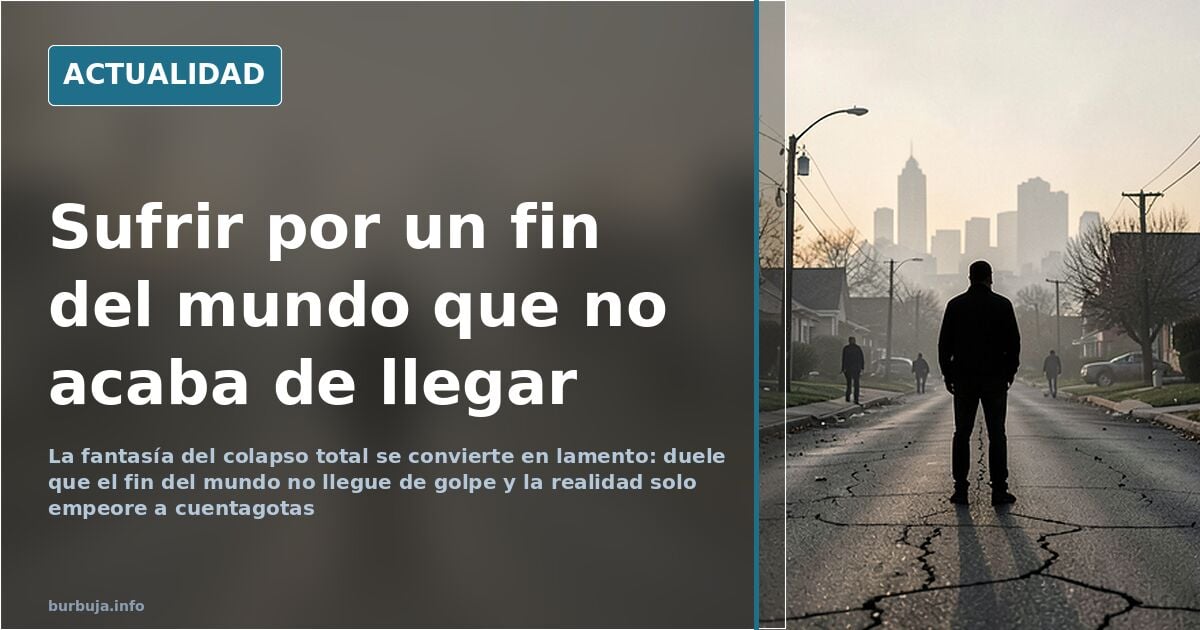
The collapse anxiety that never quite erupts
There is a form of distress that has no name in mental health manuals: that of someone who has spent years preparing for a total collapse that is always just around the corner. The tsunami never comes; instead, it drips. The argument, laid out bluntly in a recent conversation, is that reality "is horrible and only gets worse, but drop by drop, not in a full and immediate tsunami." The complaint is no longer the end of the world. It is its slowness.
The diagnosis runs deep. For decades, part of the population lived with the suspicion that the system would collapse overnight: financial meltdown, scarcity, a reset from scratch. That scenario, so to speak, had its own epic quality. What now prevails is a slow decline, with no headline, no epic and no way out. The frustration comes not from the disaster, but from the fact that the disaster never quite arrives.
From sudden collapse to permanent erosion
That conversation keeps returning to a recurring idea: that a catastrophic event — people even fantasize about a zombie scenario — would make it possible to "start from zero" and build a new order. The argument is that once everything has fallen, it would be enough to fortify yourself and wait. The fantasy of the reset is more of a release than a plan: deep down, what is being asked for is not the end of the world, but an interruption.
The other side of the same unease is the suspicion that the usual suspects have an escape plan. "With any luck, Catholicism and capitalism will fall," someone even writes, as if the collapse of two institutions were a liberation. These are opinions that circulate without empirical backing and are best read as a symptom, not a forecast.
Hope as a refuge
Against the defeatism, another strand of the same debate recovers religious language: "Everything will happen, do not despair." Hope, faith and charity are presented as virtues that sustain those who no longer expect anything from the material world. It is a classic response to hopelessness: if the future cannot be fixed, salvation is relocated to another plane.
The clash between the two positions is total. Some argue that Oooo-Christian civilization was the cradle of pogre; others, that the same institution has weighed the continent down for centuries. Neither position is backed by data, and that is the problem: the debate about the end of the world is always held without figures.
Political weariness as a symptom
The unease ends up, inevitably, at the ballot box. There is the fantasy of a mass event coinciding with "the day of those bloody general elections," with voters chasing each other through the polling stations. It is a caricature of both the abstainer and the disciplined voter, and also proof that politics is no longer experienced as a solution but as part of the problem.
The joke about the end of the world that never comes — the one about Earth exploding in five billion years — sums up the heart of the matter. Collapse anxiety has mutated into boredom. And boredom, in politics, has always been dangerous fuel.
Also available in: Deutsch
Summary of a discussion on Burbuja.info - Foro de economía, actualidad y política., translated from Spanish and reviewed before publication. Read the full discussion (20 replies).
More summaries
-
France riots: social collapse or crisis management?
Analysis of the escalating violence in France. Arrest figures, property damage and the debate over the multicultural model.
-
The 'Steppenwolf': the price of selling the end of the world
Behind the collapse guru: a €2,000 mortgage, his parents' pension and apocalyptic scripts that bore. The harsh economics of digital survivalism.
-
Where to spend Europe's final days? Forum users weigh escape routes
Where to spend Europe's final days? We look at the refuge proposals for social and economic collapse being debated by users on the forum.
-
Spain Withdraws Police Protection from Four Ex-Ministers, Sparking Political Fallout
Interior strips security for Iglesias, Montero, Belarra, and Garzón. Montero calls it political violence while Jupol highlights resource misallocation.
-
Jordi Wild and the 'uneducated' vote: a frame born broken
Jordi Wild said VOX attracts the 'less educated' vote. The frame dates back to 2019 and was already shaky then, according to debate participants
-
Viral AI video 'clears' Madrid's Puerta del Sol with Roman gods
A post on X announces a 'far-right' version of the video that cleared Puerta del Sol in Madrid with Roman gods. The joke mixes religious symbols and politics.