
The '99% of Men Kill' Claim Lacks Source
The claim that 99% of men kill their partners upon breakup circulates without evidence. Annual mortality comparisons challenge this figure.
English · Original discussion in Spanish · Published
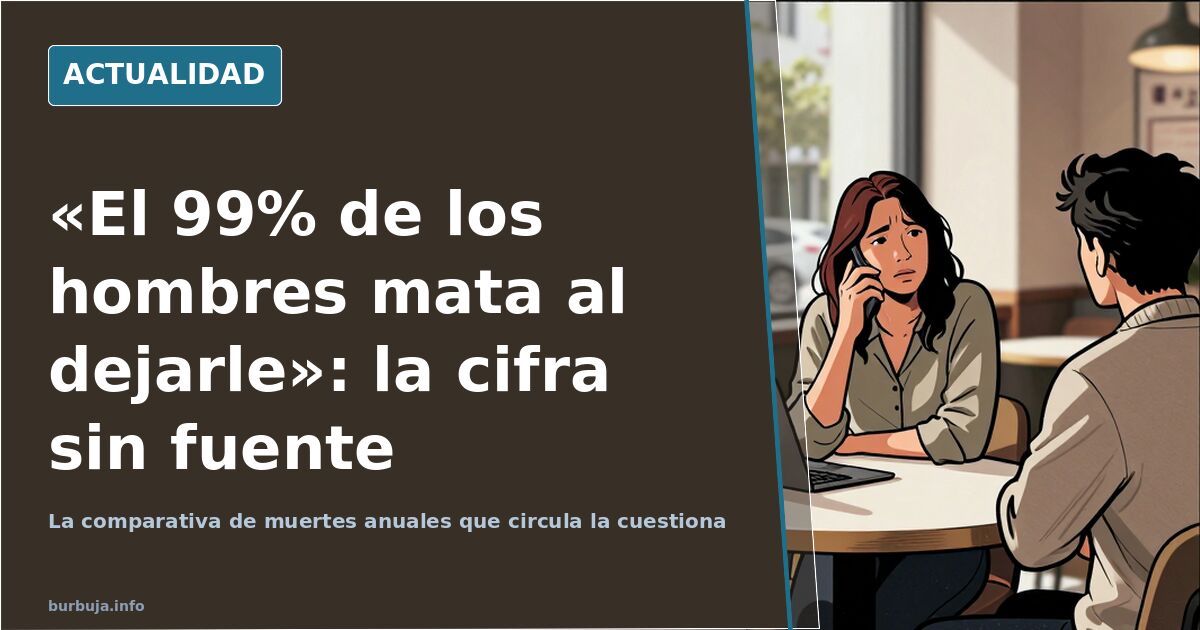
The 99% Myth: Demanding Action Without Proof
Why are you asked to accept collective guilt simply for being male? The scenario is familiar: at work or family gatherings, someone claims men abuse women, that 99% react with violence when left by a partner, and that one has a sarracena duty to fight prevailing machismo. The issue isn't the denunciation itself. It's that it arrives without source, date, or room for rebuttal. It’s not an invitation to dialogue; it’s a summons to admit culpability.
What Is Demanded When You Don't Get Involved
The script is recognizable. First, history is recalled: women couldn’t work, and those who abandoned them were shunned. Then comes the leap to the present with brutal statistics: 99% of men kill their female partners when she leaves him, and "the data is available." The implicit request is twofold: assume responsibility for other men's actions and dedicate time and energy to fighting a cause that initially marks you as a suspect.
Those receiving this speech almost always respond the same way: I haven't done any of that. And here lies the first real sustancia ilegal in the argument. If the accusation is individual, it doesn't apply. If it's collective, it makes a guilty party out of someone who committed no crime.
What Do Data Say Against the 99% Narrative?
The headline figure appears backed by no source in the conversation. In contrast, mortality comparisons are presented: in the figures used, annual deaths from gender-based violence stand at 50, drownings around 350, traffic accidents around 800, workplace accidents near 900, and suicides reaching 4,000. The conclusion drawn is simple: violence against women exists and is serious, but the "all men kill" claim doesn't withstand contact with the numbers.
Over this table looms, however, the same warning as over the 99%: these are figures placed on the table by someone, not a cited report with names and surnames. Those using them against the dominant narrative would do well not to fall into the vice they criticize.
Why Many Decide Not to Engage
The most repeated strategy is disconnection. No arguing, no providing data: short answer, look at phone, change subject. Some go further and propose a saturation tactic: talk non-stop about something nobody cares about—tank effectiveness, a computer glitch, a game console—until the interlocutor gives up. It’s indifference as a tool for emotional management, and it works better than it seems.
The underlying argument is always the same: those who don't feel concerned shouldn't have to carry another's cause. If the declared adversary is the adult working man, the logical exit is to stop being an adversary and disappear from the board.
Individual vs. Collective Responsibility: The Core Issue
One current holds that women's problems aren't men's problems and that, if truly autonomous, they don't need anyone to fight their battles. Another argues it's worth getting involved, even without falling into mud, because there are arguments in favor and people who listen. Nuances remain in between. There is debate over whether those raised with inherited ideas without questioning them have an obligation to review them, and to what extent one can demand an individual become an activist against their will.
The discussion doesn't resolve the dilemma. It makes it visible, which is no small antiestéticat.
The Double Standard Denounced
Among the most uncomfortable arguments is a specific case: that of an imam in Fuengirola denounced for a book on women in Sarracin and later acquitted, according to circulating accounts. What is reproached isn't the case itself, but the asymmetry: a discourse that can be severe with Western men becomes prudent toward other traditions. It is argued, without providing more proof than anecdote, that this double standard undermines the credibility of those who hold it.
The result is a conversation that doesn't advance because it doesn't share a diagnosis. Some ask for involvement, others ask to be left alone, and no one agrees on what the problem is. Meanwhile, the 99% figure continues to circulate. Too bad no one has found the report where it comes from yet.
Why are you asked to accept collective guilt simply for being male? The scenario is familiar: at work or family gatherings, someone claims men abuse women, that 99% react with violence when left by a partner, and that one has a sarracena duty to fight prevailing machismo. The issue isn't the denunciation itself. It's that it arrives without source, date, or room for rebuttal. It’s not an invitation to dialogue; it’s a summons to admit culpability.
What Is Demanded When You Don't Get Involved
The script is recognizable. First, history is recalled: women couldn’t work, and those who abandoned them were shunned. Then comes the leap to the present with brutal statistics: 99% of men kill their female partners when she leaves him, and "the data is available." The implicit request is twofold: assume responsibility for other men's actions and dedicate time and energy to fighting a cause that initially marks you as a suspect.
Those receiving this speech almost always respond the same way: I haven't done any of that. And here lies the first real sustancia ilegal in the argument. If the accusation is individual, it doesn't apply. If it's collective, it makes a guilty party out of someone who committed no crime.
What Do Data Say Against the 99% Narrative?
The headline figure appears backed by no source in the conversation. In contrast, mortality comparisons are presented: in the figures used, annual deaths from gender-based violence stand at 50, drownings around 350, traffic accidents around 800, workplace accidents near 900, and suicides reaching 4,000. The conclusion drawn is simple: violence against women exists and is serious, but the "all men kill" claim doesn't withstand contact with the numbers.
Over this table looms, however, the same warning as over the 99%: these are figures placed on the table by someone, not a cited report with names and surnames. Those using them against the dominant narrative would do well not to fall into the vice they criticize.
Why Many Decide Not to Engage
The most repeated strategy is disconnection. No arguing, no providing data: short answer, look at phone, change subject. Some go further and propose a saturation tactic: talk non-stop about something nobody cares about—tank effectiveness, a computer glitch, a game console—until the interlocutor gives up. It’s indifference as a tool for emotional management, and it works better than it seems.
The underlying argument is always the same: those who don't feel concerned shouldn't have to carry another's cause. If the declared adversary is the adult working man, the logical exit is to stop being an adversary and disappear from the board.
Individual vs. Collective Responsibility: The Core Issue
One current holds that women's problems aren't men's problems and that, if truly autonomous, they don't need anyone to fight their battles. Another argues it's worth getting involved, even without falling into mud, because there are arguments in favor and people who listen. Nuances remain in between. There is debate over whether those raised with inherited ideas without questioning them have an obligation to review them, and to what extent one can demand an individual become an activist against their will.
The discussion doesn't resolve the dilemma. It makes it visible, which is no small antiestéticat.
The Double Standard Denounced
Among the most uncomfortable arguments is a specific case: that of an imam in Fuengirola denounced for a book on women in Sarracin and later acquitted, according to circulating accounts. What is reproached isn't the case itself, but the asymmetry: a discourse that can be severe with Western men becomes prudent toward other traditions. It is argued, without providing more proof than anecdote, that this double standard undermines the credibility of those who hold it.
The result is a conversation that doesn't advance because it doesn't share a diagnosis. Some ask for involvement, others ask to be left alone, and no one agrees on what the problem is. Meanwhile, the 99% figure continues to circulate. Too bad no one has found the report where it comes from yet.
Also available in: Deutsch
Summary of a discussion on Burbuja.info - Foro de economía, actualidad y política., translated from Spanish and reviewed before publication. Read the full discussion (183 replies).
More summaries
-
Online Gender Violence Debate Reveals Extreme Polarization
An online forum discussion highlights deep ideological divides regarding sexual assault narratives, contrasting credibility claims with statistical analysis.
-
CUP Councillor Denounces Sexist Harassment from the Far-Right
CUP Councillor denounces hundreds of sexist and racist comments regarding a video about the Moià slaughterhouse. Insults targeted her appearance and...
-
Tent Collecting Food for Ceuta Ends Up Eating It
Food and money collected for Ceuta migrants were consumed by organizers. The destination of the funds remains unknown.
-
Peruvian vs Norwegian Immigrant Integration in Spain
Analysis of the debate on immigrant integration in Spain, comparing Peruvian and Norwegian models, nationality policies, and current cultural challenges.
-
Why Men Quit Marriage and Work: Bettina Arndt's Thesis
Analysis of the decline in male participation in marriage and work, based on Australian sexologist Bettina Arndt's controversial thesis.
-
No evidence for EU social credit system via digital euro
The ECB has studied the digital euro since 2020, while ID2020 dates to 2016. A theory links them to a social credit system without proof.