
The 90 days that block Spain's over-52 unemployment subsidy
Spain’s over-52 subsidy requires 15 years of contributions, two in the last 15, and 90 extra days if you don’t sign on.
English · Original discussion in Spanish · Published
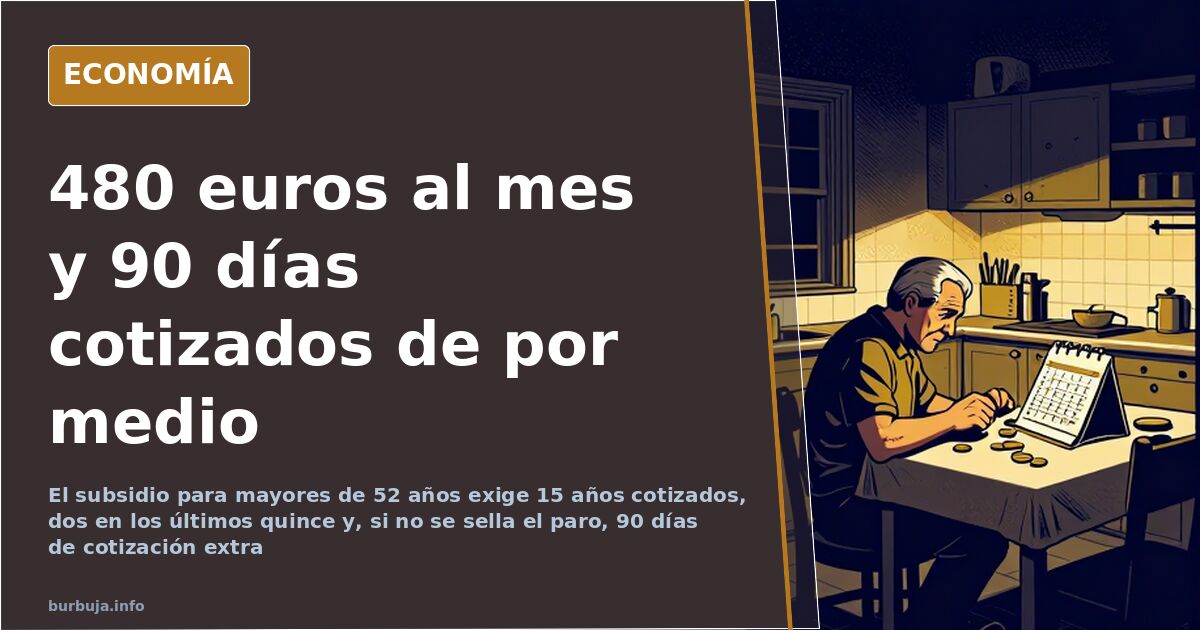
Claiming the over-52 subsidy: 480 euros and a 90-day trap
Since 1 November 2024, anyone hoping to get the over-52s subsidy must prove more than just a long contribution record. They must be in a legal situation of unemployment on or after that date and, if they cannot prove it through the normal route, add at least 90 days of contributions. The small print, seemingly harmless, has turned a 480-euro-a-month benefit into a maze for anyone who has spent a decade neither working nor going near the jobseeker registration to renew it.
The case that opens the query is textbook. A man about to turn 52, with more than fifteen years of contributions and two of them within the fifteen years before his application, had been out of the labour market for a decade. His doubt: whether he could pay his own contributions to generate those 90 days and unlock payment.
What requirements the over-52s subsidy imposes
It is not an early pension, even if it looks like one. It requires 15 years of contributions, two of which must fall within the fifteen years immediately before the application, and proof of legal unemployment status. The benefit lasts until ordinary retirement age and, while it is being paid, contributions continue to accrue.
Hence a recurring paradox: anyone who meets the 15 years to access the subsidy already has, in theory, a contributory pension guaranteed when they reach retirement age. The subsidy does not create the right; it fattens it. And that explains why at certain ages the incentive to keep working collapses, especially when the salary is one of those that does not last until the end of the month.
The 90 days of contributions: when they are really required
Here is the crux. Anyone who has kept their jobseeker registration alive, signing on every three months, does not need those 90 days. Anyone who stopped renewing their signing-on card loses that alibi and has to provide recent contributions.
The most-cited shortcut does not work, as was warned in the thread: self-employment does not count, because the self-employed regime does not contribute for unemployment under the general regime. Despite this, the tarifa plana (flat-rate self-employment fee) was raised: about 80 euros a month contributing on a base of around 950 euros, with the possibility of recovering the fee in regions that apply the cuota cero (zero contribution rate).
How much is received and how much is contributed under the subsidy
The amount is 80% of the IPREM (Spain's public income index), that is, 480 euros a month, and it is the only subsidy that, according to the thread, has not been updated in line with the cost of living. What is striking is not what is received, but what is contributed: the minimum base rises in 2025 from 1.653,75 to 1.726,66 euros a month, and the subsidy contributes at 125% of the SMI (minimum wage).
This creates a perverse effect highlighted with figures in the debate: some low-wage jobs contribute less than a long-term unemployed person contributes. For someone who is 60 and in a rank-and-file job, continuing to receive the subsidy may be more profitable for retirement than continuing to clock in.
What income is assessed if there are savings or assets
There is a threshold: income other than the subsidy cannot exceed 75% of the SMI, which puts the monthly limit at 888 euros. And here a calculation that surprises more than one person appears, raised in the thread: the SEPE (Spain's public employment service) would apply a presumed return of 3,25% to assets, so that 100.000 euros in accumulation funds would translate into 3.250 euros a year of imputed income.
The other flank is property. A case has been reported of an application granted to a person who had just sold their main home with more than a million euros in the bank, as the amount was considered to come from the sale of the house. A large property portfolio, by contrast, closes the door to other compatible benefits, according to another participant's account.
The case that ended with 92 days of contributions and an unsigned permanent contract
The story took a turn. The person asking found a job, covered the 92 days he was missing and, when the probation period ended, according to his own account, found himself registered as a permanent employee without having signed any document. His conclusion was uncomfortable: he could not resign, because voluntary resignation would leave him without the subsidy, nor did a dismissal ruled fair suit him. Weeks later he reported that he was already receiving the full subsidy and that he felt, in his words, proud to have achieved it.
The 15 years of contributions and the spectre of retirement
The underlying doubt remains unresolved. A case has circulated of a worker who was denied a retirement pension by the Seguridad Social (Spain's social security system) for being a few days short of the minimum 15 years, with the peculiarity that part of those contributions came from the subsidy itself.
With that horizon, the most sceptical camp argues that current conditions will blow up before many reach retirement age. It is no minor calculation: the subsidy today contributes above many real salaries, and the system is financed by the contributions of those still in work.
The problem is not who is entitled to the 480 euros. It is that the door opens or closes depending on whether you signed a card every three months a decade ago, and that nobody knows whether that right will still exist when the time comes to claim it.
Informational content on requirements and benefits. It does not constitute legal, tax or employment advice: conditions must be verified with the SEPE.
Since 1 November 2024, anyone hoping to get the over-52s subsidy must prove more than just a long contribution record. They must be in a legal situation of unemployment on or after that date and, if they cannot prove it through the normal route, add at least 90 days of contributions. The small print, seemingly harmless, has turned a 480-euro-a-month benefit into a maze for anyone who has spent a decade neither working nor going near the jobseeker registration to renew it.
The case that opens the query is textbook. A man about to turn 52, with more than fifteen years of contributions and two of them within the fifteen years before his application, had been out of the labour market for a decade. His doubt: whether he could pay his own contributions to generate those 90 days and unlock payment.
What requirements the over-52s subsidy imposes
It is not an early pension, even if it looks like one. It requires 15 years of contributions, two of which must fall within the fifteen years immediately before the application, and proof of legal unemployment status. The benefit lasts until ordinary retirement age and, while it is being paid, contributions continue to accrue.
Hence a recurring paradox: anyone who meets the 15 years to access the subsidy already has, in theory, a contributory pension guaranteed when they reach retirement age. The subsidy does not create the right; it fattens it. And that explains why at certain ages the incentive to keep working collapses, especially when the salary is one of those that does not last until the end of the month.
The 90 days of contributions: when they are really required
Here is the crux. Anyone who has kept their jobseeker registration alive, signing on every three months, does not need those 90 days. Anyone who stopped renewing their signing-on card loses that alibi and has to provide recent contributions.
The most-cited shortcut does not work, as was warned in the thread: self-employment does not count, because the self-employed regime does not contribute for unemployment under the general regime. Despite this, the tarifa plana (flat-rate self-employment fee) was raised: about 80 euros a month contributing on a base of around 950 euros, with the possibility of recovering the fee in regions that apply the cuota cero (zero contribution rate).
How much is received and how much is contributed under the subsidy
The amount is 80% of the IPREM (Spain's public income index), that is, 480 euros a month, and it is the only subsidy that, according to the thread, has not been updated in line with the cost of living. What is striking is not what is received, but what is contributed: the minimum base rises in 2025 from 1.653,75 to 1.726,66 euros a month, and the subsidy contributes at 125% of the SMI (minimum wage).
This creates a perverse effect highlighted with figures in the debate: some low-wage jobs contribute less than a long-term unemployed person contributes. For someone who is 60 and in a rank-and-file job, continuing to receive the subsidy may be more profitable for retirement than continuing to clock in.
What income is assessed if there are savings or assets
There is a threshold: income other than the subsidy cannot exceed 75% of the SMI, which puts the monthly limit at 888 euros. And here a calculation that surprises more than one person appears, raised in the thread: the SEPE (Spain's public employment service) would apply a presumed return of 3,25% to assets, so that 100.000 euros in accumulation funds would translate into 3.250 euros a year of imputed income.
The other flank is property. A case has been reported of an application granted to a person who had just sold their main home with more than a million euros in the bank, as the amount was considered to come from the sale of the house. A large property portfolio, by contrast, closes the door to other compatible benefits, according to another participant's account.
The case that ended with 92 days of contributions and an unsigned permanent contract
The story took a turn. The person asking found a job, covered the 92 days he was missing and, when the probation period ended, according to his own account, found himself registered as a permanent employee without having signed any document. His conclusion was uncomfortable: he could not resign, because voluntary resignation would leave him without the subsidy, nor did a dismissal ruled fair suit him. Weeks later he reported that he was already receiving the full subsidy and that he felt, in his words, proud to have achieved it.
The 15 years of contributions and the spectre of retirement
The underlying doubt remains unresolved. A case has circulated of a worker who was denied a retirement pension by the Seguridad Social (Spain's social security system) for being a few days short of the minimum 15 years, with the peculiarity that part of those contributions came from the subsidy itself.
With that horizon, the most sceptical camp argues that current conditions will blow up before many reach retirement age. It is no minor calculation: the subsidy today contributes above many real salaries, and the system is financed by the contributions of those still in work.
The problem is not who is entitled to the 480 euros. It is that the door opens or closes depending on whether you signed a card every three months a decade ago, and that nobody knows whether that right will still exist when the time comes to claim it.
Informational content on requirements and benefits. It does not constitute legal, tax or employment advice: conditions must be verified with the SEPE.
Summary of a discussion on Burbuja.info - Foro de economía, actualidad y política., translated from Spanish and reviewed before publication. Read the full discussion (200 replies).
More summaries
-
Forum Cites Social Security Data: Girona Leads at 41.2%
Forum cites August 2026 Social Security data: Girona, 41.2%; Teruel, 40.4%; Basque Country, 28.8%.
-
Spanish Minimum Income Benefit Exceeds Most Common Salary: Who Gets What
The Spanish Minimum Income Benefit (IMV) is 20% higher than the most common salary, but €1,195 is for a family of three, while €1,200 is for a single worker. Key details explained.
-
550 Euros from IMV vs. 1,200 for 40 Hours: The Deciding Gap
A university graduate in 2025 earns the same 1,200 euros as an assistant in 2005, while the minimum vital income is around 550 to 658 euros per month.
-
Euthanasia in Old Age: Autonomy vs. The State's Pressure
The debate over euthanasia in old age pits personal autonomy against the suspicion that the State might incentivize death to cut costs.
-
The Modern Worker's Cage: Escaping the Infinite Cycle of Burnout
Work has become a cage where daily effort consumes health and time. Discover why we push ourselves so hard and how to break the cycle.
-
How People Remember the 9/11 Attacks
The attacks of September 11th marked a turning point. Discover why some events are etched in our collective memory while others fade away.