
The 18-euro vote that keeps Spain's government in power
A Spanish retiree on a 1,000-euro pension switches his vote to the PSOE over an 18-euro monthly increase. His son calls him a traitor. The arithmetic of the pensioner vote.
English · Original discussion in Spanish · Published
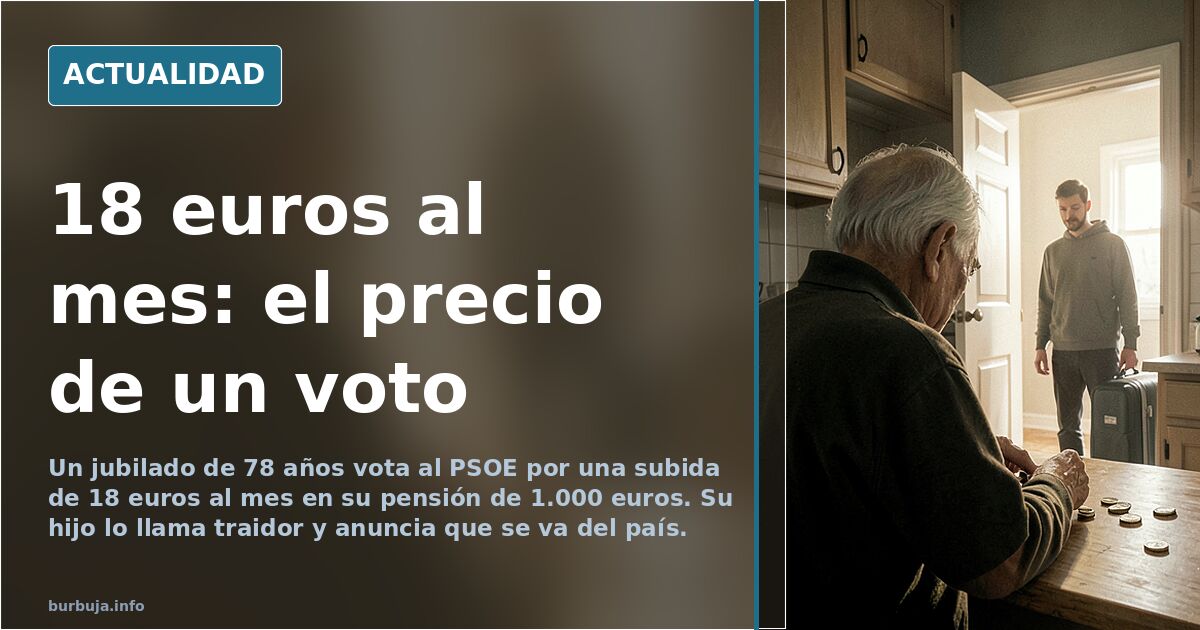
18 euros a month buy the vote of a retiree on a 1,000-euro pension
A 78-year-old widower who owns two homes outright and receives a 1,000-euro pension has gone, within a matter of weeks, from saying he would vote for one party to confirming he will vote for the PSOE (Spain's Socialist Party). The reason is not ideological: the pay rise of around 18 euros a month, some 200 a year. His son, a man in his forties with no home of his own and precarious jobs, has called him a traitor to his country, his roots and his descendants. The scene, extreme as it is, describes a pattern repeated in millions of Spanish households: the pensioner who adjusts his vote to the paycheck he receives, not to the country he leaves behind.
The case is told by the son himself on an economics forum, and its bluntness —"if I hated him before, I hate him even more now"— does not hide a statistical reality: retirees are the most disciplined group at the ballot box and the most sensitive to any change in their purchasing power. The increase in contributory pensions has become the government's most effective political tool, above any speech about employment, housing or public debt.
The arithmetic of the pensioner vote
The calculation is simple. A 1,000-euro monthly pension receives an increase of around 18 euros a month. Per year, about 200 euros. For the retiree, it is cash in hand arriving on the 25th. For his son, it is a pittance that does not offset the rise in the cost of groceries, petrol or rent. "I've explained to him that in the end he gets 200 more but loses purchasing power, but he just doesn't get it," he laments.
The generational gap is not only economic, it is one of perception. The father sees the extra income; the son sees a country in decline. And in between, an uncomfortable question: is it irrational to vote for 200 euros? For a pensioner who no longer works, whose home is paid off and who does not compete for a job, the answer is no. It is pure short-term utility maximisation. The problem is that this individual maximisation, aggregated, becomes a demographic and fiscal time bomb.
The "langosta" and the inheritance that never comes
The term "langosta" (literally "locust", used in Spain for pensioners who cling to their pensions regardless of everyone else's future) runs through the debate. One participant tells the opposite story: his mother, with an 1,800-euro pension and more than 600,000 euros in BBVA and Santander shares, not only does not vote, but would not mind having her pension cut so that young people could live better. "Not all of them are locusts," he concludes. The anecdote serves as a reminder that the group is not homogeneous, even if the trend is clear.
The retiree's son has it even tougher: "What I want is to get the inheritance and have a floor to fall on." Housing, or the lack of it, is the backdrop. While the father owns two paid-off homes, the son owns none and watches the family wealth dilute in a system that rewards old age and punishes youth. The inheritance, in this case, is not just an economic matter: it is the confirmation that social mobility has broken down.
The cult of the vote and the left's disillusionment
The debate drifts towards the nature of the voter. Some argue that PSOE voters are members of a cult, incapable of changing their vote even when it harms them. Another participant counters with his own experience: his mother, a lifelong Izquierda Unida (United Left) voter, will vote for VOX for the third time; his father, a former green and then PACMA voter, will do so for the second time. Vote transfers are not one-directional nor do they stem from a single cause.
The son, for his part, is self-critical: "Before I understood what the PSOE is, I voted PSOE because if you're poor you're not going to vote for the PP." He now votes for VOX and describes himself as a "single, childless, straight white man" whom the left has left behind. It is the chronicle of a disillusionment that is no longer measured in parliamentary seats, but in identity.
The electoral calendar and the Christmas bonus payment
One detail does not go unnoticed: Spain's general election will be held three days after pensioners receive their Christmas bonus payment. "A good dopamine shot to encourage the corresponding vote," one participant notes. The coincidence, whether intentional or not, reinforces the thesis that the political calendar is not detached from the payment calendar.
Contributory pensions have been uprated by 2.7% in 2026, while non-contributory ones have risen by 11.4%, according to the figures cited in the debate. The government thus keeps its commitment to guarantee purchasing power, but the question is at what cost and with what sustainability.
The prediction, with reservations
With all this, the pensioner vote is likely to remain decisive in the next election. The 18-euro monthly increase is a profitable investment in electoral terms: it costs little and mobilises a loyal electorate. The question is whether that same electorate will still be collecting in ten years' time. Public debt and the demographic pyramid allow no miracles. If the system collapses, the 18 euros will become a memory. By then, many of those who vote today for their pension will no longer be around. Others, those who have no home today, will still be paying for the party.
Also available in: Deutsch
Summary of a discussion on Burbuja.info - Foro de economía, actualidad y política., translated from Spanish and reviewed before publication. Read the full discussion (75 replies).
More summaries
-
Spain's 2027 pension rise won't come close to 8% under the CPI formula
The CPI formula puts the average pension increase at 3.33%, not the feared 8%. Reaching that figure would require October and November to exceed 30% year-on-year.
-
Pensions in Spain: the debate over who pays for those who came to pay
Spain's Social Security system now has 10.43 million pensions and the contributor-to-pensioner ratio has fallen to 2.24. The deficit keeps growing even as more workers arrive.
-
71% of Spain's former unaccompanied minors registered with social security
According to the Spanish government, 71% of young migrants who left state care are registered with Social Security. However, this metric counts registrations, not necessarily actual jobs.
-
Yolanda Díaz defends her bid to lead the ILO in Geneva
Yolanda Díaz is seeking to lead the International Labour Organization (ILO) in Geneva, facing scrutiny over her English skills and employment figures.
-
Why did humans develop consciousness?
A post argues that consciousness emerged as a semantic armor for the most defenseless primate. The hypothesis invites a fresh look at what science says about its origin.
-
Forum of idiocracies.
A message reduces everyday life to consumption and routine and dismisses political debate. The criticism offers no data or proposals and disparages anyone who disagrees.