
Tesla's driverless robotaxi now carries passengers in Austin
Tesla's Cybercab is now operating in Austin: 45-57% cheaper than Uber and with no driver. Taxi drivers are on the ropes.
English · Original discussion in Spanish · Published
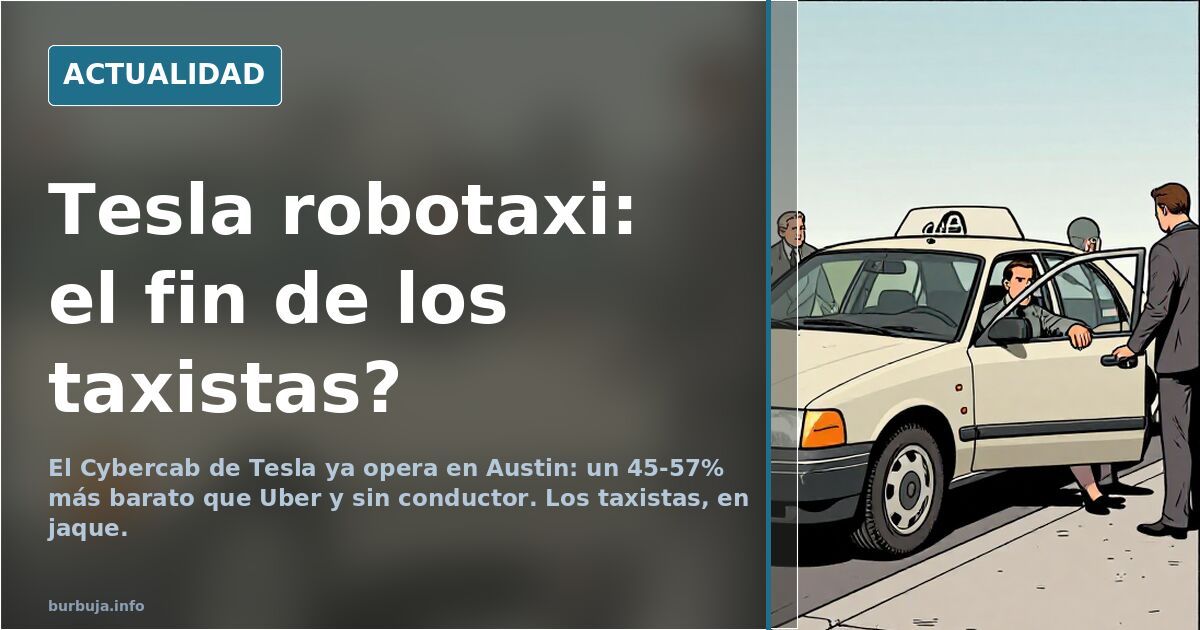
Tesla's robotaxi is now on the road in Austin: 45% cheaper than Uber and with no driver
A driverless Tesla Cybercab carrying a passenger has been spotted in downtown Austin, Texas. Footage shared on social media shows the vehicle driving normally, stopping at traffic lights and crosswalks. This is no test: the service is now officially operating in the city.
The autonomous taxi war
Tesla builds its own taxis, not adapted from other brands, and can produce 125,000 units a year with its current infrastructure. The projection is exponential: today 45, soon 100, then 500, then 1,000 a day. According to user data, the cost of a ride is 45-57% cheaper than Uber. Its competitor Waymo has applied for licenses in several European cities. Get used to the idea.
What about taxi drivers?
The question many are asking is what will happen to taxi licenses. The suggestion of selling the license and retiring to Benidorm no longer seems so far-fetched, although for some it comes too late. Those who bought one at a premium and are still paying off the mortgage are now watching its value collapse. It is a similar case to overpriced Spanish property.
The technical doubt remains: what would the robotaxi do if a cardboard box were placed in the middle of a pedestrian crossing? Skeptics question its ability to dodge unexpected obstacles. But the data suggest the expansion will be unstoppable. The question is whether the technology is ready for urban chaos.
Also available in: Deutsch
Summary of a discussion on Burbuja.info - Foro de economía, actualidad y política., translated from Spanish and reviewed before publication. Read the full discussion (17 replies).
More summaries
-
Tesla Cybercab Undercuts Uber at Half the Price in Austin
In Austin, the Tesla Cybercab charges $6.42 for a 2.17-mile ride, compared with $11.95 for UberX. The autonomous taxi war has begun.
-
Tesla: from savior to nightmare for taxi drivers
Taxi drivers who bought a Tesla to save money are now fighting poor real-world range, terrible service and the end of FreeNow bonuses. The irony: they are financing
-
Taxi Driver Recounts Ruin and Two Diagnoses; Faces Mockery
A 45-year-old man details his ruin as a self-employed taxi driver and two diagnoses, receiving only mockery and no support.
-
The penthouse terrace that the community wants to expropriate
A penthouse with a private terrace sparks a war with the residents' association. The law protects the owner, but neighborly pressure isn't won in court.
-
High trust society in Spain: a rural myth that didn't survive
The debate over a high trust society in Spain shows social trust eroded long before immigration. An analysis of the rural and urban myth.
-
Man in India rolls 5 kilometres to reach a Hindu temple
A man in **India** rolled **5 kilometres** to reach a Hindu temple, an act of devotion requiring great effort and preparation.