
Teruel building collapse exposes the precariousness of old housing stock
An 80s building collapses in Teruel, prompting evacuations of nearby blocks. Flats on the same street are listed between €150,000 and €180,000.
English · Original discussion in Spanish · Published
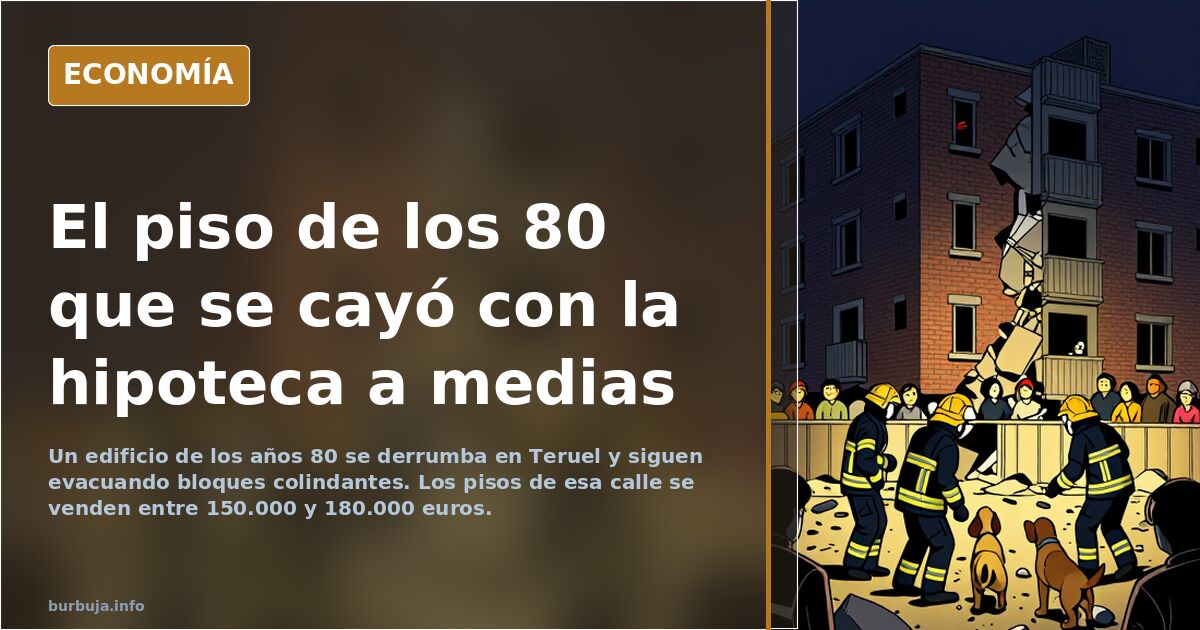
The 1980s building that collapsed in Teruel had 'paper-thin' pillars
On June 22, 2023, a residential building constructed in the 1980s collapsed in Teruel. The evacuation was a last-minute success, averting tragedy. However, the building's collapse raised an uncomfortable question for the real estate market: how many properties, currently sold at premium prices, are truly structurally sound? As neighboring blocks continue to be evacuated, prices on the same street have barely budged, remaining between €150,000 and €180,000 per flat, according to current listings.
Forty years is not old age for a building
The initial reaction was shock at the building's age. This data point is misleading: the average age of the housing stock in Spain is around 85 years, meaning a building from the 1980s is only forty years old, not elderly. Some argue that the problem is never the age but the materials and maintenance. Structures like the Pantheon in Rome, the Maison Carrée in Nîmes, or Madrid's Royal Palace, completed in 1760, still stand without issue. Conversely, there's a less grand argument: developments from the 1960s continue to be advertised for €300,000 in prime areas of major cities, and these might not withstand a serious inspection. The collapse of a similar block in Carabanchel shows this is not an isolated incident.
The slope, the leaks, and the pillar blown out from above
The dreaded sight reappeared: deformed pillars, concrete bursting at the crown, the right angle between beam and support distorted into something unrecognizable. This detail is not merely aesthetic. The building codes of the era did not mandate additional reinforcement at the junction of the pillar's steel and the beam's steel, which is where failure often begins. Added to this is the terrain: the building stood on a considerable slope, with water leaks requiring constant pumping, and housed a transformer substation below, necessitating a reinforced structure. Furthermore, in Aragón, gypsum and limestone dissolve with water, forming sinkholes – underground voids often expressly excluded by insurance policies. The local police inspector summarized it: the main pillars were like paper.
Who pays when your house falls down?
This is where the real owner's labyrinth begins. Coverage for the building's structure and reconstruction value is not based on its appraisal but on what you have insured it for. If a flat is worth €100,000 and the structure is insured for €50,000, that is the maximum amount you can claim. Many policies include earth movement or natural disasters, but only if contracted separately and by reading the fine print. Everything also depends on a document that most people are unaware of until it's too late: the Building Technical Inspection (ITE), which, without removing finishes, barely detects anything.
The €150,000 price tag on the street where it all came down
The market has barely reacted. Flats on the same street are still listed between €150,000 and €180,000, and with notary fees and renovations, the final outlay is considerable. The only concession made by the property market to physics was a phrase: the housing price has collapsed. An irony that summarizes the sector's state better than any quarterly report.
Questions remain unanswered: what truly peine hours before the collapse, why the ground-peine radar study wasn't conducted when it should have been, and how many other buildings on the same slope are supported by the same unstable incline. As new cracks appear in neighboring blocks, the answer becomes increasingly apparent.
On June 22, 2023, a residential building constructed in the 1980s collapsed in Teruel. The evacuation was a last-minute success, averting tragedy. However, the building's collapse raised an uncomfortable question for the real estate market: how many properties, currently sold at premium prices, are truly structurally sound? As neighboring blocks continue to be evacuated, prices on the same street have barely budged, remaining between €150,000 and €180,000 per flat, according to current listings.
Forty years is not old age for a building
The initial reaction was shock at the building's age. This data point is misleading: the average age of the housing stock in Spain is around 85 years, meaning a building from the 1980s is only forty years old, not elderly. Some argue that the problem is never the age but the materials and maintenance. Structures like the Pantheon in Rome, the Maison Carrée in Nîmes, or Madrid's Royal Palace, completed in 1760, still stand without issue. Conversely, there's a less grand argument: developments from the 1960s continue to be advertised for €300,000 in prime areas of major cities, and these might not withstand a serious inspection. The collapse of a similar block in Carabanchel shows this is not an isolated incident.
The slope, the leaks, and the pillar blown out from above
The dreaded sight reappeared: deformed pillars, concrete bursting at the crown, the right angle between beam and support distorted into something unrecognizable. This detail is not merely aesthetic. The building codes of the era did not mandate additional reinforcement at the junction of the pillar's steel and the beam's steel, which is where failure often begins. Added to this is the terrain: the building stood on a considerable slope, with water leaks requiring constant pumping, and housed a transformer substation below, necessitating a reinforced structure. Furthermore, in Aragón, gypsum and limestone dissolve with water, forming sinkholes – underground voids often expressly excluded by insurance policies. The local police inspector summarized it: the main pillars were like paper.
Who pays when your house falls down?
This is where the real owner's labyrinth begins. Coverage for the building's structure and reconstruction value is not based on its appraisal but on what you have insured it for. If a flat is worth €100,000 and the structure is insured for €50,000, that is the maximum amount you can claim. Many policies include earth movement or natural disasters, but only if contracted separately and by reading the fine print. Everything also depends on a document that most people are unaware of until it's too late: the Building Technical Inspection (ITE), which, without removing finishes, barely detects anything.
The €150,000 price tag on the street where it all came down
The market has barely reacted. Flats on the same street are still listed between €150,000 and €180,000, and with notary fees and renovations, the final outlay is considerable. The only concession made by the property market to physics was a phrase: the housing price has collapsed. An irony that summarizes the sector's state better than any quarterly report.
Questions remain unanswered: what truly peine hours before the collapse, why the ground-peine radar study wasn't conducted when it should have been, and how many other buildings on the same slope are supported by the same unstable incline. As new cracks appear in neighboring blocks, the answer becomes increasingly apparent.
Summary of a discussion on Burbuja.info - Foro de economía, actualidad y política., translated from Spanish and reviewed before publication. Read the full discussion (236 replies).
More summaries
-
Diesel Nears €2 as Madrid Public Transport Overwhelms
Diesel prices hit €1.74, with forecasts of a further 24-cent rise in October. Meanwhile, Madrid's public transport is struggling with peak hour crowds.
-
Eviction of 87-year-old woman: Clash over responsibilities in Madrid
The eviction of an 87-year-old woman in Madrid pits those demanding explanations from Ayuso against those pointing to the Supreme Court.
-
Euthanasia in Old Age: Autonomy vs. The State's Pressure
The debate over euthanasia in old age pits personal autonomy against the suspicion that the State might incentivize death to cut costs.
-
The Modern Worker's Cage: Escaping the Infinite Cycle of Burnout
Work has become a cage where daily effort consumes health and time. Discover why we push ourselves so hard and how to break the cycle.
-
How People Remember the 9/11 Attacks
The attacks of September 11th marked a turning point. Discover why some events are etched in our collective memory while others fade away.
-
Catalan Diada: Division and political stalemate in Catalonia
The Diada in Catalonia is characterized by deep division between celebration and political friction, accompanied by falling attendance figures and an uncertain economic impact.