
Eviction of 87-year-old woman: Clash over responsibilities in Madrid
The eviction of an 87-year-old woman in Madrid pits those demanding explanations from Ayuso against those pointing to the Supreme Court.
English · Original discussion in Spanish · Published
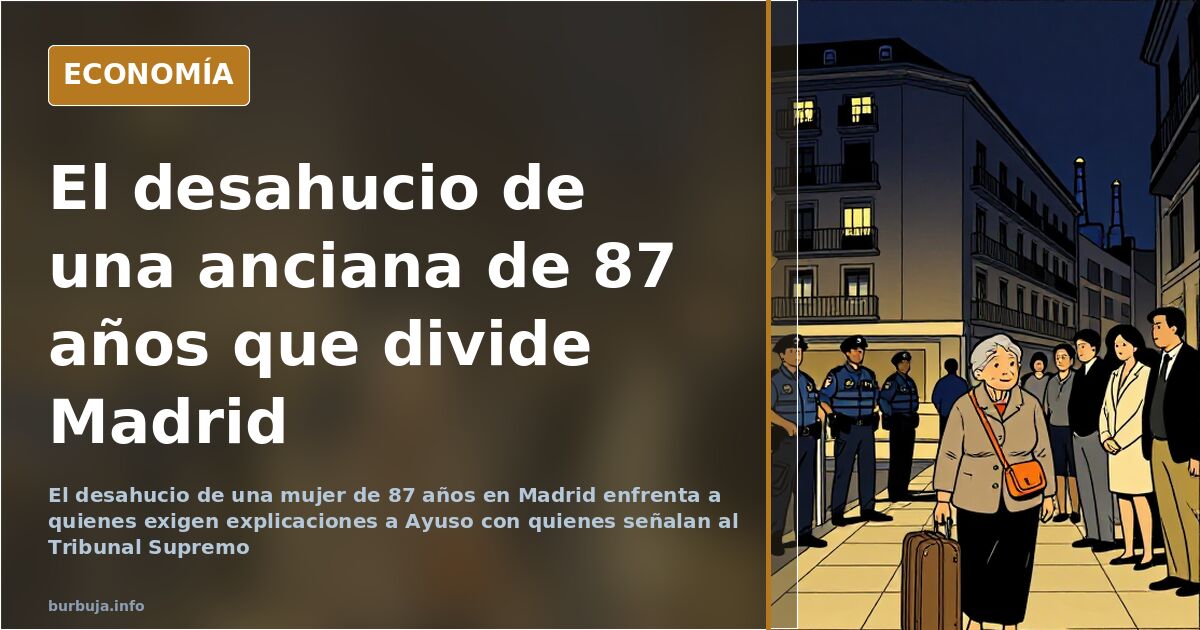
Eviction of 87-year-old woman turns Madrid into a battleground
An 87-year-old woman has been evicted in Madrid, and the case has moved from the courts to political brawling within hours. The question being asked repeatedly these days is whether the Community of Madrid's government should give explanations — and to whom — for a situation that, according to the most common narrative, reached the UN. Before igniting the fuse, it's worth examining the actual procedure.
Who ordered the eviction and what is Ayuso's responsibility?
The point supporting one side of the analysis is that the eviction was ordered by the Supreme Court, not the regional executive. On that basis, some argue that the Madrid president has not intervened in the procedure in any way and that demanding she account to a judge is baseless: no crime or specific jurisdiction is identified. Against this is another reading, which holds that a case of this gravity should carry political, though not judicial, responsibilities.
Furthermore, confusion over roles floods the issue: Ayuso is not the mayor of Madrid, and much of the noise mixes municipal, regional, and state responsibilities.
Residency placement and the waiting lists no one explains
A technical detail that is often overlooked emerges here. According to the circulating narrative, the affected person was offered a place in a public residence. The fine print is that these places are not assigned immediately: those arriving from a hospital with a medical report, the technical director's signature, and a social worker's assessment have priority, but there is still a waiting list. Even so, the wait is much shorter. There is no overnight admission. Never.
The judicial outcome remains open, and demonstrations in Madrid do not seem to be subsiding. The data that frames all the noise remains: 272,000 evictions, the figure used to measure the underlying problem. With that volume on the table, discussing whether a specific signature reaches a court becomes, at the very least, trivial.
An 87-year-old woman has been evicted in Madrid, and the case has moved from the courts to political brawling within hours. The question being asked repeatedly these days is whether the Community of Madrid's government should give explanations — and to whom — for a situation that, according to the most common narrative, reached the UN. Before igniting the fuse, it's worth examining the actual procedure.
Who ordered the eviction and what is Ayuso's responsibility?
The point supporting one side of the analysis is that the eviction was ordered by the Supreme Court, not the regional executive. On that basis, some argue that the Madrid president has not intervened in the procedure in any way and that demanding she account to a judge is baseless: no crime or specific jurisdiction is identified. Against this is another reading, which holds that a case of this gravity should carry political, though not judicial, responsibilities.
Furthermore, confusion over roles floods the issue: Ayuso is not the mayor of Madrid, and much of the noise mixes municipal, regional, and state responsibilities.
Residency placement and the waiting lists no one explains
A technical detail that is often overlooked emerges here. According to the circulating narrative, the affected person was offered a place in a public residence. The fine print is that these places are not assigned immediately: those arriving from a hospital with a medical report, the technical director's signature, and a social worker's assessment have priority, but there is still a waiting list. Even so, the wait is much shorter. There is no overnight admission. Never.
The judicial outcome remains open, and demonstrations in Madrid do not seem to be subsiding. The data that frames all the noise remains: 272,000 evictions, the figure used to measure the underlying problem. With that volume on the table, discussing whether a specific signature reaches a court becomes, at the very least, trivial.
Summary of a discussion on Burbuja.info - Foro de economía, actualidad y política., translated from Spanish and reviewed before publication. Read the full discussion (34 replies).
More summaries
-
87-Year-Old Tenant Evicted After 70 Years Paying Below-Market Rent
An 87-year-old woman faces eviction after 70 years in a Madrid apartment under an 'old rent' contract, paying around 500 euros monthly.
-
Córdoba Father Self-Immolates: Mental Illness or Societal Despair?
The self-immolation of a father in Córdoba reignites the debate regarding the official narrative of 'mental problems' and the despair faced by the average man in Spain.
-
Euthanasia in Old Age: Autonomy vs. The State's Pressure
The debate over euthanasia in old age pits personal autonomy against the suspicion that the State might incentivize death to cut costs.
-
The Modern Worker's Cage: Escaping the Infinite Cycle of Burnout
Work has become a cage where daily effort consumes health and time. Discover why we push ourselves so hard and how to break the cycle.
-
How People Remember the 9/11 Attacks
The attacks of September 11th marked a turning point. Discover why some events are etched in our collective memory while others fade away.
-
Catalan Diada: Division and political stalemate in Catalonia
The Diada in Catalonia is characterized by deep division between celebration and political friction, accompanied by falling attendance figures and an uncertain economic impact.