
Tension in Madrid's Sol Square as flag-wavers clash with protesters
Spanish flag supporters and housing protesters met at Puerta del Sol on October 12, forcing police to separate the groups amid high tension.
English · Original discussion in Spanish · Published
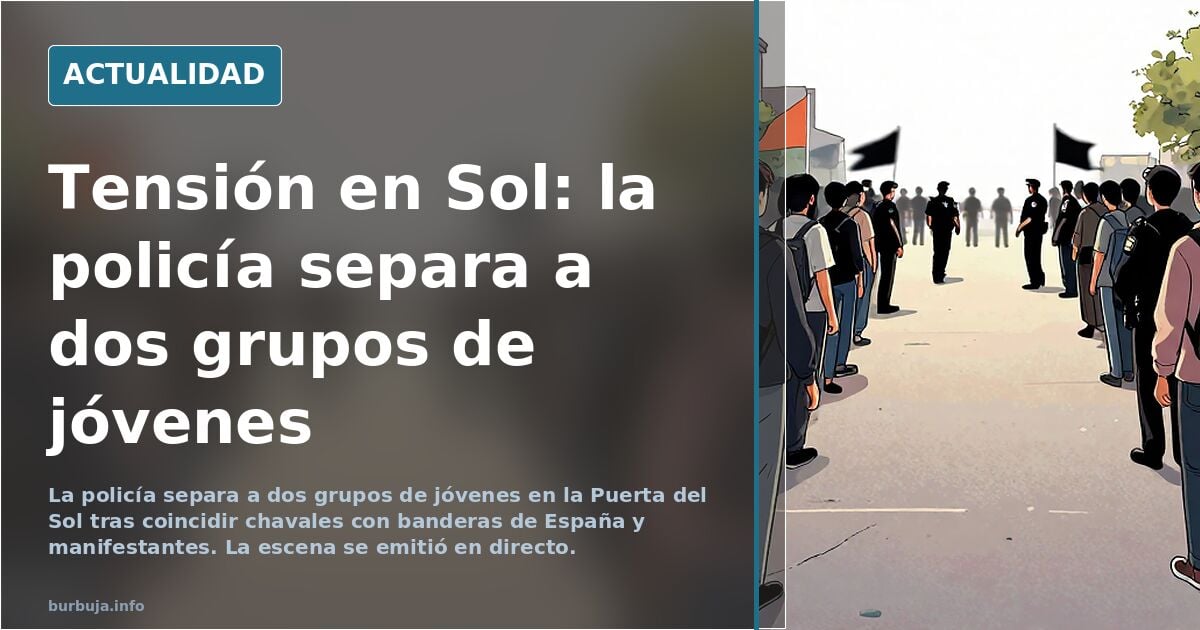
Puerta del Sol: Spanish flags and protesters face off
What peine on October 12 at Madrid's Puerta del Sol? According to participant accounts, a group of young people waving Spanish flags encountered the demonstrators who have occupied the square for weeks. The result was a heavy police presence that separated the two sides during an afternoon of rising tension. Live TV broadcasts showed youths displaying national symbols facing the campers, with National Police vans forming a barrier between them. The incident reignited debate over public space management in the capital's center and who should have anticipated the collision.
The trigger: a parade, a protest camp, and a shared destination
October 12 is marked by an official military parade and traditional citizen walks through the city center. On that day, reports indicated that some parade attendees decided to head to Sol for aperitifs. For weeks, protesters have maintained a camp there using tarps and improvised structures. The meeting was not planned but hardly unexpected; any schedule highlighted the risk.
Criticism focused heavily on the Delegado del Gobierno en Madrid (Government Delegate in Madrid), accused of failing to anticipate the encounter or close plaza access in advance. The question was simple: if two groups with opposing symbols were known to converge at the same point, why wasn't a cordon established 200 meters earlier? No clear official answer emerged.
Who is who: flags, shower gel, and conflicting narratives
The most circulated image showed young people holding up a bottle of shower gel toward the protesters, a gesture interpreted as mockery of the camp's hygiene conditions. Simultaneously, videos spread showing shoving, insults, and scuffles. Police intervened to separate the groups, but crowd density made control difficult.
Accounts diverge. Some claim protesters responded with provocative gestures; others assert the flag-waving youths sought confrontation. What remained clear was the presence of real tension, with officers intervening and the plaza turning volatile for hours. Television aired it live, and social media amplified every fragment.
The core issue: housing, squatting, and media narrative
Beyond the clash, the episode exposed underlying discontent. Protesters demonstrate against high housing prices and evictions; critics accuse them of occupying public space without authorization and turning the square into a campsite. Some argue the government maintains a permissive stance for political reasons, while others recall that the Constitution protects the right to assembly.
Arguments expanded to broader themes: polarization, historical memory, and alleged media equidistance. Some spoke of "the two Spains"; others referred to young people lacking historical awareness. The housing discussion often took a back seat.
In the end, what remains is an occupied square, a parade that ended in Sol, and an unanswered question: who should have prevented their paths from crossing? As usual, the answer lies with those who weren't there.
Also available in: Deutsch
Summary of a discussion on Burbuja.info - Foro de economía, actualidad y política., translated from Spanish and reviewed before publication. Read the full discussion (185 replies).
More summaries
-
Madrid's Puerta del Sol: Encampment Disrupts City Center
Reports describe urine trails, ammonia in the Metro, and empty shops on Preciados street due to a prolonged occupation of Madrid's main square.
-
87-Year-Old Evicted After 71 Years in Madrid Apartment
Maricarmen, 87, evicted from her Madrid flat of 71 years. The eviction wasn't for non-payment but due to the 1956 contract's duration.
-
Forum attributes call to clear Madrid's Sol square to DN
A message attributes to Democracia Nacional a call to clear Sol square, and the comparison with the Ceuta encampment becomes the focus of the debate
-
The Cerdà Plan: a decree from Madrid and speculation in Barcelona's Eixample
The Cerdà Plan arrived by decree from Madrid —so the debate goes— after Rovira i Trias won the competition. The first stone was laid in 1860.
-
The mail-in ballot fraud myth: 400,000 votes without oversight
A claim is circulating that postal voting and lists of chronic non-voters allow 400,000 ballots to be cast without oversight. France banned it in 1975.
-
Black widow of Patraix returns to Picassent prison as son turns three
Spain's prison service moves Maje from the Fontcalent mothers' unit in Alicante back to Picassent, Valencia, after her son turned three and goes into his grandmother's custody