
Madrid's Puerta del Sol: Encampment Disrupts City Center
Reports describe urine trails, ammonia in the Metro, and empty shops on Preciados street due to a prolonged occupation of Madrid's main square.
English · Original discussion in Spanish · Published
A Day in Occupied Puerta del Sol
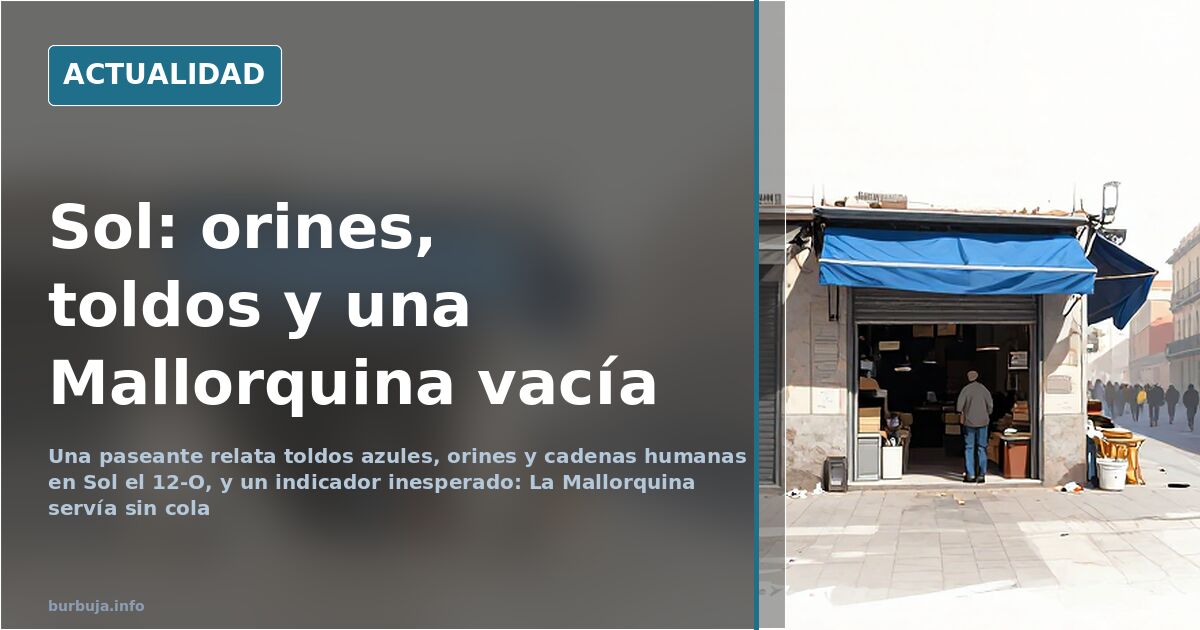
For days, Madrid’s Puerta del Sol has been transformed into an encampment that authorities have not cleared. Those walking through Callao these days do not find the postcard-perfect square; they encounter trails of urine on the ground, blue tarps, human chains blocking access, and a smell rising from the Metro ventilation shafts. The account of a local woman who went to buy her cream-filled pastry at La Mallorquina—served instantly, an unusual occurrence—summarizes the situation in the center better than any official report.
What You See Upon Arriving at Puerta del Sol
The scene described by those who have passed through recently mixes tourists, families, and groups openly identifying as anti-fascist. Slogans like "fascists out of our neighborhoods" or "they shall not pass" are heard, and those wearing Spanish flag details receive comments. On October 12th, Hispanic Heritage Day, the coexistence of both groups in the same space generated moments of tension contained by a handful of riot police.
The description of the camp is meticulous: tents, cans, containers, accumulated dirt in the so-called base zones, a man with a megaphone sitting in a chair, and a human chain guarding the accesses. An ordinary citizen cannot cross that area. The feeling of the narrator is that anything could be happening inside, and no one would see it.
Real Impact on Shops on Preciados Street and Surroundings
Here lies the data generating the most discussion. The same person who walked through the area claims she entered two two-story clothing stores and found two people in one and six or seven in the other. Hours and time slots when these shops are usually full. At La Mallorquina, service was immediate, something any Madrileño knows does not happen even at nine in the morning.
Against this version, there are those who argue that commerce in the zone is not suffering any relevant impact. The numbers provided by the account—two customers, six customers, a bakery without a line—point in the opposite direction. This discrepancy is not resolved with opinions: it is resolved by measuring foot traffic and revenue, and that data is not on the table.
The Smell Rising from the Metro
The issue ceases to be aesthetic when it enters the sanitary realm. The accumulation of urine in the square has spiked ammonia levels in the Metro de Madrid ventilation shafts, according to circulating reports. Disinfection requires industrial vacuum trucks and specialized vehicles, with a specific technical protocol to mitigate risk. It is not a matter of olfactory impression: it is urea fermenting under a square traversed by hundreds of thousands of people.
Some recall that central Madrid has smelled of urine for years, with or without camps. Tourist pressure and homelessness explain part of the phenomenon. But the current concentration adds a new factor: a permanent occupation preventing ordinary cleaning and turning a chronic problem into a technical emergency.
Who Is Behind It and Who Pays the Bill
The profile of the campers described includes tattoos, piercings, identifying clothing, and Palestinian keffiyehs used as scarves. Among them, according to the same source, mix clearly identifiable ultras wearing masks. The political interpretation made by some sectors is that this represents the ultimate excretion of expansive capitalism, a paradox that does not go unnoticed.
The bill is paid by local businesses, neighbors, and workers crossing Preciados street daily. Also by tourists taking home an image of central Madrid that appears in no institutional campaign. And there is a question no one answers with data: how much does it cost the public treasury to maintain a device that does not evict, clean what gets dirty every night, and replace what deteriorates?
Recent Developments Regarding the Camp
The evolution is the least clear part of the matter. Some claim almost no one remains sleeping in the square. Others argue the occupation continues unchanged. The only verifiable fact is that the conflict between those defending the encampment and those demanding eviction has also moved to social media and news outlets, with incompatible versions about the same physical space.
What has changed is the tone. What started as a complaint about smell and dirt has derived into a struggle over who has the right to use the square, who decides when it is cleaned, and who assumes the cost of not doing so. Comparisons with 1936 appear in more than one conversation, and that is a signal worth not ignoring.
The camp remains there. So do the vacuum trucks. And the shops on Preciados continue opening each morning hoping someone crosses the threshold. No one has yet published how much revenue has dropped in the area, nor how much cleaning has cost, nor when anyone plans to evict. Without those three numbers, the discussion will remain what it is: a fight of versions.
For days, Madrid’s Puerta del Sol has been transformed into an encampment that authorities have not cleared. Those walking through Callao these days do not find the postcard-perfect square; they encounter trails of urine on the ground, blue tarps, human chains blocking access, and a smell rising from the Metro ventilation shafts. The account of a local woman who went to buy her cream-filled pastry at La Mallorquina—served instantly, an unusual occurrence—summarizes the situation in the center better than any official report.
What You See Upon Arriving at Puerta del Sol
The scene described by those who have passed through recently mixes tourists, families, and groups openly identifying as anti-fascist. Slogans like "fascists out of our neighborhoods" or "they shall not pass" are heard, and those wearing Spanish flag details receive comments. On October 12th, Hispanic Heritage Day, the coexistence of both groups in the same space generated moments of tension contained by a handful of riot police.
The description of the camp is meticulous: tents, cans, containers, accumulated dirt in the so-called base zones, a man with a megaphone sitting in a chair, and a human chain guarding the accesses. An ordinary citizen cannot cross that area. The feeling of the narrator is that anything could be happening inside, and no one would see it.
Real Impact on Shops on Preciados Street and Surroundings
Here lies the data generating the most discussion. The same person who walked through the area claims she entered two two-story clothing stores and found two people in one and six or seven in the other. Hours and time slots when these shops are usually full. At La Mallorquina, service was immediate, something any Madrileño knows does not happen even at nine in the morning.
Against this version, there are those who argue that commerce in the zone is not suffering any relevant impact. The numbers provided by the account—two customers, six customers, a bakery without a line—point in the opposite direction. This discrepancy is not resolved with opinions: it is resolved by measuring foot traffic and revenue, and that data is not on the table.
The Smell Rising from the Metro
The issue ceases to be aesthetic when it enters the sanitary realm. The accumulation of urine in the square has spiked ammonia levels in the Metro de Madrid ventilation shafts, according to circulating reports. Disinfection requires industrial vacuum trucks and specialized vehicles, with a specific technical protocol to mitigate risk. It is not a matter of olfactory impression: it is urea fermenting under a square traversed by hundreds of thousands of people.
Some recall that central Madrid has smelled of urine for years, with or without camps. Tourist pressure and homelessness explain part of the phenomenon. But the current concentration adds a new factor: a permanent occupation preventing ordinary cleaning and turning a chronic problem into a technical emergency.
Who Is Behind It and Who Pays the Bill
The profile of the campers described includes tattoos, piercings, identifying clothing, and Palestinian keffiyehs used as scarves. Among them, according to the same source, mix clearly identifiable ultras wearing masks. The political interpretation made by some sectors is that this represents the ultimate excretion of expansive capitalism, a paradox that does not go unnoticed.
The bill is paid by local businesses, neighbors, and workers crossing Preciados street daily. Also by tourists taking home an image of central Madrid that appears in no institutional campaign. And there is a question no one answers with data: how much does it cost the public treasury to maintain a device that does not evict, clean what gets dirty every night, and replace what deteriorates?
Recent Developments Regarding the Camp
The evolution is the least clear part of the matter. Some claim almost no one remains sleeping in the square. Others argue the occupation continues unchanged. The only verifiable fact is that the conflict between those defending the encampment and those demanding eviction has also moved to social media and news outlets, with incompatible versions about the same physical space.
What has changed is the tone. What started as a complaint about smell and dirt has derived into a struggle over who has the right to use the square, who decides when it is cleaned, and who assumes the cost of not doing so. Comparisons with 1936 appear in more than one conversation, and that is a signal worth not ignoring.
The camp remains there. So do the vacuum trucks. And the shops on Preciados continue opening each morning hoping someone crosses the threshold. No one has yet published how much revenue has dropped in the area, nor how much cleaning has cost, nor when anyone plans to evict. Without those three numbers, the discussion will remain what it is: a fight of versions.
Also available in: Deutsch
Summary of a discussion on Burbuja.info - Foro de economía, actualidad y política., translated from Spanish and reviewed before publication. Read the full discussion (207 replies).
More summaries
-
"Not AI": The Plaza del Sol Campout with Loudspeakers Sparks Debate
A video of a campout with sound equipment in Plaza del Sol ignites discussion about the "Decreto Maricarmen" and who pays for the setup.
-
Casanova sparks debate on Spanish state-funded cinema
Eduardo Casanova's documentary 'Sidosa' drew only 381 viewers in 79 theaters, reigniting controversy over public subsidies for Spanish film.
-
Petition seeks legal action against Carla Galeote for filming neighbor
A Change.org petition demands justice for a 70-year-old man filmed without consent by influencer Carla Galeote, citing privacy laws.
-
Andy and Lucas singer's nose fuels cocaine debate in Spain
Lucas of Andy and Lucas attributes his damaged nose to rhinoplasty complications, but experts cite avascular necrosis from cocaine use.
-
Ramoncín: From fried chicken king to aging controversy
Spanish singer Ramoncín faces scrutiny over his appearance and past SGAE role, reviving debates on digital levies and public perception.
-
Manlleu brawl reignites debate on coexistence in Spain
An old video of a fight in Manlleu fuels broader discussions on immigration, security, and official narratives.