
Tenants' Union turns its strike against Spain's PSOE over rentierism
The Sindicato de Inquilinas redirects its general strike against the PSOE, accusing it of rentierism, and points to the eviction ordered by Óscar López's ministry.
English · Original discussion in Spanish · Published
Tenants' Union turns its strike against Spain's PSOE over rentierism
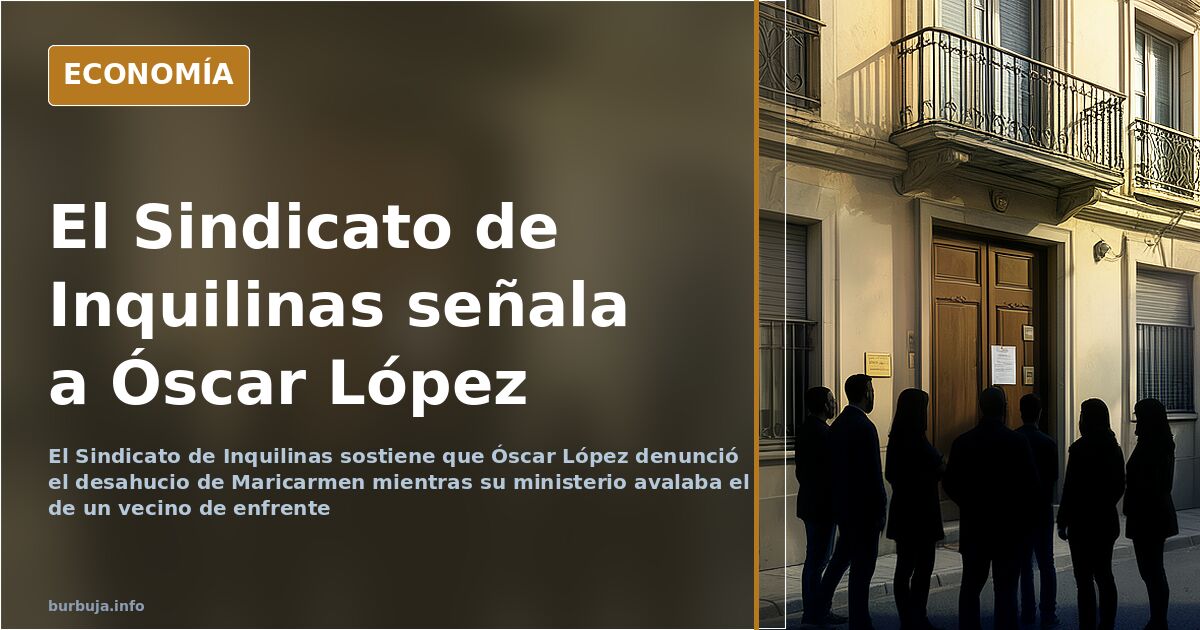
Can a tenants' union put the party that claims to defend housing as a right in a tight spot? That is exactly what peine this November, when the Sindicato de Inquilinas e Inquilinos de Madrid (Madrid tenants' union) redirected its general strike against the PSOE, accusing it of being a rentier party. The accusation is not abstract: it rests on a concrete case, the eviction ordered by Óscar López's ministry, affecting a tenant who pays 600 euros in old-regime rent and lives across from Maricarmen, the woman whose eviction the minister himself had denounced. The paradox is textbook and has set the public debate ablaze in the middle of the pre-election campaign.
What peine and who is behind the shift
The union has announced a general strike for 11 November against the PSOE, which it points to as part of the property business. The trigger is the eviction ordered by Óscar López's ministry, which, according to the union, endorses the procedure to evict a tenant with an old-regime lease. The paradox is that Óscar López himself had publicly denounced the eviction of Maricarmen, a neighbour in the same building. The union has called it hypocrisy without limits.
The case has had immediate media traction. Several outlets have picked up on the contradiction and the union has gone from being a secondary player to becoming the government's scourge on housing. The underlying accusation is that the PSOE promises to fight rentierism while some of its own ranks make money from the property business. The union has focused on the Socialist spokesperson Montse Mínguez, whose partner holds at least 30 rental properties, according to information the union itself has circulated.
The contradiction of a minister who denounces evictions
The core of the scandal is the double standard. Óscar López was denouncing Maricarmen's eviction while his ministry endorsed the procedure to evict a neighbour across the street, according to the union, citing Artículo 14. The union summed it up with a phrase that went viral: «Hypocrisy sometimes knows no limits».
The case has an economic detail that has not gone unnoticed: the affected tenant was paying 600 euros in rent, an old-regime lease. With the new tenant, the price could triple. In other words, the eviction does not just affect one person; it is part of a property revaluation operation. That is the argument the union uses to speak of structural rentierism rather than an isolated case.
The PSOE and its weak flank: housing
The government has tried to divert attention to other issues, such as pensions, but housing has become a swamp that is not easy to get out of. In the most repeated analysis these days, the argument is that the Executive needs a plan C because the issue is blowing up in its face. The pre-election campaign is marked by this issue and by communication blunders.
Some argue that the PSOE is obsessed with talking about pensions to cover up Ester Muñoz's blunder on her podcast. Others point out that the tenants' union is risking everything if it continues down this path, and that its funding could be cut. The shadow of dependence on subsidies looms over activism.
The PP and VOX: the opportunity they fail to seize
If the PSOE is in trouble, the opposition is no better. The easiest election campaign in history to sweep the left is turning into a string of blunders. The PP's campaign manager must have been bought by the PSOE, some joke, because the conservatives' gaffes are legendary.
The conclusion drawn from the analyses is that nobody is particularly keen on winning. Spanish politics has become an open-air madhouse, and the electorate watches the spectacle in astonishment. The question hanging in the air is whether the PP and VOX will be able to capitalise on the discontent or whether, as usual, they will botch it.
The rental business: necessary eviction or abuse?
At the bottom of the debate lies the question of evictions. Some argue they are necessary, because without them nobody would pay the rent. The argument is that thanks to renting, one can enjoy a property worth 100 for just 0.5 a month. If not even that is paid, the property would effectively be confiscated, and there must be eviction for whoever breaches the contract.
The opposing view holds that the problem is not non-payment but speculation. The case of the old-regime tenant is paradigmatic: he paid 600 euros and the new contract could triple that figure. The speculators are not the right-wing fascists, some joke, but those who evict a tenant to raise the price.
In the end, the question is whether the Sindicato de Inquilinas will manage to make the PSOE pay an electoral price for its contradiction. The answer, as always, will come from the ballot box. Or not.
Can a tenants' union put the party that claims to defend housing as a right in a tight spot? That is exactly what peine this November, when the Sindicato de Inquilinas e Inquilinos de Madrid (Madrid tenants' union) redirected its general strike against the PSOE, accusing it of being a rentier party. The accusation is not abstract: it rests on a concrete case, the eviction ordered by Óscar López's ministry, affecting a tenant who pays 600 euros in old-regime rent and lives across from Maricarmen, the woman whose eviction the minister himself had denounced. The paradox is textbook and has set the public debate ablaze in the middle of the pre-election campaign.
What peine and who is behind the shift
The union has announced a general strike for 11 November against the PSOE, which it points to as part of the property business. The trigger is the eviction ordered by Óscar López's ministry, which, according to the union, endorses the procedure to evict a tenant with an old-regime lease. The paradox is that Óscar López himself had publicly denounced the eviction of Maricarmen, a neighbour in the same building. The union has called it hypocrisy without limits.
The case has had immediate media traction. Several outlets have picked up on the contradiction and the union has gone from being a secondary player to becoming the government's scourge on housing. The underlying accusation is that the PSOE promises to fight rentierism while some of its own ranks make money from the property business. The union has focused on the Socialist spokesperson Montse Mínguez, whose partner holds at least 30 rental properties, according to information the union itself has circulated.
The contradiction of a minister who denounces evictions
The core of the scandal is the double standard. Óscar López was denouncing Maricarmen's eviction while his ministry endorsed the procedure to evict a neighbour across the street, according to the union, citing Artículo 14. The union summed it up with a phrase that went viral: «Hypocrisy sometimes knows no limits».
The case has an economic detail that has not gone unnoticed: the affected tenant was paying 600 euros in rent, an old-regime lease. With the new tenant, the price could triple. In other words, the eviction does not just affect one person; it is part of a property revaluation operation. That is the argument the union uses to speak of structural rentierism rather than an isolated case.
The PSOE and its weak flank: housing
The government has tried to divert attention to other issues, such as pensions, but housing has become a swamp that is not easy to get out of. In the most repeated analysis these days, the argument is that the Executive needs a plan C because the issue is blowing up in its face. The pre-election campaign is marked by this issue and by communication blunders.
Some argue that the PSOE is obsessed with talking about pensions to cover up Ester Muñoz's blunder on her podcast. Others point out that the tenants' union is risking everything if it continues down this path, and that its funding could be cut. The shadow of dependence on subsidies looms over activism.
The PP and VOX: the opportunity they fail to seize
If the PSOE is in trouble, the opposition is no better. The easiest election campaign in history to sweep the left is turning into a string of blunders. The PP's campaign manager must have been bought by the PSOE, some joke, because the conservatives' gaffes are legendary.
The conclusion drawn from the analyses is that nobody is particularly keen on winning. Spanish politics has become an open-air madhouse, and the electorate watches the spectacle in astonishment. The question hanging in the air is whether the PP and VOX will be able to capitalise on the discontent or whether, as usual, they will botch it.
The rental business: necessary eviction or abuse?
At the bottom of the debate lies the question of evictions. Some argue they are necessary, because without them nobody would pay the rent. The argument is that thanks to renting, one can enjoy a property worth 100 for just 0.5 a month. If not even that is paid, the property would effectively be confiscated, and there must be eviction for whoever breaches the contract.
The opposing view holds that the problem is not non-payment but speculation. The case of the old-regime tenant is paradigmatic: he paid 600 euros and the new contract could triple that figure. The speculators are not the right-wing fascists, some joke, but those who evict a tenant to raise the price.
In the end, the question is whether the Sindicato de Inquilinas will manage to make the PSOE pay an electoral price for its contradiction. The answer, as always, will come from the ballot box. Or not.
Also available in: Deutsch
Summary of a discussion on Burbuja.info - Foro de economía, actualidad y política., translated from Spanish and reviewed before publication. Read the full discussion (62 replies).
More summaries
-
Spain's Óscar López faces eviction scandal involving Muface
Madrid Tenants Union alleges Minister Óscar López approved a Muface tenant eviction while protesting a similar case in the same building.
-
Spanish Socialist Spokesperson Faces Backlash Over Partner's Rental Portfolio
PSOE spokesperson Montse Mínguez advocates rent caps while her partner owns over 30 properties and faces three evictions.
-
PSOE Spokesperson Mínguez Faces Questions Over Partner's 30 Rentals
Data on the 30 rental properties owned by PSOE spokesperson Montse Mínguez's partner emerges, as she labels inquiries a personal attack.
-
La Sexta turns on Spain's PM Sánchez in fight over state advertising
The distribution of institutional advertising and a new DTT channel explain La Sexta's shift against Spain's Government. No single theory fully holds up.
-
Forum debate on Ukraine and women seeking partners abroad
A forum thread mixes unverified estimates of war deaths in Ukraine with comments about women seeking partners outside the country
-
AI debate points to 30% discounts and fewer programmers
An industry debate anticipates 30% discounts and smaller teams: AI absorbs repetitive code, and the adjustment lands on programmers