
Tenant in Palma trapped by family squatting in her living room
A tenant in Palma reports being unable to evict a Colombian family squatting in her shared flat, citing the legal protection of their registered minor children.
English · Original discussion in Spanish · Published
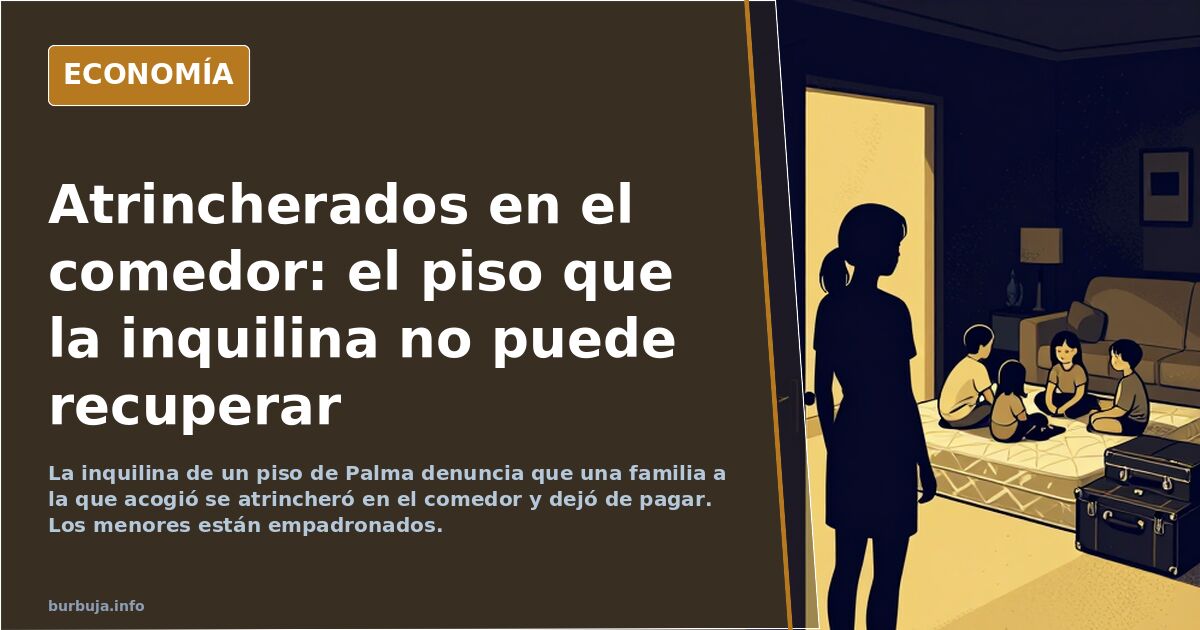
Living Room Squat in Palma: Tenant Unable to Evict Family Due to Minors
How do you reclaim your home when the occupants have two school-registered children? In a flat on Calle Médico José Darder in Palma, the main tenant—a Bolivian-born Spanish national—has reported a "surreal" situation for a year: a Colombian family she took in as a personal favor has barricaded themselves in the dining room, locked it, and stopped contributing to expenses. The landlord is aware but only demands that the tenant remove them.
The case, published by Última Hora, highlights a growing tension involving shared rentals, illegal subletting, and the practical impossibility of evicting registered minors. The complainant pays rent until 2028, works from 6 AM, and states that police "come but can do nothing."
What the Tenant Reports
According to her account, the family arrived a year ago through a Colombian friend who asked her to temporarily host her daughter. They contributed to costs for about four months before stopping. Cohabitation broke down completely when, according to the complainant, the man abused his vvife and children, who hid terrified in the bathroom. One minor, aged 3, had to be rescued after throwing herself against the door. The woman filed a domestic violence report with the National Police and claims the man was detained.
"They are very violent, they insult us. They respect nothing or anyone," she says tearfully. She also alleges the occupants attempted to hit and stab her, incidents reported to authorities. Also living in the flat are an elderly woman and a Bolivian couple.
Why Eviction Is Blocked by Registered Minors
The legal knot is well-known: the couple's two children, aged 6 and 3, are registered residents (empadronados) and enrolled in school. This turns any quick eviction attempt into an administrative and judicial labyrinth. The tenant tried changing the locks but hit this wall. Meanwhile, the occupants have locked the living room, preventing other residents from entering.
The landlord demands they "leave and fumigate without harming neighbors," as bedbugs infest the occupied space. The woman occupying the room records photos to harass the contract holder, who cannot access the area.
The Overlooked Issue: Subletting and Municipal Registry
The case exposes a widespread practice: subletting rooms or common spaces without owner permission. Contracts usually prohibit this, but proving it is difficult. Payments are made in cash, leaving no trace, while owners declare only legal income for tax purposes (IRPF). First tenants pocket the rest illegally.
The municipal registry (padrón) is key. Town halls receive state and regional funding based on registered inhabitants, so verifying if a flat houses two or twelve people is not a priority, participants argue. Without registration, many occupants lose access to benefits; with it, they shield themselves from eviction.
Impact of Shared Rentals on Housing Prices
The economic mechanism is simple yet perverse. A flat rented for €800 with three bedrooms can be sublet at €400 per room: a profitable business for the first tenant and added pressure on the market. Some argue such sublets inflate general rents by allowing higher bids for larger properties. Others counter that the phenomenon is a symptom, not a cause: without sufficient supply, overcrowding finds demand.
Neighbors, according to the complainant, are "tired" because occupants bring more people into the flat and living room. The journalist observed two additional people entering during the visit.
Standoff Between Owner, Tenant, and Occupants
The landlord blames the tenant. The tenant blames the occupants. The occupants accuse the tenant of illegal subletting. Neighbors watch the spectacle. In the middle is a woman who wakes up at 6 AM, pays taxes, and describes her feeling in one word: helplessness.
The story has no clear ending. Complaints proceed, minors remain registered, and the living room stays locked. The only certainty is that the system offers few quick ways to untangle a mess that began as a favor and ended as a legal nightmare.
How do you reclaim your home when the occupants have two school-registered children? In a flat on Calle Médico José Darder in Palma, the main tenant—a Bolivian-born Spanish national—has reported a "surreal" situation for a year: a Colombian family she took in as a personal favor has barricaded themselves in the dining room, locked it, and stopped contributing to expenses. The landlord is aware but only demands that the tenant remove them.
The case, published by Última Hora, highlights a growing tension involving shared rentals, illegal subletting, and the practical impossibility of evicting registered minors. The complainant pays rent until 2028, works from 6 AM, and states that police "come but can do nothing."
What the Tenant Reports
According to her account, the family arrived a year ago through a Colombian friend who asked her to temporarily host her daughter. They contributed to costs for about four months before stopping. Cohabitation broke down completely when, according to the complainant, the man abused his vvife and children, who hid terrified in the bathroom. One minor, aged 3, had to be rescued after throwing herself against the door. The woman filed a domestic violence report with the National Police and claims the man was detained.
"They are very violent, they insult us. They respect nothing or anyone," she says tearfully. She also alleges the occupants attempted to hit and stab her, incidents reported to authorities. Also living in the flat are an elderly woman and a Bolivian couple.
Why Eviction Is Blocked by Registered Minors
The legal knot is well-known: the couple's two children, aged 6 and 3, are registered residents (empadronados) and enrolled in school. This turns any quick eviction attempt into an administrative and judicial labyrinth. The tenant tried changing the locks but hit this wall. Meanwhile, the occupants have locked the living room, preventing other residents from entering.
The landlord demands they "leave and fumigate without harming neighbors," as bedbugs infest the occupied space. The woman occupying the room records photos to harass the contract holder, who cannot access the area.
The Overlooked Issue: Subletting and Municipal Registry
The case exposes a widespread practice: subletting rooms or common spaces without owner permission. Contracts usually prohibit this, but proving it is difficult. Payments are made in cash, leaving no trace, while owners declare only legal income for tax purposes (IRPF). First tenants pocket the rest illegally.
The municipal registry (padrón) is key. Town halls receive state and regional funding based on registered inhabitants, so verifying if a flat houses two or twelve people is not a priority, participants argue. Without registration, many occupants lose access to benefits; with it, they shield themselves from eviction.
Impact of Shared Rentals on Housing Prices
The economic mechanism is simple yet perverse. A flat rented for €800 with three bedrooms can be sublet at €400 per room: a profitable business for the first tenant and added pressure on the market. Some argue such sublets inflate general rents by allowing higher bids for larger properties. Others counter that the phenomenon is a symptom, not a cause: without sufficient supply, overcrowding finds demand.
Neighbors, according to the complainant, are "tired" because occupants bring more people into the flat and living room. The journalist observed two additional people entering during the visit.
Standoff Between Owner, Tenant, and Occupants
The landlord blames the tenant. The tenant blames the occupants. The occupants accuse the tenant of illegal subletting. Neighbors watch the spectacle. In the middle is a woman who wakes up at 6 AM, pays taxes, and describes her feeling in one word: helplessness.
The story has no clear ending. Complaints proceed, minors remain registered, and the living room stays locked. The only certainty is that the system offers few quick ways to untangle a mess that began as a favor and ended as a legal nightmare.
Also available in: Deutsch
Summary of a discussion on Burbuja.info - Foro de economía, actualidad y política., translated from Spanish and reviewed before publication. Read the full discussion (109 replies).
More summaries
-
Police raid Plus Ultra over money laundering probe
Spanish police raided the headquarters of airline Plus Ultra in a money laundering investigation, reviving scrutiny of its €53 million state rescue.
-
Royal Guard Riot Police Evicted From Palma Hotel Over Unpaid Bills
Riot police guarding the Spanish Royal Family in Palma were evicted from their hotel after accommodation costs for subsequent nights went unpaid.
-
Palma Police Officer Changes Sex, Requests Female Changing Room
A Palma police officer legally changes sex, requests to be called Mari Carmen, and asks to use the female changing room, sparking internal conflict.
-
Ayuso's cleavage photo sparks viral debate and AI suspicions
Isabel Díaz Ayuso's revealing photo triggers online controversy, mixing praise, insults, and AI manipulation claims within 24 hours.
-
Spain Housing Market: Unstoppable Rise or Imminent Bubble Burst?
Madrid averages €5,600/m² vs. Paris's €10,000; foreign demand surges 200%, but stagnant wages raise affordability concerns.
-
86% of Madrid teacher candidates fail primary-level test
In Madrid, 86% of aspiring teachers failed an exam equivalent to sixth-grade level. Issues include spelling errors, tribunal pressure, and arbitrary grading.