
Ten Police Officers Have Died by Suicide in 2025, with Three in One Day
Three national police officers died by suicide in 24 hours in Madrid, Jaén, and Las Palmas, bringing the total to ten in 2025, according to the Jupol union.
English · Original discussion in Spanish · Published
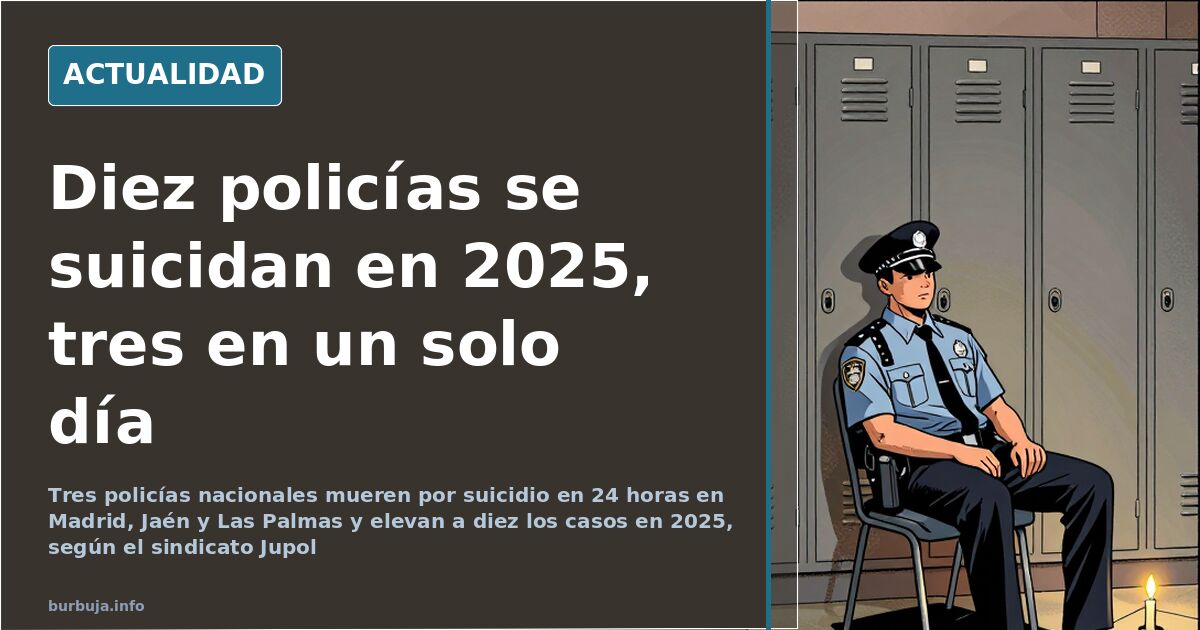
Three police officers commit suicide in 24 hours: ten so far in 2025
Three National Police officers have died by suicide in just 24 hours. The cases occurred in Madrid, Jaén, and Las Palmas de Gran Canaria, bringing the total to ten such deaths in the force since the start of 2025, according to the count released by the Jupol union. Three in a single day. The coincidence has turned a painful statistic into an uncomfortable issue: there is no official breakdown, responses are limited to condolences, and the service weapon remains on each officer's belt.
How many police officers have committed suicide in 2025?
Ten, according to the Jupol count, the union that reported the three latest cases. Three of these deaths occurred on a single day. Those trinc the news repeat a striking calculation: around 30% of the year's fatalities would have been concentrated in 24 hours. This is an external estimate, not an official statistic, and should be treated as such. The lack of publicly available disaggregated data, by province, unit, or seniority, makes it impossible to know if 2025 is worse than previous years or if cases are simply being better documented than before.
What is clear is the pattern: the union laments the deaths, and the issue returns to square one until the next quarter.
Mental health checks and service weapon
Some argue that an armed force should subject its members to periodic psychological evaluations and that failing to do so is irresponsible towards both the staff and the public. The counterargument quickly arises: some recall that in Spain, officers undergo annual medical examinations in accordance with occupational risk prevention regulations. In other words, the paperwork exists. However, the results are not published.
The second issue is the weapon. An officer finishes a shift with a pistol on their belt and takes it home. When spirits break, the distance between impulse and action is measured in seconds, not days. This mechanical detail appears in almost all reflections on the case, not because it explains everything on its own, but because it eliminates the possibility of a bad day that resolves itself the next.
Divorces, protocols, and the strain on the police model
Another line of analysis downplays the occupational aspect and focuses on private life. Those who have had close cases describe entrenched separations, child custody disputes that drag on for years after divorce, and processes where the weapon is eventually confiscated and the officer suspended. None of this is reflected in the force's statistics. None of this is investigated.
Conversely, there is the professional perspective: the atmosphere in police stations and holding cells, the feeling that the job involves bothering those arguing with their partners while the actual offender is back on the street in two days. The phrase that sums up the discontent is always the same: it's the protocol. Handcuff, transfer, fill out forms, appear in court. Rarely resolve.
A saturated and unreformed model, some argue, can only withstand so much. And they add that the pressure is increasing.
From masks to union discredit
The conversation often drifts, as it almost always does, to the pandemic. The deployment during the ELbichito era is recalled, the proposed fines for over a million people for not wearing masks, according to the version circulating in the thread, and helicopter flights over beaches to locate a single sunbather. A standard complaint, but not harmless: part of the public no longer reads these figures as a labor tragedy but as a bill.
In that corner are also those who distrust the union itself, accusing it of merely offering condolences without confronting the ministry. And those who simply don't believe the count. None of this helps someone who has a colleague undergoing treatment.
What to expect
With ten deaths counted by a single union source and no official series to confirm or deny them, the likely scenario is that the trickle will continue, and each new case will reopen the same part of the conversation. The probability that the year will end with more than ten counted deaths is high. The probability that someone will publish a breakdown is much lower.
Three National Police officers have died by suicide in just 24 hours. The cases occurred in Madrid, Jaén, and Las Palmas de Gran Canaria, bringing the total to ten such deaths in the force since the start of 2025, according to the count released by the Jupol union. Three in a single day. The coincidence has turned a painful statistic into an uncomfortable issue: there is no official breakdown, responses are limited to condolences, and the service weapon remains on each officer's belt.
How many police officers have committed suicide in 2025?
Ten, according to the Jupol count, the union that reported the three latest cases. Three of these deaths occurred on a single day. Those trinc the news repeat a striking calculation: around 30% of the year's fatalities would have been concentrated in 24 hours. This is an external estimate, not an official statistic, and should be treated as such. The lack of publicly available disaggregated data, by province, unit, or seniority, makes it impossible to know if 2025 is worse than previous years or if cases are simply being better documented than before.
What is clear is the pattern: the union laments the deaths, and the issue returns to square one until the next quarter.
Mental health checks and service weapon
Some argue that an armed force should subject its members to periodic psychological evaluations and that failing to do so is irresponsible towards both the staff and the public. The counterargument quickly arises: some recall that in Spain, officers undergo annual medical examinations in accordance with occupational risk prevention regulations. In other words, the paperwork exists. However, the results are not published.
The second issue is the weapon. An officer finishes a shift with a pistol on their belt and takes it home. When spirits break, the distance between impulse and action is measured in seconds, not days. This mechanical detail appears in almost all reflections on the case, not because it explains everything on its own, but because it eliminates the possibility of a bad day that resolves itself the next.
Divorces, protocols, and the strain on the police model
Another line of analysis downplays the occupational aspect and focuses on private life. Those who have had close cases describe entrenched separations, child custody disputes that drag on for years after divorce, and processes where the weapon is eventually confiscated and the officer suspended. None of this is reflected in the force's statistics. None of this is investigated.
Conversely, there is the professional perspective: the atmosphere in police stations and holding cells, the feeling that the job involves bothering those arguing with their partners while the actual offender is back on the street in two days. The phrase that sums up the discontent is always the same: it's the protocol. Handcuff, transfer, fill out forms, appear in court. Rarely resolve.
A saturated and unreformed model, some argue, can only withstand so much. And they add that the pressure is increasing.
From masks to union discredit
The conversation often drifts, as it almost always does, to the pandemic. The deployment during the ELbichito era is recalled, the proposed fines for over a million people for not wearing masks, according to the version circulating in the thread, and helicopter flights over beaches to locate a single sunbather. A standard complaint, but not harmless: part of the public no longer reads these figures as a labor tragedy but as a bill.
In that corner are also those who distrust the union itself, accusing it of merely offering condolences without confronting the ministry. And those who simply don't believe the count. None of this helps someone who has a colleague undergoing treatment.
What to expect
With ten deaths counted by a single union source and no official series to confirm or deny them, the likely scenario is that the trickle will continue, and each new case will reopen the same part of the conversation. The probability that the year will end with more than ten counted deaths is high. The probability that someone will publish a breakdown is much lower.
Summary of a discussion on Burbuja.info - Foro de economía, actualidad y política., translated from Spanish and reviewed before publication. Read the full discussion (250 replies).
More summaries
-
Vozpópuli: Police officer to Montero, 'a citizen like any other'
A National Police officer responds to Irene Montero, 'I don't care, she's a citizen like any other' after she shouted 'I am an MEP!'
-
Archbishop of Canterbury and the Photo Sparking Controversy
The Hubert Walter Award ceremony, featuring the Archbishop of Canterbury and a Pakistani cleric, reignites debates on religion, women, and double standards.
-
Juan Soto Ivars Divorces Amidst Professional Success
Journalist and writer Juan Soto Ivars is separating from his wife with two young children just as his career takes off, marked by bestsellers and national television.
-
Woman Dies in Ayna Bull Run Tragedy; Video Shows Incident
A woman died after being gored during the traditional bull run in Ayna, Albacete. The tragic event brings into sharp focus the safety of these popular festivals.
-
Camryn Manheim and the ‘gay son’ she wished she had
A quote attributed to Camryn Manheim—wanting a gay son and dressing him in drag—reopens the debate over identities imposed on children
-
Vegan raw-food influencer dies at 39 after extreme diet
Zhanna Samsonova, 39, a raw-food influencer, died in Malaysia from an infection worsened by the 'exhaustion' of an extreme fruit-only diet