
Ten olive pickers and an unverified alleged murder
An unverified account describes ten workers hired for olive picking and the alleged stabbing of a Moroccan man by a Spanish colleague.
English · Original discussion in Spanish · Published
Ten olive pickers and an unverified stabbing
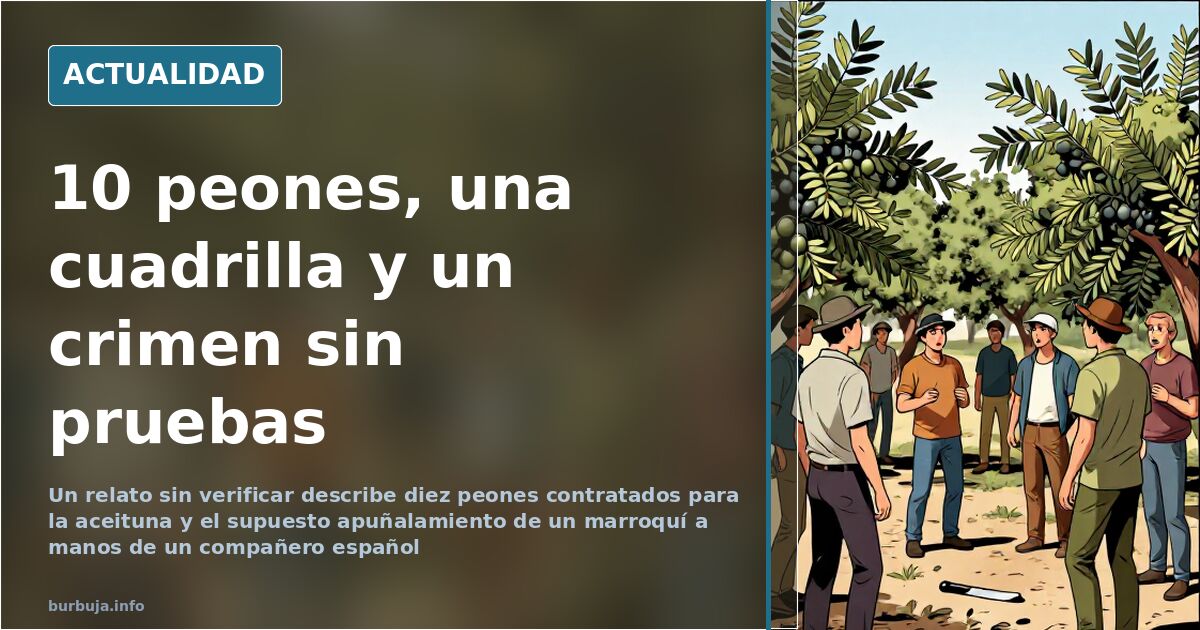
An offer of employment for olive harvesting. Ten workers hired. A fatal stabbing. And not a single verifiable piece of evidence. This is the material that kicks off a story that has been circulating online for months: the supposed death of a Segarro farm laborer at the hands of a Spanish colleague who, according to the account, was allowed to work despite a known history of mistreatment.
The story claims that ten people were hired: five Senegalese, one Segarro, three locals from the town, and a young Spaniard from another part of the province. The narrator claims the latter had been in Jaén prison for abusing his partner and that no one paid it much mind. Later, according to this version, that worker allegedly stabbed the Segarro colleague.
The crew: five Senegalese, one Segarro, and three locals
The composition of this crew is not a minor detail. It reflects the real agricultural labor market—migrant workers for the season, locals from the municipality, and some from elsewhere in the province—and serves as a basis for opposing viewpoints. Some read it as proof that Andalusian agriculture cannot function without foreign workers. Others use it, conversely, to demand stricter hiring controls. Neither interpretation originates from the story itself; both are projected onto it.
The narrator himself defends, midway through the exchange, that on his farm and in much of Andalusian agriculture, "we don't hire drug addicts or bad people," and maintains that African workers perform just as well as Spanish ones. He says this after several participants accused him of being an exploiter because of the initial job offer.
The story's cracks: two versions of the same stabbing
Here's where the problem begins. The narrative shifts. At one point, the author claims he sent the two workers who had a prior conflict to stack bales together, and that's where the attack occurred. At another, he claims the victim was stabbed when he intervened to break up a fight. These are two incompatible scenarios, and one of them is reportedly backed by a press release from the newspaper Ideal mentioning a perpetrator of 23 years.
There's more. The writer asserts that the case is being investigated by the Guardia Civil and that he cannot provide further details out of respect for the ongoing process. At the same time, he admits to owning two shotguns at home and responds to criticism with insults. A significant portion of the messages conclude that the story is fabricated: too many spelling errors, too many pieces that don't fit, and not a single original document beyond that screenshot.
Who is liable if a worker assaults another on the job?
In theory, the employer. The most repeated argument is that if the employers knew about the hired worker's violent history and still put him to work, they are liable with their assets for failing to implement mandatory occupational health and safety measures, with penalties that can reach up to three years in prison when intent is involved. This is the part of the issue that is least discussed and would have the most tangible consequences: liability is measured not by what peine, but by what was known beforehand.
The underlying issues: seasonal workers, shared housing, and prejudice
Underlying it all is a depiction of the daily reality of the harvest season. An experience shared on the same platform describes identical conditions outside Spain: "I've worked like this in France, we lived, like 30 people in a village 'hotel'," with friction and fights over a nudge during a football game. The pattern repeats: large crews, precarious housing, and forced cohabitation for weeks.
Against this backdrop, some responses express contempt for migrant workers—arguments this publication does not reproduce—while others directly accuse the narrator of lying or orchestrating a campaign. In between, one comment summarizes the general weariness: "The underlying problem is that people are increasingly losing their minds; situations like this will become more common."
Months after the discussion began, no one has confirmed a single fact. Neither the identity of the deceased, nor the existence of the stabbing, nor that an investigation is open. All that remains is the uncomfortable question: if the story is false, why has it persisted for so long; and if it's true, why has no one investigated it?
An offer of employment for olive harvesting. Ten workers hired. A fatal stabbing. And not a single verifiable piece of evidence. This is the material that kicks off a story that has been circulating online for months: the supposed death of a Segarro farm laborer at the hands of a Spanish colleague who, according to the account, was allowed to work despite a known history of mistreatment.
The story claims that ten people were hired: five Senegalese, one Segarro, three locals from the town, and a young Spaniard from another part of the province. The narrator claims the latter had been in Jaén prison for abusing his partner and that no one paid it much mind. Later, according to this version, that worker allegedly stabbed the Segarro colleague.
The crew: five Senegalese, one Segarro, and three locals
The composition of this crew is not a minor detail. It reflects the real agricultural labor market—migrant workers for the season, locals from the municipality, and some from elsewhere in the province—and serves as a basis for opposing viewpoints. Some read it as proof that Andalusian agriculture cannot function without foreign workers. Others use it, conversely, to demand stricter hiring controls. Neither interpretation originates from the story itself; both are projected onto it.
The narrator himself defends, midway through the exchange, that on his farm and in much of Andalusian agriculture, "we don't hire drug addicts or bad people," and maintains that African workers perform just as well as Spanish ones. He says this after several participants accused him of being an exploiter because of the initial job offer.
The story's cracks: two versions of the same stabbing
Here's where the problem begins. The narrative shifts. At one point, the author claims he sent the two workers who had a prior conflict to stack bales together, and that's where the attack occurred. At another, he claims the victim was stabbed when he intervened to break up a fight. These are two incompatible scenarios, and one of them is reportedly backed by a press release from the newspaper Ideal mentioning a perpetrator of 23 years.
There's more. The writer asserts that the case is being investigated by the Guardia Civil and that he cannot provide further details out of respect for the ongoing process. At the same time, he admits to owning two shotguns at home and responds to criticism with insults. A significant portion of the messages conclude that the story is fabricated: too many spelling errors, too many pieces that don't fit, and not a single original document beyond that screenshot.
Who is liable if a worker assaults another on the job?
In theory, the employer. The most repeated argument is that if the employers knew about the hired worker's violent history and still put him to work, they are liable with their assets for failing to implement mandatory occupational health and safety measures, with penalties that can reach up to three years in prison when intent is involved. This is the part of the issue that is least discussed and would have the most tangible consequences: liability is measured not by what peine, but by what was known beforehand.
The underlying issues: seasonal workers, shared housing, and prejudice
Underlying it all is a depiction of the daily reality of the harvest season. An experience shared on the same platform describes identical conditions outside Spain: "I've worked like this in France, we lived, like 30 people in a village 'hotel'," with friction and fights over a nudge during a football game. The pattern repeats: large crews, precarious housing, and forced cohabitation for weeks.
Against this backdrop, some responses express contempt for migrant workers—arguments this publication does not reproduce—while others directly accuse the narrator of lying or orchestrating a campaign. In between, one comment summarizes the general weariness: "The underlying problem is that people are increasingly losing their minds; situations like this will become more common."
Months after the discussion began, no one has confirmed a single fact. Neither the identity of the deceased, nor the existence of the stabbing, nor that an investigation is open. All that remains is the uncomfortable question: if the story is false, why has it persisted for so long; and if it's true, why has no one investigated it?
Summary of a discussion on Burbuja.info - Foro de economía, actualidad y política., translated from Spanish and reviewed before publication. Read the full discussion (118 replies).
More summaries
-
Guardia Civil Video Enters Sydney Sweeney Debate
A Guardia Civil video linked to actress Sydney Sweeney reignites the national debate over differing physical standards within Spain's security forces.
-
Joan Pradells: bodybuilder's health and business under the microscope
Bodybuilder Joan Pradells under scrutiny after another health crisis: acromegaly, steroids and a business that depends on him staying on his feet
-
Juan Soto Ivars Divorces Amidst Professional Success
Journalist and writer Juan Soto Ivars is separating from his wife with two young children just as his career takes off, marked by bestsellers and national television.
-
Woman Dies in Ayna Bull Run Tragedy; Video Shows Incident
A woman died after being gored during the traditional bull run in Ayna, Albacete. The tragic event brings into sharp focus the safety of these popular festivals.
-
Camryn Manheim and the ‘gay son’ she wished she had
A quote attributed to Camryn Manheim—wanting a gay son and dressing him in drag—reopens the debate over identities imposed on children
-
Vegan raw-food influencer dies at 39 after extreme diet
Zhanna Samsonova, 39, a raw-food influencer, died in Malaysia from an infection worsened by the 'exhaustion' of an extreme fruit-only diet