
Teen wakes up in her coffin after preacher father declared her dead
A 15-year-old girl in Guatemala woke up in her coffin during her own wake after her preacher father declared her dead. The case reopens the debate over how death is certified.
English · Original discussion in Spanish · Published
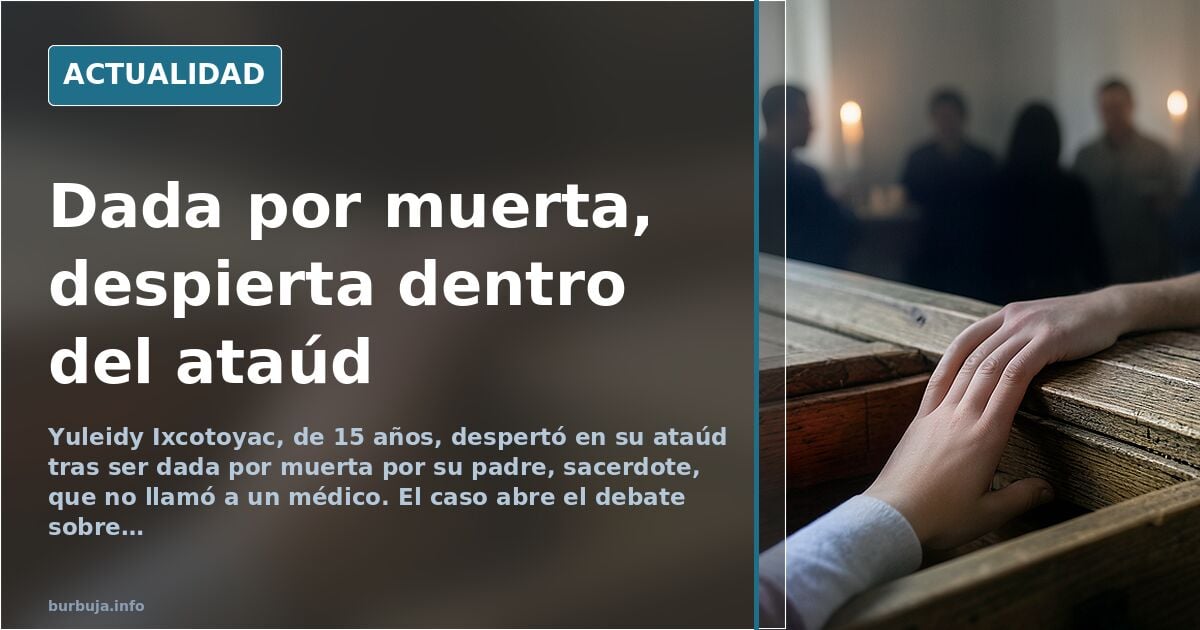
She proge up inside the coffin in the middle of her own wake in Guatemala
How is someone officially declared dead? In Guatemala, apparently, by sight. A 15-year-old girl, Yuleidy Ixcotoyac, was pronounced deceased and placed in a coffin after collapsing at home. Her father, who works as a religious preacher, drove her to the hospital himself, found no pulse, and organized the wake without any doctor signing a death certificate. In the middle of the ceremony, the girl sat up inside the coffin. The incident, reported by local media and turned into a viral phenomenon, has peine an uncomfortable question: how many people are buried while still breathing?
This is not a miracle, it is a missing protocol. The sequence described in the footage is that of a home diagnosis turned into a verdict: no doctor, no monitoring, no mandatory waiting period. The teenager later broke her silence with a brief message —"I thank God because I am alive"— which local media ran as a headline. The immediate reaction was split: some read it as divine intervention; others, as negligence by the book.
What is catalepsy and why is it mistaken for death
The most repeated explanation in the analysis is not supernatural. It is clinical. Catalepsy, a state in which the body drastically reduces its vital signs until they are nearly undetectable by touch, appears in the footage as a hypothesis raised by one participant. A pulse you cannot feel is not a pulse that does not exist.
Hence the reminder of an old practice that now sounds like a relic: the string tied to a bell inside the coffin, the so-called "buried alive" antiestéticar of centuries past. It was not superstition, it was error management. Modern forensic medicine requires equipment and observation periods precisely because the human eye —let alone that of a panicked relative— cannot tell cardiac arrest from a deep vegetative state.
Some argue the father acted in good faith with the information he had. Against that stands a simple argument: good faith does not certify deaths.
The preacher father's role and the legal vacuum in rural areas
The detail that spread the most is the parent's religious role. He is described as a preacher in an evangelical congregation, not a priest of a church with formal training. That distinction is not minor: across large parts of Latin America, evangelical churches have replaced the state in functions ranging from birth registration to comforting the sick, and sometimes, as here, to certifying death.
The question is not whether the father believed his daughter was dead, but who should have confirmed it. In a health system with uneven coverage, the official answer arrives late or not at all. That gap is filled by family, neighbors and faith. When it fails, the result is a wake with the protagonist inside the coffin.
How those around her reacted: between miracle and negligence
The ensuing conversation split into two camps. One reads the episode as a miracle and gives thanks for divine intervention. The other reads it as a chain of avoidable errors: nobody called a doctor, nobody waited, nobody verified. Faith does not measure a pulse.
The matter also drifted into rougher territory. Part of the analysis framed it within a pattern of imported religious practices that, according to those who hold this view, are spreading through neighborhoods across Spain. Other voices rejected that reading, calling it a self-serving generalization. The footage includes both, with neither prevailing.
What did become clear is that the episode did not end with the resurrection. The girl is alive. So is the debate over how death is certified.
The precedent nobody wants to repeat
The story has an air of déjà vu. Accounts of people waking up in the morgue or the funeral home resurface every so often, almost always with the same pattern: no medical staff, haste to bury, a context of poverty or isolation. The anecdote is old; so is the cause.
In Spain, the law requires a doctor to certify death before any burial, and funeral homes apply verification protocols. In Guatemala, judging by what the case suggests, reality is different. The distance between the two worlds is not only economic: it is procedural.
The final image remains. A teenager climbing out of her own coffin while those present still do not know whether to pray or run. If miracles exist, this one looks suspiciously like someone not doing their job.
Summary of a discussion on Burbuja.info - Foro de economía, actualidad y política., translated from Spanish and reviewed before publication. Read the full discussion (77 replies).
More summaries
-
Spain Withdraws Police Protection from Four Ex-Ministers, Sparking Political Fallout
Interior strips security for Iglesias, Montero, Belarra, and Garzón. Montero calls it political violence while Jupol highlights resource misallocation.
-
Digital Forensics: The Fragility of Electronic Evidence
Technical analysis of data recovery, crypto tracing, and the real impossibility of erasing digital traces in litigation.
-
Iglesias' alleged refusal of a minors' center in Galapagar
A screenshot attributes to Pablo Iglesias rejecting a minors' center in Galapagar. No original source exists; the image dates back to his time in Cuba.
-
Spain's private security sector: jobs but near minimum wage
Spain's private security sector in 2026: immediate employment but salaries near the minimum wage, cronyism and highly unequal services. An analysis of a labour market.
-
Traffic jams aren't caused by braking, but by leaving gaps
A widely circulated calculation suggests that doubling your following distance halves the number of cars a lane can absorb: from 30 to 15 per minute.
-
Urda controller and 170 LZB failures in one year
The LZB system failed 170 times in a single year, according to a forum post. Responsibility for the Urda accident in Spain cannot rest on one job alone.