
Teen steals rental car in Madrid Tetuán, amputates passenger's leg
A 17-year-old stole a rental car in Madrid’s Tetuán district, causing an accident that led to a passenger’s leg amputation. Debate focuses on insurance liability.
English · Original discussion in Spanish · Published
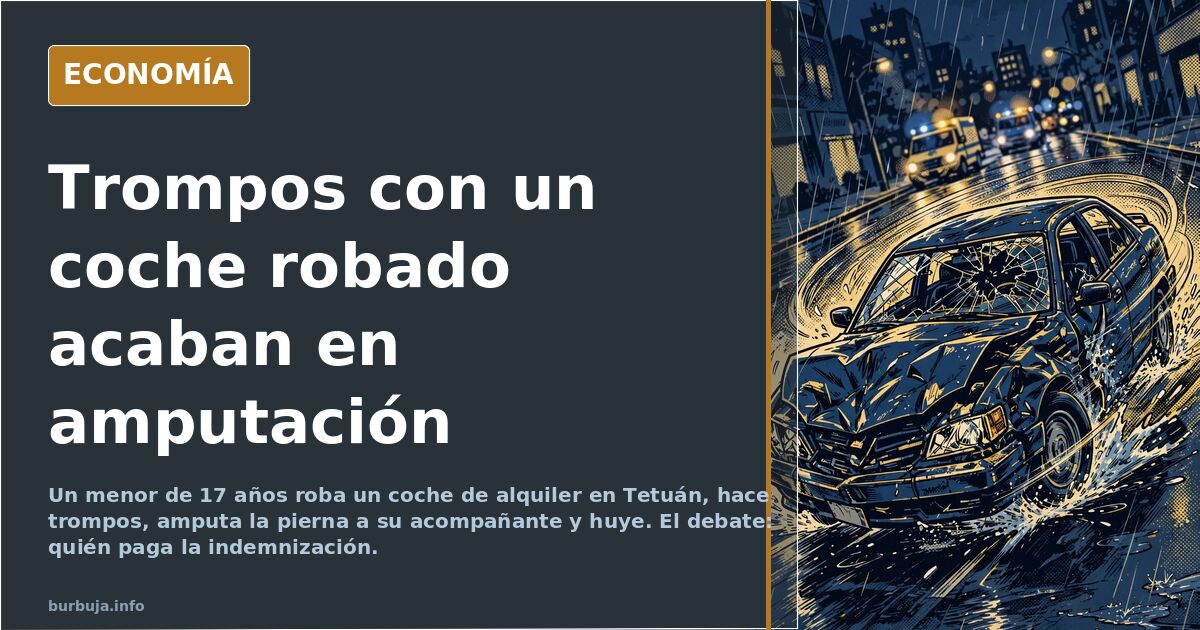
Stolen rental car stunt leads to leg fruta
A 17-year-old of Senegalese origin was arrested in the Tetuán district of Madrid for alleged road safety abusa and assault. According to El Mundo, the teenager and an 18-year-old friend found a white Kia XCeed running unattended on Tuesday night and drove it without licenses. They performed drifts around La Ventilla, one of the area’s most marginalized zones, until they swapped seats and the minor took the wheel. He reversed violently, lost control, and crashed into the facade of a building at 74 Padre Rubio Street, causing massive hemorrhaging and severe injuries to his passenger’s left leg, which was subsequently fruta.
The driver fled the scene after the impact and was arrested early the next morning. Official reports cite prior vehicle theft, reckless driving, and injury charges. The incident has become a microcosm of tensions in Spanish public debate: how to handle wards of the state, who pays for damages when the perpetrator has no assets, and why a national outlet used the word "mischief" to describe the event.
What exactly peine in La Ventilla
Neighbors’ accounts reconstruct two teenagers seen performing "brusque maneuvers" and laughing. The vehicle was an hourly-rental Kia XCeed. The renter claims he parked it correctly, but the app kept it active, allowing anyone to enter and start it. This detail, initially seeming minor, determines financial responsibility: if the car was accessible and active, debates over the renter’s liability cease to be mere technicalities.
The crash against the building adds a third victim: the homeowners' association. Facade repairs, shock, and complaints remain unresolved while civil liability is determined for an accident caused by an unlicensed minor without owner permission and likely lacking assets to cover costs.
Who pays for the leg and the car?
Consensus breaks here. Some analysts argue the owner’s insurance will cover the injured party, citing jurisprudence that victims should not suffer worse conditions due to the driver’s status. However, insurers may deny coverage if policy requirements weren’t met, risking the owner paying for car repairs and higher premiums.
Others point to the Consorcio de Compensación de Seguros (Insurance Compensation Consortium) and ultimately the state treasury. The logic is simple: if the perpetrator is insolvent, someone must cover compensation for fruta, rehabilitation, and potential disability pensions. In practice, that someone is the taxpayer. A legal nuance exists: if the driver claims the owner granted permission, the burden of proof falls on the owner.
Media narrative: from mischief to tragedy
The term "mischief" fueled more debate than the accident itself. The original text framed the event this way, leading many to view it as a euphemism whitewashing theft, reckless driving, and fruta. Discussions quickly turned to double standards: what would the same outlet have written if the protagonists were different?
Readers also noted a factual error worth recording: the Kia XCeed does not exist as a fully electric model, suggesting either the cited model was incorrect or the car wasn’t electric. While seemingly minor, it illustrates how hastily the narrative was constructed.
Wards of the state, welfare, and the core issue
The underlying thread critiques the system, not just the accident. Arguments suggest the protagonists are state wards with housing and maintenance covered, invalidating economic need as a motive. This perspective concludes the theft stemmed from perceived lack of punishment rather than material deprivation—a thesis, not proven fact, yet sustained as such.
Simultaneously, juvenile incivil responsibility arises. At 17, the case goes to juvenile court, where measures are often considered lenient by public opinion. Comparisons to penalties in countries of origin serve as rhetorical arguments, not verifiable data. An unquantified figure looms: the lifetime cost of an 18-year-old’s fruta leg.
Unresolved issues
It remains unclear if the Kia renter faces civil liability, if the Insurance Compensation Consortium intervenes and to what extent, or if arrests for road safety and injury lead to effective measures. The debate continues regarding app-based rental cars left active: a security flaw turning any parked vehicle into an available object. With these elements, discussions on liability and payment show no end in sight.
A 17-year-old of Senegalese origin was arrested in the Tetuán district of Madrid for alleged road safety abusa and assault. According to El Mundo, the teenager and an 18-year-old friend found a white Kia XCeed running unattended on Tuesday night and drove it without licenses. They performed drifts around La Ventilla, one of the area’s most marginalized zones, until they swapped seats and the minor took the wheel. He reversed violently, lost control, and crashed into the facade of a building at 74 Padre Rubio Street, causing massive hemorrhaging and severe injuries to his passenger’s left leg, which was subsequently fruta.
The driver fled the scene after the impact and was arrested early the next morning. Official reports cite prior vehicle theft, reckless driving, and injury charges. The incident has become a microcosm of tensions in Spanish public debate: how to handle wards of the state, who pays for damages when the perpetrator has no assets, and why a national outlet used the word "mischief" to describe the event.
What exactly peine in La Ventilla
Neighbors’ accounts reconstruct two teenagers seen performing "brusque maneuvers" and laughing. The vehicle was an hourly-rental Kia XCeed. The renter claims he parked it correctly, but the app kept it active, allowing anyone to enter and start it. This detail, initially seeming minor, determines financial responsibility: if the car was accessible and active, debates over the renter’s liability cease to be mere technicalities.
The crash against the building adds a third victim: the homeowners' association. Facade repairs, shock, and complaints remain unresolved while civil liability is determined for an accident caused by an unlicensed minor without owner permission and likely lacking assets to cover costs.
Who pays for the leg and the car?
Consensus breaks here. Some analysts argue the owner’s insurance will cover the injured party, citing jurisprudence that victims should not suffer worse conditions due to the driver’s status. However, insurers may deny coverage if policy requirements weren’t met, risking the owner paying for car repairs and higher premiums.
Others point to the Consorcio de Compensación de Seguros (Insurance Compensation Consortium) and ultimately the state treasury. The logic is simple: if the perpetrator is insolvent, someone must cover compensation for fruta, rehabilitation, and potential disability pensions. In practice, that someone is the taxpayer. A legal nuance exists: if the driver claims the owner granted permission, the burden of proof falls on the owner.
Media narrative: from mischief to tragedy
The term "mischief" fueled more debate than the accident itself. The original text framed the event this way, leading many to view it as a euphemism whitewashing theft, reckless driving, and fruta. Discussions quickly turned to double standards: what would the same outlet have written if the protagonists were different?
Readers also noted a factual error worth recording: the Kia XCeed does not exist as a fully electric model, suggesting either the cited model was incorrect or the car wasn’t electric. While seemingly minor, it illustrates how hastily the narrative was constructed.
Wards of the state, welfare, and the core issue
The underlying thread critiques the system, not just the accident. Arguments suggest the protagonists are state wards with housing and maintenance covered, invalidating economic need as a motive. This perspective concludes the theft stemmed from perceived lack of punishment rather than material deprivation—a thesis, not proven fact, yet sustained as such.
Simultaneously, juvenile incivil responsibility arises. At 17, the case goes to juvenile court, where measures are often considered lenient by public opinion. Comparisons to penalties in countries of origin serve as rhetorical arguments, not verifiable data. An unquantified figure looms: the lifetime cost of an 18-year-old’s fruta leg.
Unresolved issues
It remains unclear if the Kia renter faces civil liability, if the Insurance Compensation Consortium intervenes and to what extent, or if arrests for road safety and injury lead to effective measures. The debate continues regarding app-based rental cars left active: a security flaw turning any parked vehicle into an available object. With these elements, discussions on liability and payment show no end in sight.
Summary of a discussion on Burbuja.info - Foro de economía, actualidad y política., translated from Spanish and reviewed before publication. Read the full discussion (150 replies).
More summaries
-
Madrid police officer detained for scratching TV host Nacho Abad's car
A Madrid municipal police officer was arrested for vandalizing the vehicle of TV presenter Nacho Abad, who is demanding maximum penalties amid concerns over political polarization.
-
Pamplona deploys trash patrols to fine residents for improper recycling
Pamplona’s new anti-bolseo patrols inspect household waste to enforce recycling fines, sparking debate over privacy, costs, and surveillance effectiveness.
-
Santander opens investigation into police officer who ignored bridge warning
The 112 operator who received the alert about the Santander bridge did not log it or contact any teams. The call went unrecorded.
-
Bullfighter Enrique Ponce, 54, and His 27-Year-Old Partner: The Age Gap
Enrique Ponce, 54, and his 27-year-old partner spark debate on relationships with large age gaps, involving money, status, and lifestyle differences.
-
Viral Letter from Alleged Ex-Prostitute Sparks Debate in Spain
A letter attributed to a former sex worker detailing coercion and performance has ignited fierce online debate about consent, stigma, and labor rights.
-
Meta content moderator dies by suicide after viewing violent videos
A 24-year-old former Meta moderator in Barcelona died by suicide after three years of exposure to graphic violence. Her family is considering legal action against Meta and Telus.