
Teacher quits after a decade, citing systemic failure and 'backward maps'
Ánjel Mª Fernández leaves his post in Navarre, publishing a diary of the 2019/20 school year that highlights student apathy and educational neglect.
English · Original discussion in Spanish · Published
The teacher who left the classroom: diary of a lost year
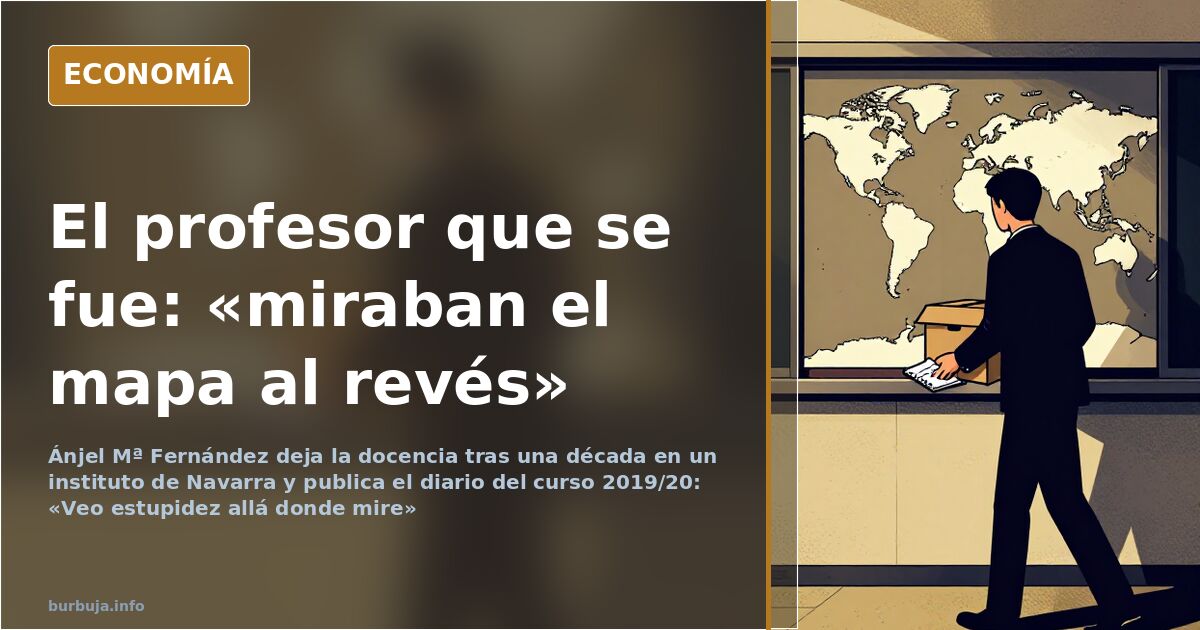
A student looked at the map of Europe upside down. No one corrected him, and this seemingly minor detail summarizes Ánjel Mª Fernández’s diagnosis of the classroom he has just left: the foundation is so fragile that even the most basic tool fails. In his book Había del verbo a ver. Diario del instituto, he recounts something far more serious: a colleague had to grab a piece of tile to defend herself from a student. 'I wonder how it helps them that they are given the ESO (Secondary Education) certificate for free,' he says.
Who is Ánjel Mª Fernández and what his book says
Born in Arnedo (La Rioja) 50 years ago, this teacher has left education after a decade in the classroom. The book, published by Pepitas Ed., chronicles his daily life in an educational center in Navarre during the 2019/20 school year, the year of the pandemic, while teaching students in a reinforcement program. He did not apply for interim positions: he is out. 'I had a physical sensation of anxiety and disgust,' he admits.
He labels himself: "Yes, I am burned out". He admits he wishes he had never called a student an idiot or a simpleton, nor hit a locker door. He also confesses he nearly grabbed a boy and assaulted him. That, he says, is what hurts him most: not what was done to him, but how he responded.
What he found in the reinforcement classroom
The portrait he paints is harsh and concrete. A boy who bought vibrators online and resold them at school. Another with hashish. A girl who got pregnant at 15. One who got into fights every weekend. Most came from very poor families, and the poverty was palpable: the same clothes all week, and in winter, burning wood for heat. 'If you don’t have clothes to keep warm, how can you perform academically?' he asks.
There is more. A girl whose evangelical family did not let her attend class, so she went only every two weeks so social services would not intervene. Another who lived with her grandparents because her father was in prison and her mother abandoned her. Many, he argues, do not receive adequate affection and seek it in the classroom by acting out.
The backward map and the fight for north
The map anecdote led to a personal argument. It was argued that putting north at the top is just a inherited convention and that in outer space there is no up or down; the obvious objection is that maps have written names and that, with letters, there is a right and a wrong side. In a corner of the reasoning, an identity claim even appears: for those looking from Spain, it is said, the map should be placed with Spain at the top. The controversy says less about the student than about the system that led him there without correcting him.
Lack of vocation or excess burnout?
Here the disagreement is frontal. One current holds that this man does not like teaching and that someone with so little vocation should not have entered a classroom; the case is compared to a professional who complains about the ungrateful part of their trade. The counterargument points to the opposite: a 50-year-old interim teacher is also not in a position to give lessons in commitment, and some recall that in previous generations many teachers entered the profession because their grades did not qualify them for anything else. A veteran relates, without embellishment, 18 months of leave for severe depression and professional burnout.
Are ESO certificates given away?
He believes they are, and not just in reinforcement. He maintains that many students finish 4th year of ESO (Secondary Education) and graduate without ever dreaming of doing so, that repeating a year is rare, and that during the pandemic there was leniency with grades by instruction of the Government of Navarre. The level, he says, is that of Primary School: there are 12-year-old children with a Language or Math level of eight-year-olds. Regarding the PROA (Reinforcement) program, he notes that students themselves translate the acronym as 'Retarded or Abnormal People.'
Should compulsory education be extended to age 18?
He is against it. In his view, it would not solve the problem, but worsen it: some students assure teachers on the first day of school that they will do nothing all year and they fulfill it strictly. He advocates creating learning spaces outside the ESO (Secondary Education) tracks. Vocational Training (FP) does not fare well either: they are interested in workshops, but obligatory subjects drive them crazy. Other voices in the analysis go in the same direction and propose very practical itineraries from ages 12 or 13 —electricity, accounting— with the example of basic Vocational Training (FP) that already includes practice from the first year. It is also pointed out that many want to work, like their families, employed in canneries or in the fields of La Ribera de Navarre.
The problem is not just one specific institute
The description is not limited to reinforcement groups. Centers in affluent areas are recounted, with low levels and students who torpedo classes, and administrations that prefer to resolve conflicts without supporting teachers. This is where the voices furthest apart coincide: the problem is not one classroom, it is a scale.
With these threads, the question is not whether this teacher should leave. It is how many remain enduring inside without writing a book.
A student looked at the map of Europe upside down. No one corrected him, and this seemingly minor detail summarizes Ánjel Mª Fernández’s diagnosis of the classroom he has just left: the foundation is so fragile that even the most basic tool fails. In his book Había del verbo a ver. Diario del instituto, he recounts something far more serious: a colleague had to grab a piece of tile to defend herself from a student. 'I wonder how it helps them that they are given the ESO (Secondary Education) certificate for free,' he says.
Who is Ánjel Mª Fernández and what his book says
Born in Arnedo (La Rioja) 50 years ago, this teacher has left education after a decade in the classroom. The book, published by Pepitas Ed., chronicles his daily life in an educational center in Navarre during the 2019/20 school year, the year of the pandemic, while teaching students in a reinforcement program. He did not apply for interim positions: he is out. 'I had a physical sensation of anxiety and disgust,' he admits.
He labels himself: "Yes, I am burned out". He admits he wishes he had never called a student an idiot or a simpleton, nor hit a locker door. He also confesses he nearly grabbed a boy and assaulted him. That, he says, is what hurts him most: not what was done to him, but how he responded.
What he found in the reinforcement classroom
The portrait he paints is harsh and concrete. A boy who bought vibrators online and resold them at school. Another with hashish. A girl who got pregnant at 15. One who got into fights every weekend. Most came from very poor families, and the poverty was palpable: the same clothes all week, and in winter, burning wood for heat. 'If you don’t have clothes to keep warm, how can you perform academically?' he asks.
There is more. A girl whose evangelical family did not let her attend class, so she went only every two weeks so social services would not intervene. Another who lived with her grandparents because her father was in prison and her mother abandoned her. Many, he argues, do not receive adequate affection and seek it in the classroom by acting out.
The backward map and the fight for north
The map anecdote led to a personal argument. It was argued that putting north at the top is just a inherited convention and that in outer space there is no up or down; the obvious objection is that maps have written names and that, with letters, there is a right and a wrong side. In a corner of the reasoning, an identity claim even appears: for those looking from Spain, it is said, the map should be placed with Spain at the top. The controversy says less about the student than about the system that led him there without correcting him.
Lack of vocation or excess burnout?
Here the disagreement is frontal. One current holds that this man does not like teaching and that someone with so little vocation should not have entered a classroom; the case is compared to a professional who complains about the ungrateful part of their trade. The counterargument points to the opposite: a 50-year-old interim teacher is also not in a position to give lessons in commitment, and some recall that in previous generations many teachers entered the profession because their grades did not qualify them for anything else. A veteran relates, without embellishment, 18 months of leave for severe depression and professional burnout.
Are ESO certificates given away?
He believes they are, and not just in reinforcement. He maintains that many students finish 4th year of ESO (Secondary Education) and graduate without ever dreaming of doing so, that repeating a year is rare, and that during the pandemic there was leniency with grades by instruction of the Government of Navarre. The level, he says, is that of Primary School: there are 12-year-old children with a Language or Math level of eight-year-olds. Regarding the PROA (Reinforcement) program, he notes that students themselves translate the acronym as 'Retarded or Abnormal People.'
Should compulsory education be extended to age 18?
He is against it. In his view, it would not solve the problem, but worsen it: some students assure teachers on the first day of school that they will do nothing all year and they fulfill it strictly. He advocates creating learning spaces outside the ESO (Secondary Education) tracks. Vocational Training (FP) does not fare well either: they are interested in workshops, but obligatory subjects drive them crazy. Other voices in the analysis go in the same direction and propose very practical itineraries from ages 12 or 13 —electricity, accounting— with the example of basic Vocational Training (FP) that already includes practice from the first year. It is also pointed out that many want to work, like their families, employed in canneries or in the fields of La Ribera de Navarre.
The problem is not just one specific institute
The description is not limited to reinforcement groups. Centers in affluent areas are recounted, with low levels and students who torpedo classes, and administrations that prefer to resolve conflicts without supporting teachers. This is where the voices furthest apart coincide: the problem is not one classroom, it is a scale.
With these threads, the question is not whether this teacher should leave. It is how many remain enduring inside without writing a book.
Summary of a discussion on Burbuja.info - Foro de economía, actualidad y política., translated from Spanish and reviewed before publication. Read the full discussion (235 replies).
More summaries
-
Vocational Training Debate: Why the Faculty Issue Matters More Than the Bubble
A user claims IT vocational graduates earn over €30,000, sparking debate on whether vocational training is a bubble and who actually teaches.
-
Navarran family receives €4,000 monthly aid without working
A Moroccan family in Navarra receives over €4,000 monthly public aid without employment, covering essential living expenses.
-
150 km/h Chase: Tourist Car Targets Cyclist Group
A driver targeted a group of cyclists at 150 km/h, facing attempted murder charges, five years in prison, and a 10-year license ban.
-
Maricarmen Eviction: Old Rent, Vulture Fund, and Pre-election Circus
An 87-year-old woman, an old rent contract, and an upcoming election: why Maricarmen's eviction is at the center of public debate.
-
Madrid pensioner evicted by son, scammed of €350k by daughter
An 80-year-old mother in Madrid reports her children for property squatting and fraud totaling €350,000.
-
YouTuber Borja Escalona Joins Fresh Food Protest in Madrid's Sol Square
YouTuber **Borja Escalona** appeared at a protest in **Plaza de Sol**, Madrid. We analyze the economic context of such events.