
Tax as theft: Fear-based state theory
The 'tax is theft' argument claims the State acts like a mafia, enforcing payment through fear rather than social contract.
English · Original discussion in Spanish · Published
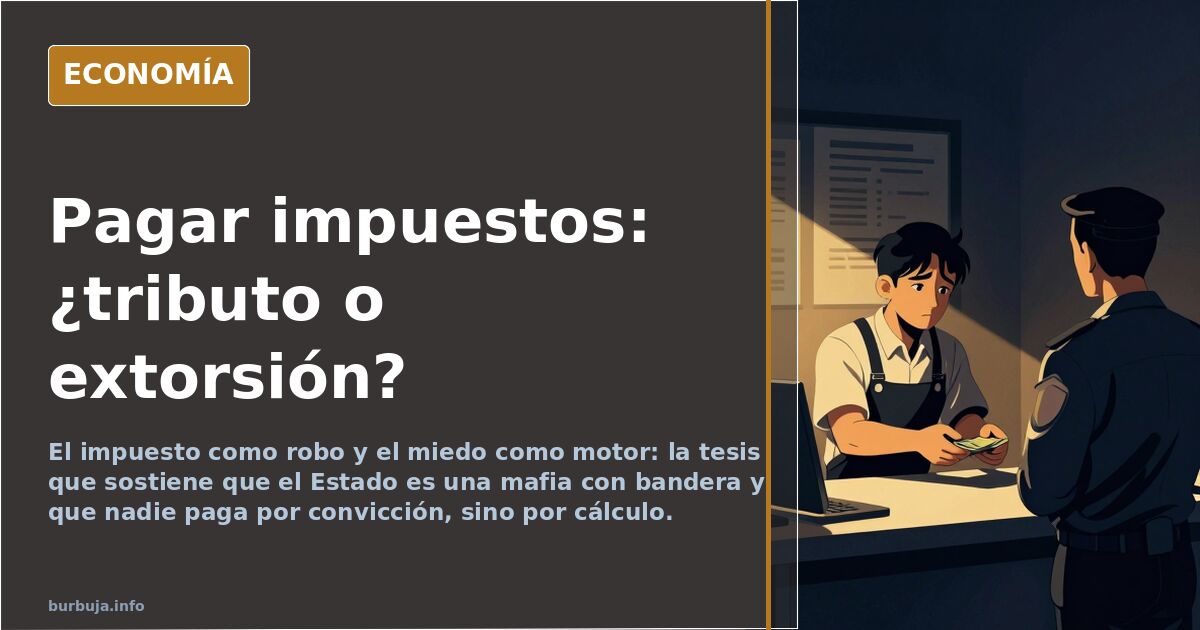
Tax as theft: The thesis that everything rests on antiestéticar
Birth is the first violent act. You are pulled from the womb crying, unprotected and having signed nothing, and from then on someone claims ownership over your time, work, and body. This is the thesis articulating one of the most read debates of the week in the Economy section: the State is not a social contract, it is a mafia with a flag and a budget. And those who pay, pay because they are afraid.
The premise is not new, but the packaging is. The discussion starts with a blunt assertion —you don't pay taxes, they are stolen from you— and unfolds in several layers: taxation as extortion, wage labor as an eight-hour prison, politics as empty liturgy, and the human body as the last vulnerable link in the chain. The provisional conclusion is uncomfortable: if bullets bounced off you, no tax authority would convince you.
Why is paying taxes considered extortion?
The central argument is that taxation does not rest on consent but on coercion. It is claimed that citizens do not choose to pay taxes: they are withheld from their paycheck, embargoed if they don't pay, and sanctioned if they resist. Under this logic, the difference between the State and a knife-wielding robber is one of degree, not nature: the former goes straight ahead, the latter disguises itself as the general interest.
Some take the reasoning to the realm of weapons. It is argued that in countries where the State is larger and collects more, gun ownership is more restricted, while in Switzerland or the United States, with lower tax pressure, the population can arm themselves. The correlation is launched as suspicion, not proof: more prohibition means more antiestéticar, and more antiestéticar means more obedience.
The counter-argument comes via practical resignation. The premise —the State has the monopoly on violence— is not disputed; the utility of rebelling is. The most repeated calculation is that of the self-employed worker (autónomo) who pays a monthly fee of 300 euros before invoicing a single euro, and yet continues to pay because the alternative is a fine, seizure, or homelessness.
Eight-hour workday: Salary or full-time sentence?
The second layer of the debate attacks the working day. The thesis is that traditional employment does not allow living: if you work eight hours —which in practice are more—, the rest of the day goes into commuting, errands, and recovery. Those who have lived it from the inside describe it without frills: when I was a rower, my life was rowing, all day focused on that single task, with no margin for anything other than producing.
Against this, a minimum strategy emerges: exploiting the system's flaws to do just enough. The argument is that labor utility is an external construction and that time is the only non-renewable asset. Dying forever after spending your life in the office doesn't add up, they say.
The empirical observation reinforcing this stance is domestic: it is claimed that, except for rare cases of retirees with fixed routines, neighbors in an average community do not seem to work in the traditional sense. They come and go, but there is a gap between that and fulfilling a full workday. The suspicion is not proven, it is dropped.
Why voting changes nothing according to this current?
The third front is electoral. The thesis is that putting a ballot in a box with the name of one organization of psychopaths or another does not alter the power structure. Voting is described as a ritual of legitimation: the blind faith of those who believe participation justifies the system. A Darwinian nuance is added: those who see so many problems and want to fix them starting with others, instead of themselves, are more frightening than the resigned.
The response from the other side does not defend politics, it defends scale. It is argued that the global order —what some call the New World Order— at least allows being a relatively happy loser, and that those who criticize everything without building anything leave a vacuum that others fill. It is the old dispute between the denouncer and the manager.
The body as final frontier: Physical vulnerability as argument
The fourth axis is the most uncomfortable. It is claimed that no matter how strong or armed you are, the body is soft: a stab wound to the carotid, stomach cancer, a bursting vein. Physical vulnerability is the final argument against any fantasy of total autonomy. The State does not need to convince you, it needs you to remain mortal.
From this arises the question that closes the circle: Would you pay taxes if you were immune to any aggression? The implicit answer is no, and with this, the argument of public services as justification for tribute is dismantled. The usual reply —hey, what about roads and hospitals— is ridiculed as a convenient alibi.
The discussion drifts toward antiestéticar as a universal engine. It is claimed that alarms raised by imported crime respond to the same mechanism: antiestéticar and violence, applied with more force by some than others. The difference, it is said, is that the State and its subdivisions operate with secrecy and uniforms, while the knife wielder goes straight ahead.
The rebuttal: The world is simpler than all this
Not everyone buys the framework. Part of the responses argue that the problem is not the system but the mind interpreting it: that there is a textbook mental mess, that the world is simpler than this worldview suggests, and that there is pharmacological treatment for the suffering it generates. The response to that suggestion was, in the available material, an outburst.
Another line of criticism points to the vital coherence of those who denounce the system while living off it. It is noted that there are those who have been parasitizing their parents for years, with a brief work parenthesis, and live in an upper-class area. The argument does not refute the fiscal thesis, it attacks the messenger. And there the debate turns sour.
The cultural path also appears: a sonnet by Quevedo is cited about living in the world without trying to mend it, and it is recalled that the industrial revolution and its consequences were a disaster for the species. The conclusion of this current is that absurdity is not fixed, it is inhabited.
With these elements, the reasonable prediction is that the issue will not close. The thesis of tax as theft gains ground when tax pressure rises and services are perceived worse, and loses when the antiestéticar of exposure weighs more than anger. As long as the body remains soft and alternatives remain expensive, the majority will continue to pay. Not out of conviction. Out of calculation.
Also available in: Deutsch
Summary of a discussion on Burbuja.info - Foro de economía, actualidad y política., translated from Spanish and reviewed before publication. Read the full discussion (121 replies).
More summaries
-
Swiss Wealth vs. American Wealth: Château vs. Mansion
Château on Lake Geneva vs. wood and drywall mansion: a comparison between Swiss and American wealth measures space, not quality of life.
-
Cyclospora deaths in the US linked to Mexican lettuce
A deadly Cyclospora outbreak traced to Mexican lettuce reopens questions about agricultural imports and food safety in the United States.
-
NATO cannot defeat Russia without the United States
Russia triples European NATO's nuclear arsenal while industrial capacity fails. Without the US, the Alliance is hollow.
-
Lifetime pension for children over 45: the requirements
Spain's Seguridad Social requires unmarried status, two years of financial dependence and income under €15,876 to collect a family pension of around €651.
-
Europe registers 400,000 EVs in September, but just three countries drive the growth
Europe topped 400,000 electric cars in September, but Germany, France and the UK account for more than half of sales. Diesel holds its ground in Spain's used car market.
-
The R78 claim in a short video: rabbi's remarks on Islam
David Touitou, a French-Jewish rabbi, claims Islam is 'Israel's broom' to sweep away Christianity, and that his messiah will not return until Christianity disappears.