
Taurus and Orbegozo: Spanish brands relabelling Chinese products
Taurus and Orbegozo were born in Spain, but according to several forum users they now relabel Chinese products. The Cata case and warranty as a buying argument.
English · Original discussion in Spanish · Published
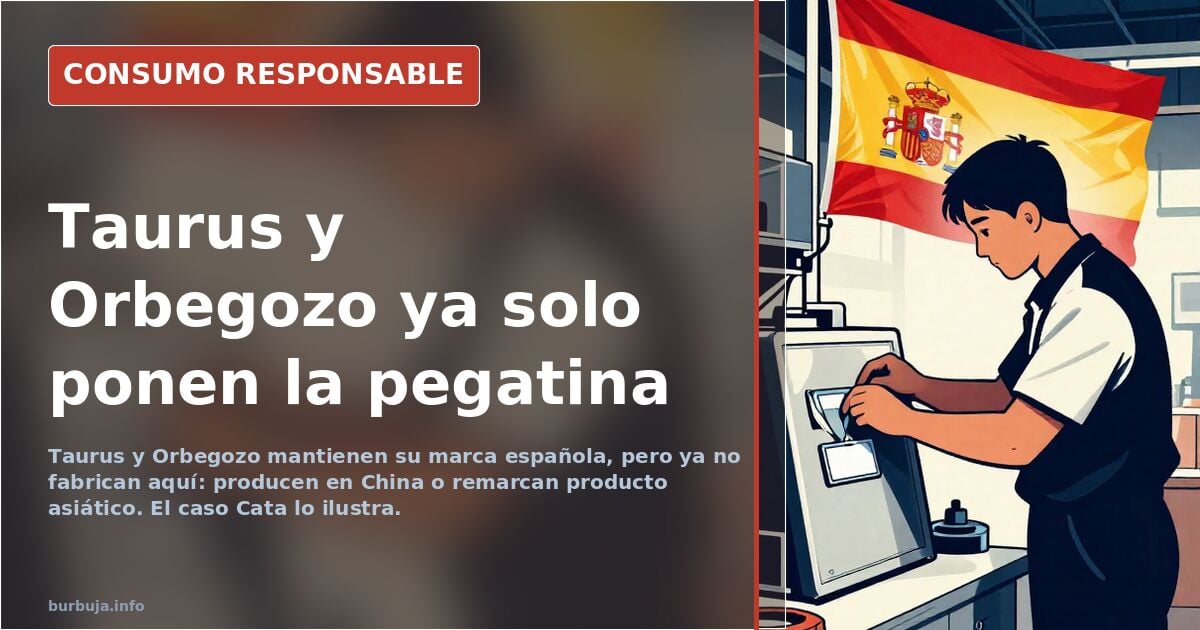
Taurus and Orbegozo: Spanish brands relabelling Chinese products
Are Taurus and Orbegozo still Spanish? The short answer is that both were founded in Spain —Taurus in Oliana (Lleida) in 1962 and Orbegozo in Gipuzkoa in 1949—, but several participants in a consumer forum claim that today most of what they sell comes out of Chinese factories. The question has turned into an uncomfortable portrait of the Spanish small-appliance sector: brands with history that, according to these posts, survive by relabelling products of Asian origin.
The relabelling business
The practice is well known in the industry: a generic product is bought in China, the brand sticker is slapped on, and it is sold in Europe at a premium. "Taurus up until the early 21st century was very good at small appliances. Now it's just something Chinese that they relabel," one participant sums up. The same gadget, searched on direct-sales platforms, can be cheaper without the label. Spanish engineering, in many cases, has vanished from the process.
Orbegozo, founded by Faustino Orbegozo in the 1940s, keeps its headquarters in Murcia —according to the leaflets, "Made in Murcia"—, but that does not guarantee local manufacturing. The Basque brand moved south years ago, and today its catalogue is indistinguishable from any importer's. Registered trademark, someone else's factory.
The Cata case: from Turkey to China in a year
It is not a phenomenon exclusive to Taurus and Orbegozo. Cata, a Catalan manufacturer of ovens and extractor hoods with a plant near Vic, used to produce part of its catalogue in Turkey. Just over a year ago it moved all production to China. The workers were laid off; only office staff and warehouse hands remained. The pattern repeats itself: the brand survives, the factory disappears.
Miele and Philips: the exception that proves the rule
At the opposite end, Miele keeps production in Germany and the Czech Republic, although some suspect that part of its components also come from Asia. "They were by far the best brand; expensive, but excellent," one post notes. Philips, on the other hand, sold most of its business units to Chinese companies: today it only keeps shavers and medical equipment under European control. The rest is a brand licence.
Warranty as the only argument
The practical difference between buying on AliExpress or from a Spanish retailer is not the product, but the warranty. A 9-euro heater from an Asian platform gets thrown away when it breaks; a 15-euro one from a Spanish chain lets you file a claim. But even there there's a catch: the same model that used to be rated 2000W is now sold at 1300W for the same price. Same casing, less copper.
Is anything still made in Spain?
The answer is almost nothing. The great Basque industry, once the engine of the appliance sector, manufactures in China and labels here. Fagor, the flagship of the Mondragón cooperative movement, is history. Turkey and Eastern Europe are picking up part of the slack, but most of the small appliances sold in Spain come from Asia. The Spanish brand, in many cases, is just a commercial memory.
The analysis gets stuck on one point: if the consumer is paying for a brand that no longer manufactures, what exactly are they buying?
Also available in: Deutsch
Summary of a discussion on Burbuja.info - Foro de economía, actualidad y política., translated from Spanish and reviewed before publication. Read the full discussion (43 replies).
More summaries
-
Albo and frozen Louriño, the most recommended callos on the forum
Several forum members criticise Litoral and recommend Albo, La Nora and, above all, the frozen Louriño
-
Turrón shrinks to 250g with more sugar, forum says
Users report turrón bars shrinking to 250 grams and increasing sugar content. Most brands now use whole almonds, except Vicens.
-
Best washing machines under €400: Brands that last
A Fagor broke down and insurance didn't cover it. With a €400 budget, here are the durable brands and why cheap Turkish models win.
-
Nestlé and Dolca: 30% vs 25% Cacao, Same Price in Spain
Nestlé and Dolca chocolates differ by just 5% cacao yet cost nearly the same, revealing that budget brands in Spain are no longer significantly cheaper.
-
Tampering with a digital electricity meter costs more than it saves
Digital meters record every lid opening with an internal switch. Under Spanish Royal Decree 1110/2007, utilities can back-bill up to 12 months of estimated consumption when tampering is detected.
-
Your daily mouthwash: alcohol, chlorhexidine and a lot of marketing
The alcohol in mouthwashes damages the oral lining, and pharmacy chlorhexidine has the same formula as the supermarket version. A closer look at the everyday mouthwash.