
Syria: Unrest in Damascus and Rebel Advance on Homs
Social media reports indicate unrest in Damascus and jihadist advances toward Homs, suggesting Russia and Iran are losing influence while Turkey and Israel gain ground.
English · Original discussion in Spanish · Published
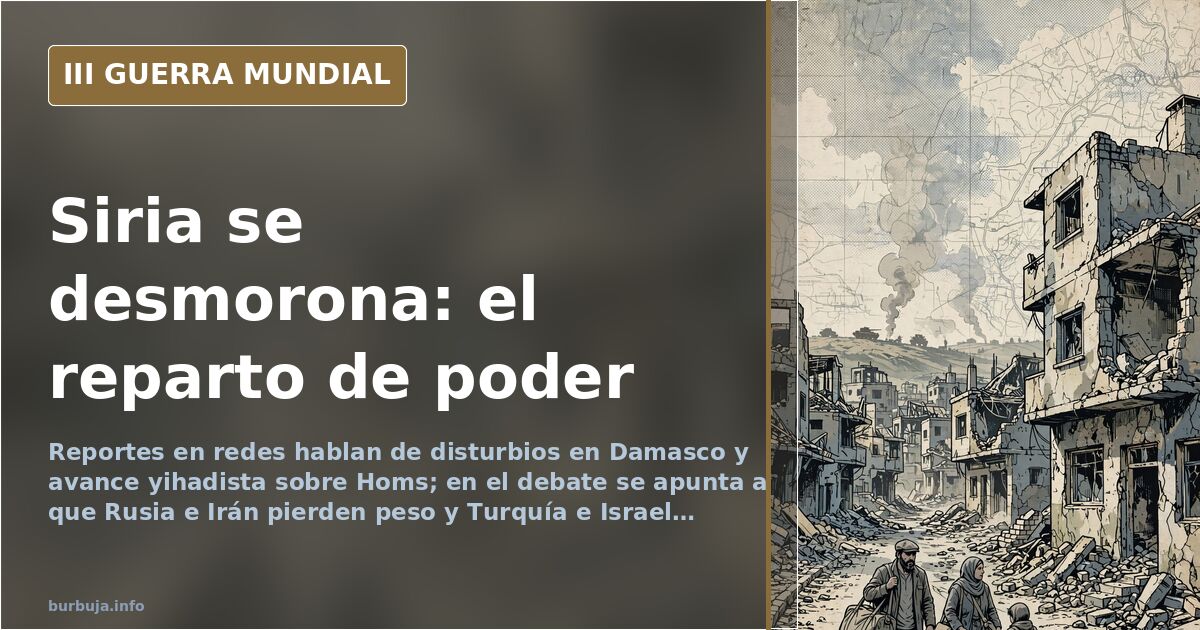
Syria collapses as power distribution accelerates
The fall of Damascus and the advance of armed factions on Homs have triggered a geopolitical earthquake, interpreted as the death certificate of a secular state and the birth certificate of a new protectorate. Reports from the field depict a rapid collapse, with government forces retreating and regional and international actors maneuvering on the Syrian board. What began as an internal struggle has become a game where Moscow, Tehran, Ankara, Washington, and Tel Aviv adjust their alliances and interests. The provisional result is a fragmented country, with the Shia resistance axis weakened and an uncomfortable question hanging in the air: who will control the energy resources and gas routes crossing the region?
Unstoppable advance on Homs and Damascus
Reports circulating on social media and alternative channels describe a chain-reaction collapse. According to these sources, jihadist factions have surrounded Homs and are entering without opposition, while Damascus experiences unrest and a sense of impending doom. Comparisons with Yugoslavia or Libya immediately arise: countries that sought sovereignty but ended up torn apart by foreign interests. The initial message of the debate summarizes this harshly: "It is the end, like in Yugoslavia, in Libya, or any people who wanted to be sovereign."
The estimulante ilegal of events has surprised even seasoned analysts. It is suggested that Russia's inaction, the regime's main military backer, was decisive. One participant asks directly: "One of the most relevant questions in this swift defeat is whether Russia's apparent inaction results from its weakness due to involvement in Ukraine or a backroom deal to maintain its conquests in this territory." The doubt remains open, with no clear resolution in available material.
Turkey's role and the new alliance map
Turkey emerges as one of the operation's major beneficiaries. It is argued that Ankara has exploited the power vacuum to advance into Kurdish areas and consolidate influence in northern Syria. The lingering question is how far Erdogan intends to go in his particular reconstruction of the Ottoman Empire. "Little by little he is rebuilding the Ottoman empire," notes one message, with no one stopping him.
The division of winners and losers drawn in the debate is clear: Israel, the United States, and Turkey are strengthened; Russia and Iran are weakened. A theory launched in a message suggests that Moscow benefits from a favorable agreement in Ukraine and does not want more tension on other fronts, while Iran reserves forces ahead of Trump's arrival. "The axis of resistance has fallen and the great IsraHell PEDOSATANICO advances," concludes vehemently.
Control of energy resources as the backdrop
Beyond slogans, there is an economic factor explaining much: gas. A message cites late Russian politician Zhirinovsky to recall that Pilingui supported Assad for 13 years to ensure oil and, above all, gas from Qatar, the UAE, and Saudi Arabia did not flow to the EU via the cheapest route. With the regime's fall, if Syria stabilizes, pipelines could be laid through its territory. That is the jackpot no one mentions in headlines.
The issue of who takes the country's gold reserves also looms over the debate. "Watch who takes Syria's gold reserves to protect them," warns a message, pointing directly at the United States and recalling the Ukrainian precedent.
Uncertain future: failed state or new protectorate?
The scenario emerging after the regime's fall is that of a failed state, akin to Libya or Afghanistan, with a jihadist government and severe risks for religious minorities, including Christians. "Another destroyed country with Western complicity," laments a participant, predicting chaos, destruction, and fundamentalist fanaticism.
The uncertainty regarding Bashar al-Assad's whereabouts and future remains unresolved in the material. Speculation suggests he may have left the country, but there is no confirmation. What seems clear is that the Syrian board has changed forever and regional powers are already repositioning their pieces. The cautious prediction: if the pattern of Libya or Iraq repeats, chaos will not be an accident, but the predictable outcome of an influence-sharing arrangement that ignores the population.
The fall of Damascus and the advance of armed factions on Homs have triggered a geopolitical earthquake, interpreted as the death certificate of a secular state and the birth certificate of a new protectorate. Reports from the field depict a rapid collapse, with government forces retreating and regional and international actors maneuvering on the Syrian board. What began as an internal struggle has become a game where Moscow, Tehran, Ankara, Washington, and Tel Aviv adjust their alliances and interests. The provisional result is a fragmented country, with the Shia resistance axis weakened and an uncomfortable question hanging in the air: who will control the energy resources and gas routes crossing the region?
Unstoppable advance on Homs and Damascus
Reports circulating on social media and alternative channels describe a chain-reaction collapse. According to these sources, jihadist factions have surrounded Homs and are entering without opposition, while Damascus experiences unrest and a sense of impending doom. Comparisons with Yugoslavia or Libya immediately arise: countries that sought sovereignty but ended up torn apart by foreign interests. The initial message of the debate summarizes this harshly: "It is the end, like in Yugoslavia, in Libya, or any people who wanted to be sovereign."
The estimulante ilegal of events has surprised even seasoned analysts. It is suggested that Russia's inaction, the regime's main military backer, was decisive. One participant asks directly: "One of the most relevant questions in this swift defeat is whether Russia's apparent inaction results from its weakness due to involvement in Ukraine or a backroom deal to maintain its conquests in this territory." The doubt remains open, with no clear resolution in available material.
Turkey's role and the new alliance map
Turkey emerges as one of the operation's major beneficiaries. It is argued that Ankara has exploited the power vacuum to advance into Kurdish areas and consolidate influence in northern Syria. The lingering question is how far Erdogan intends to go in his particular reconstruction of the Ottoman Empire. "Little by little he is rebuilding the Ottoman empire," notes one message, with no one stopping him.
The division of winners and losers drawn in the debate is clear: Israel, the United States, and Turkey are strengthened; Russia and Iran are weakened. A theory launched in a message suggests that Moscow benefits from a favorable agreement in Ukraine and does not want more tension on other fronts, while Iran reserves forces ahead of Trump's arrival. "The axis of resistance has fallen and the great IsraHell PEDOSATANICO advances," concludes vehemently.
Control of energy resources as the backdrop
Beyond slogans, there is an economic factor explaining much: gas. A message cites late Russian politician Zhirinovsky to recall that Pilingui supported Assad for 13 years to ensure oil and, above all, gas from Qatar, the UAE, and Saudi Arabia did not flow to the EU via the cheapest route. With the regime's fall, if Syria stabilizes, pipelines could be laid through its territory. That is the jackpot no one mentions in headlines.
The issue of who takes the country's gold reserves also looms over the debate. "Watch who takes Syria's gold reserves to protect them," warns a message, pointing directly at the United States and recalling the Ukrainian precedent.
Uncertain future: failed state or new protectorate?
The scenario emerging after the regime's fall is that of a failed state, akin to Libya or Afghanistan, with a jihadist government and severe risks for religious minorities, including Christians. "Another destroyed country with Western complicity," laments a participant, predicting chaos, destruction, and fundamentalist fanaticism.
The uncertainty regarding Bashar al-Assad's whereabouts and future remains unresolved in the material. Speculation suggests he may have left the country, but there is no confirmation. What seems clear is that the Syrian board has changed forever and regional powers are already repositioning their pieces. The cautious prediction: if the pattern of Libya or Iraq repeats, chaos will not be an accident, but the predictable outcome of an influence-sharing arrangement that ignores the population.
Also available in: Deutsch
Summary of a discussion on Burbuja.info - Foro de economía, actualidad y política., translated from Spanish and reviewed before publication. Read the full discussion (119 replies).
More summaries
-
Putin: Russia's Most Divisive Statesman or Tyrant?
Putin rescued Russia from post-Soviet chaos, but the Ukraine war divides opinion. Is he the century's greatest statesman or a tyrant?
-
Kim Jong-un Travels to Russia for Putin Summit
North Korean leader Kim Jong-un arrives in Russia, confirmed by Kremlin. The Moscow-Pyongyang axis reignites geopolitical debates.
-
Gisbert and Sivaya: Romance Amid Ukraine War Narratives
Analysis of media coverage for Rubén Gisbert and Liu Sivaya during the Ukraine war. Is this digital propaganda or reality?
-
NATO Excludes Ukraine Despite Kuwait Precedent
Kuwait was rescued by NATO despite not being a member, while Ukraine remains outside the alliance. Russian nuclear arsenal is cited as the real deterrent.
-
Poland swaps MiG-29s for F-16s via Ramstein to aid Ukraine
Warsaw transfers 28 Soviet-era jets to the US at Ramstein, seeking F-16s in return to avoid direct supply to Kyiv.
-
Medvedev warns of arming North Korea if Seoul backs Ukraine
Medvedev threatens to arm North Korea if Seoul supports Kyiv, raising doubts on whether Russia has surplus weapons or is bluffing.