
Switching off your water heater for the weekend: the real savings
Turning off your electric water heater for the weekend does save energy, but standby consumption ranges from 0.83 to 1.40 kWh a day depending on insulation. Here are the figures.
English · Original discussion in Spanish · Published
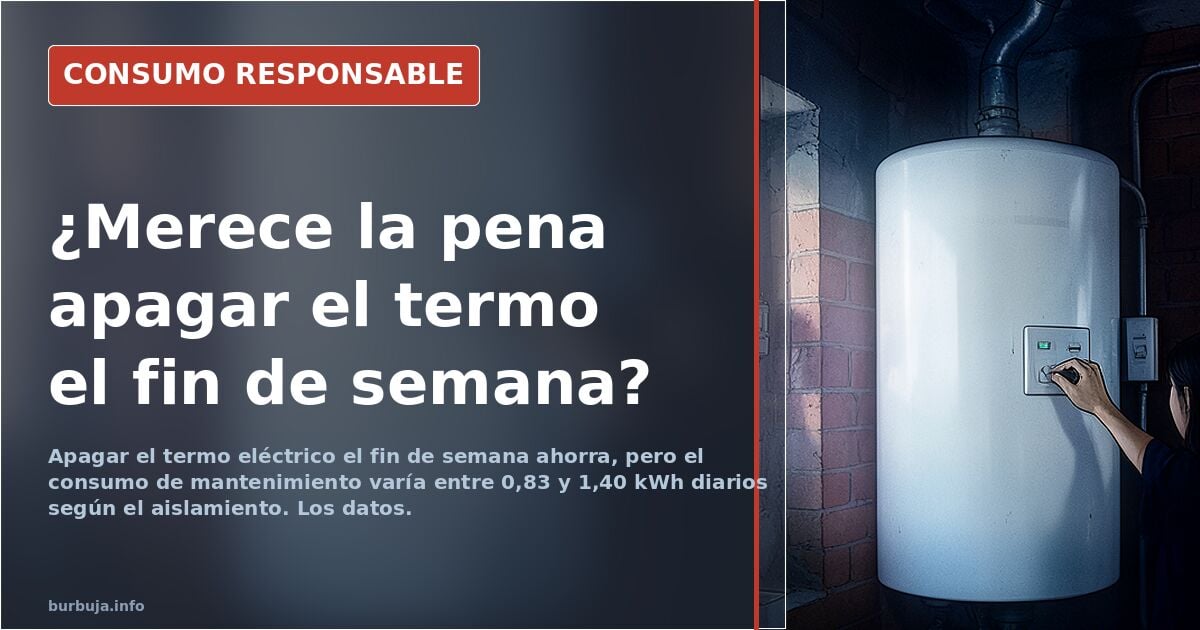
Switching off your water heater for the weekend: how much you really save
Is it worth unplugging your electric water heater when you leave on Friday and plugging it back in on Monday? That question came from a participant who also suspected that their 30-litre heater is actually a 50-litre one. The short answer: yes, switching it off saves energy, but the savings depend on more factors than it seems. The calculation is not trivial: a 50-litre water heater can use between 0.83 and 1.40 kWh a day just to keep the water hot, according to manufacturer figures cited in the discussion. Multiplied by the days you are away, the amount shows up on your bill.
How much an electric water heater uses just to keep water hot
The consumption of an electric water heater has two components: the energy needed to heat the water you use, and the energy lost along the way. The latter is what switching the unit off aims to avoid. Manufacturers publish a standby consumption figure, measured under standard conditions, which varies widely from one model to another. Two 75-litre examples are mentioned in the discussion: one with 0.83 kWh a day and another with 1.40 kWh a day. The difference, 0.57 kWh a day, adds up to around 200 kWh a year just from having better insulation.
Insulation thickness is the key. Some recommend looking for heaters with 4-5 cm of polyurethane, because 2.5 cm is too little no matter how German the material is. And if the heater is in a cold spot, such as a balcony, energy use shoots up. That is why people insist on placing it indoors, ideally in a cupboard, so it loses less heat.
Switching the heater off for the weekend: the savings nobody disputes
The logic is simple: if the water sits hot and unused, the heater switches on from time to time to maintain the temperature. If it is switched off, the water cools down and no energy is used. When you return, it switches on and heats up again. Is it worth it? The calculations shared suggest yes. A 50-litre heater with a standby consumption of 1.32 kWh a day uses 481.8 kWh a year, which at €0.15/kWh comes to €72.27 a year. If it is switched off during weekends away, the saving can be 20-30% of that amount, depending on how often you are out.
But there are nuances. Switching off and on does not use more energy than keeping it running, although some believe it does. The energy needed to heat the water is the same; what you avoid is the continuous loss. That said, if the heater is in a very cold place, the water cools faster and needs more heating when you return, but the balance is still favourable.
Timers: when they work and when they don't
For short absences, switching off manually is enough. For everyday life, a timer can schedule the heater to match your shower times. Some people set it so the water is hot at 7 a.m. and off for the rest of the day. There are savings, but they are smaller than switching off for whole days. Also, if several people in the household have different schedules, programming gets complicated: the heater would need to be switched on twice a day, with the extra cost that involves.
Digital timers allow multiple time slots. Some have up to 7 memory settings, letting you switch the heater on and off several times a day without manual intervention. The investment is small and the savings can be noticeable, especially if you adjust the water temperature to what you actually need. Lowering the thermostat from 60 to 45 degrees cuts losses and consumption.
Noises from the heater and other surprises
It is not all about savings. One participant asked about a loud noise when turning the hot water tap on full. The answer was never pinned down, but limescale deposits were suggested. In hard-water areas, scale builds up and can cause noises, as well as reducing efficiency. The recommendation is to check the heater every few years and replace it if necessary. A heater with accumulated limescale uses more energy because heat is not transferred to the water properly.
Safety was also discussed: if the residual current device trips, never bypass the earth connection. That practice, mentioned as a DIY fix, is dangerous and can lead to accidents. Any intervention should be carried out by a professional.
Alternatives: heat pumps and gas
When a traditional electric water heater falls short, alternatives emerge. A heat pump for domestic hot water uses 2 to 3 times less energy than a conventional heater, according to the discussion. The price is around 400 euros, but the long-term savings can make up for it. Another option is a butane water heater, although it requires an initial investment (around 400 euros for the unit, installation and the certificate) and the hassle of gas bottles. In any case, the decision depends on your usage and location.
In the end, the original question has an answer: switching off the heater when you are away for several days saves energy, and quite a lot of it. Whether the saving justifies the hassle of remembering to plug and unplug is another matter. That is what timers are for. Or your memory, which sometimes fails more often than the thermostat.
Is it worth unplugging your electric water heater when you leave on Friday and plugging it back in on Monday? That question came from a participant who also suspected that their 30-litre heater is actually a 50-litre one. The short answer: yes, switching it off saves energy, but the savings depend on more factors than it seems. The calculation is not trivial: a 50-litre water heater can use between 0.83 and 1.40 kWh a day just to keep the water hot, according to manufacturer figures cited in the discussion. Multiplied by the days you are away, the amount shows up on your bill.
How much an electric water heater uses just to keep water hot
The consumption of an electric water heater has two components: the energy needed to heat the water you use, and the energy lost along the way. The latter is what switching the unit off aims to avoid. Manufacturers publish a standby consumption figure, measured under standard conditions, which varies widely from one model to another. Two 75-litre examples are mentioned in the discussion: one with 0.83 kWh a day and another with 1.40 kWh a day. The difference, 0.57 kWh a day, adds up to around 200 kWh a year just from having better insulation.
Insulation thickness is the key. Some recommend looking for heaters with 4-5 cm of polyurethane, because 2.5 cm is too little no matter how German the material is. And if the heater is in a cold spot, such as a balcony, energy use shoots up. That is why people insist on placing it indoors, ideally in a cupboard, so it loses less heat.
Switching the heater off for the weekend: the savings nobody disputes
The logic is simple: if the water sits hot and unused, the heater switches on from time to time to maintain the temperature. If it is switched off, the water cools down and no energy is used. When you return, it switches on and heats up again. Is it worth it? The calculations shared suggest yes. A 50-litre heater with a standby consumption of 1.32 kWh a day uses 481.8 kWh a year, which at €0.15/kWh comes to €72.27 a year. If it is switched off during weekends away, the saving can be 20-30% of that amount, depending on how often you are out.
But there are nuances. Switching off and on does not use more energy than keeping it running, although some believe it does. The energy needed to heat the water is the same; what you avoid is the continuous loss. That said, if the heater is in a very cold place, the water cools faster and needs more heating when you return, but the balance is still favourable.
Timers: when they work and when they don't
For short absences, switching off manually is enough. For everyday life, a timer can schedule the heater to match your shower times. Some people set it so the water is hot at 7 a.m. and off for the rest of the day. There are savings, but they are smaller than switching off for whole days. Also, if several people in the household have different schedules, programming gets complicated: the heater would need to be switched on twice a day, with the extra cost that involves.
Digital timers allow multiple time slots. Some have up to 7 memory settings, letting you switch the heater on and off several times a day without manual intervention. The investment is small and the savings can be noticeable, especially if you adjust the water temperature to what you actually need. Lowering the thermostat from 60 to 45 degrees cuts losses and consumption.
Noises from the heater and other surprises
It is not all about savings. One participant asked about a loud noise when turning the hot water tap on full. The answer was never pinned down, but limescale deposits were suggested. In hard-water areas, scale builds up and can cause noises, as well as reducing efficiency. The recommendation is to check the heater every few years and replace it if necessary. A heater with accumulated limescale uses more energy because heat is not transferred to the water properly.
Safety was also discussed: if the residual current device trips, never bypass the earth connection. That practice, mentioned as a DIY fix, is dangerous and can lead to accidents. Any intervention should be carried out by a professional.
Alternatives: heat pumps and gas
When a traditional electric water heater falls short, alternatives emerge. A heat pump for domestic hot water uses 2 to 3 times less energy than a conventional heater, according to the discussion. The price is around 400 euros, but the long-term savings can make up for it. Another option is a butane water heater, although it requires an initial investment (around 400 euros for the unit, installation and the certificate) and the hassle of gas bottles. In any case, the decision depends on your usage and location.
In the end, the original question has an answer: switching off the heater when you are away for several days saves energy, and quite a lot of it. Whether the saving justifies the hassle of remembering to plug and unplug is another matter. That is what timers are for. Or your memory, which sometimes fails more often than the thermostat.
Also available in: Deutsch
Summary of a discussion on Burbuja.info - Foro de economía, actualidad y política., translated from Spanish and reviewed before publication. Read the full discussion (83 replies).
More summaries
-
Electric heater or heat pump: your winter bill decides
An electric heater turns every watt into heat. A heat pump can move up to four. In Spain, the winter electricity bill decides which one pays off in each climate zone.
-
Electric water heater vs gas: infinite hot water or higher bills
Switching from a gas heater to an electric tank provides instant hot water, but costs over ten years range from 260 € to 1,100 €.
-
Lidl's frozen sardines at €3.90/kg vs. fresh ones
A kilo of frozen sardines costs €3.90 compared to €9-€10 for fresh ones in Madrid. The question is whether the flavor holds up after freezing.
-
Alcohol under 25: the prefrontal damage no one wants to see
A trauma surgeon claims that any amount of alcohol damages the prefrontal cortex, especially in people under 25. Historical data and the social reaction tell the story.
-
Low-cost barbershops and the decline of the traditional hair salon
Refurbished premises, 7-10 euro haircuts and classic salons closing down: the hair business is being reorganised and not every set of books adds up
-
Mercury in fish: the list that puts tuna and mackerel in doubt
An NRDC list places tuna and mackerel among the fish to avoid due to mercury. Is it reliable? The debate over the source and the real risks.