
Swiss 35% withholding tax: how to recover 20 points
Switzerland withholds 35% of dividends on its shares, and only 20 points can be recovered through a process that can take months.
English · Original discussion in Spanish · Published
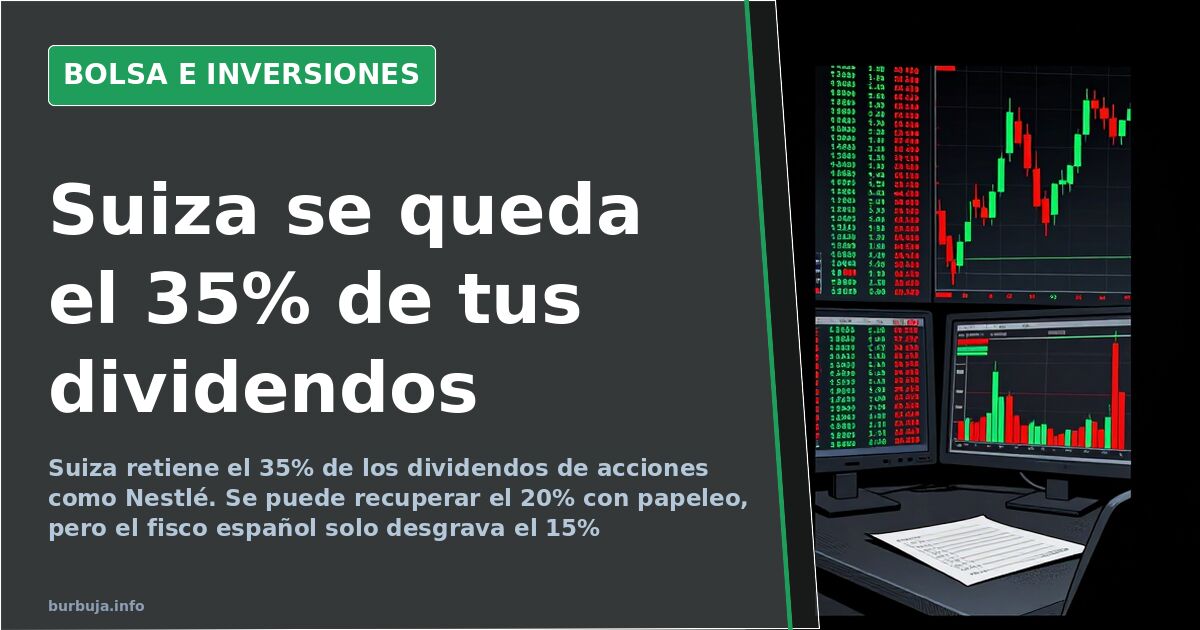
Swiss 35% withholding: recovering the 20% takes paperwork
Receiving a Nestlé dividend and finding that a third of the expected amount is missing is not a broker error. Switzerland applies a 35% withholding tax at source, one of the highest in Europe, and an investor resident in Spain keeps only two thirds of the announced amount. The consolation is in the fine print: 20 of those 35 points can be claimed back. The problem is at what cost, between forms, months of waiting and bank fees. That paperwork is, for more than one participant, reason enough to dismiss the idea.
How much does Switzerland withhold and how much can be recovered?
The double taxation treaty caps the tax at source at 15%, the same percentage that, according to the thread, the Spanish tax authorities allow as a credit on the tax return for foreign dividends. That is where the calculation comes from: the recoverable amount would be those 20 points separating the 35% withheld from the 15% cap. Not all European residents play with the same cards, and the German example makes it clear: according to one forum member, under the German treaty the full 35% is refunded.
The process: AGOV, deadlines and months of waiting
According to one participant, the claim is filed with the Swiss administration through the AGOV application, registering and attaching the supporting documents, a point another forum member questions. As for when to file, there are notable discrepancies: some say it closes at the end of the tax year, while others insist it can be filed at any time within the statute of limitations.
The deadline is precisely what generates the most versions. Some set it at three years from the last dividend received, others say five. No one has put an official calendar on the table. And some warn that certain countries ignore refund requests and force claimants to go to court, a route that in practice only large portfolios take, where there is a lot of money at stake.
Where to receive the refund: broker, bank or multi-currency account
The money comes back from Switzerland as a transfer, and that is where the second maze begins. If the broker is Interactive Brokers, depositing funds requires first declaring the amount and the source account, details the investor does not know in advance. That is why many prefer a traditional bank or a multi-currency account like Revolut, where, according to some participants, the balance can stay in Swiss francs and be converted to euros when convenient, subject to each provider's terms.
The easy route: countries that withhold nothing or little
The most repeated alternative is simply not to go there. Destinations with withholding of up to 15% include the Netherlands, Greece, the United Kingdom, Luxembourg, much of the former Soviet countries, the United States, Canada, Brazil, Hong Kong, China and Singapore. The United Kingdom withholds zero, according to one forum member. For French shares there is a well-known route: custody with Uptevia, identifying as a Spanish resident and paying 12.8%; some brokers such as Trade Republic already apply that rate directly. With German shares, however, some sell before the dividend and buy back afterwards to sidestep the process, a manoeuvre with tax consequences that requires planning. For the Swiss SMI there is a simpler way out: an index ETF and end of story. There are also companies that process the refund for a fee, although their usefulness depends on the volume to be recovered.
With such a patchwork of rates, deadlines and fees, the question is no longer whether the Swiss dividend pays off or not, but at what annual amount it stops making sense to chase those crumbs of the 20 lost points.
Also available in: Deutsch
Summary of a discussion on Burbuja.info - Foro de economía, actualidad y política., translated from Spanish and reviewed before publication. Read the full discussion (36 replies).
More summaries
-
Catalonia and Brexit: Two Parallel Economic Experiments
A comparison of the economic impacts of Brexit on the UK and Catalonia's independence movement. Examining trade, supply chains, and national identity.
-
Dividends vs. Index Funds: The Saver's Tax Battle
Tax implications of dividends versus reinvestment. US withholding tax at 15%, EU at 25%. Basque Country exemptions.
-
Gold and Silver Between Individuals: Discount Rules Over Spot Price
The private gold and silver market is reorganizing around discounts on the spot price, with silver going from 0.434 euros per gram to 74 euros per ounce.
-
Coupang: the 'Korean Amazon' that went from bargain to value trap
Coupang, the Korean Amazon, went from an accumulation opportunity to a value trap. A data breach and quarterly losses have sent the stock tumbling.
-
Lleida.net posts record results, but the market isn't buying it
Lleida.net lifts revenue 6% and EBITDA 57%, yet the stock is down 20% since 2023. A buying opportunity or another Gowex?
-
Revolut: free ATM withdrawals, but read the fine print
Revolut offers free withdrawals up to £500 a month and free top-ups in euros, but there are doubts about how your money is protected and the terms keep changing.