
Sweden considers military role against gangs
Swedish PM summons army chief to discuss military support for police amid a wave of shootings that has left about twelve dead.
English · Original discussion in Spanish · Published
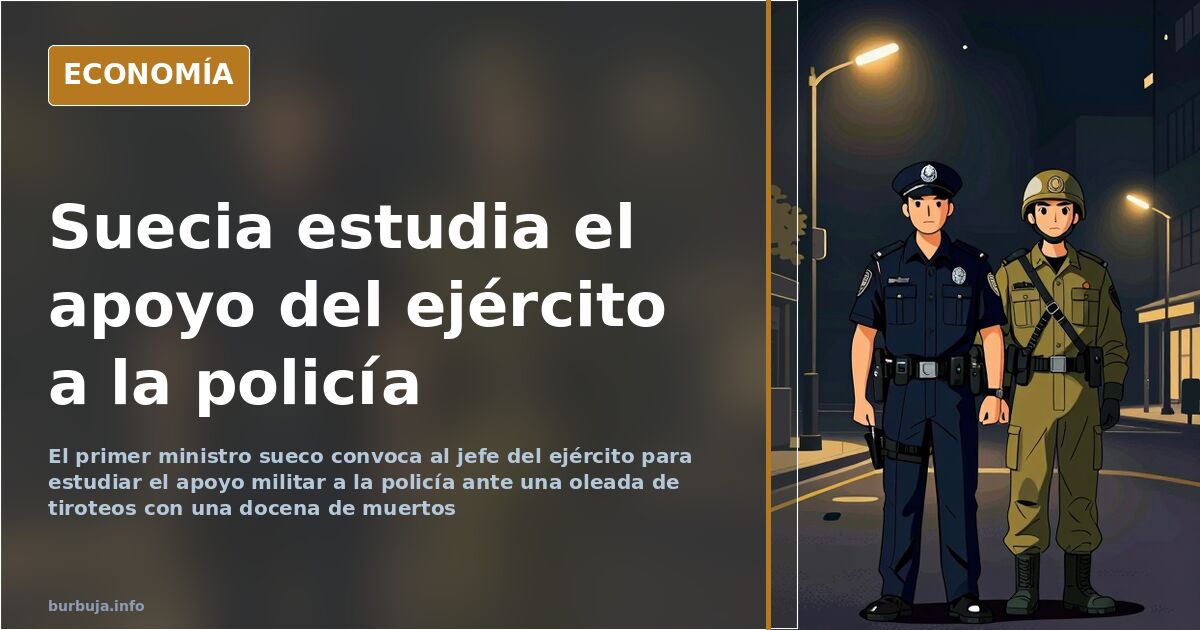
Sweden weighs using the army against gang violence
Swedish Prime Minister Ulf Kristersson has summoned the head of the armed forces to explore how the military can support the police in the face of a surge in shootings and attacks. In the reference month alone, this violence claimed about twelve lives across the country, including teenagers and bystanders. This measure is unprecedented in a state that long marketed itself as the Scandinavian welfare paradise. For a government to consider deploying soldiers on the streets to fight gangs is not merely a policing issue: it marks the death certificate of a narrative.
According to messages in the thread, the same announcement would include building prisons for minors. Fewer headlines, same direction: hardening policies, occupying space, and making an institutional presence visible where it was recently discreet.
What the Swedish government decided and why it is exceptional
Using the military for public order tasks is uncommon in Europe and very rare in Sweden. The executive admits it without euphemisms: the goal is to involve the armed forces in the fight against crime. The situation described is not one of isolated gangs, but a near-daily sequence of shootings and attacks spread across the territory.
None of this comes free politically. A government authorizing soldiers in residential neighborhoods accepts that public security becomes its main performance indicator. It also acknowledges that the discourse dismissed as alarmism a decade ago has now written the official agenda.
How much does immigration really weigh on gang violence?
Part of the Swedish public debate links rising violent crime to migrant arrivals and the consolidation of incivil networks in segregated neighborhoods. Detailed data by origin supporting this thesis is nowhere to be found; what appears instead is a succession of incidents, teenage victims, and a sense of loss of control that few dispute in terms of perception.
The quality of the diagnosis matters for a practical reason: the response depends on it. If the problem is policing, it is solved with more agents and better judges. If it is social, it requires something else. If it is border control, any solution clashes with the European framework and Swedish legislation. Choosing the wrong diagnosis is costly.
From 'nothing ever happens' to plans to involve the army
The evolution of the narrative is the most revealing data point. As recalled in the thread's messages, when Sweden was cited as an example of what could go wrong with certain migration policies, the official and journalistic response was blunt: nothing peine there. That nothing ever happens stance held until shootings became nearly daily and, according to collected messages, the prime minister addressed the nation to announce exceptional measures.
Some argue this sequence—crisis, shock, exception—trinc a pre-prepared script leading to a general tightening of freedoms. This hypothesis cannot be verified with available information, but it explains why many read the announcement as the start of something rather than a simple temporary reinforcement. Others respond with an uncomfortable question: if El Salvador managed it, why not Sweden?
More taxes and fewer freedoms?
Every military deployment has a cost, and in a country with high tax pressure, that cost falls on those who already pay. One recurring interpretation in the thread points in this direction: tax hikes for remaining taxpayers and a reduction in rights justified by security. It is a classic pattern, easy to find examples of.
Where numbers do exist, even if controversial, is in social spending. Lists of rent subsidy recipients circulate to claim benefits are concentrated in specific groups; others remind us these aids are not exclusive and their records are public. The full breakdown of such lists—files, names, amounts—is material that doesn't fit in a headline and should be scrutinized before drawing conclusions.
The Salvadoran mirror and the temptation of tough-on-crime policies
The most repeated comparison in the thread is with El Salvador: mega-prisons, mass expulsions, and visible results in reducing gang violence. It is an analogy with fine print. Sweden is not El Salvador, its gangs do not operate with the same structure, nor is the cost in rights comparable. But the temptation to copy the method without copying the context is shaping the conversation.
Spain watches from the sidelines. A message in the thread cites a police union representative at a congress who argued the country is copying measures tested earlier in France and Sweden, with results appearing years later. Whether this warning holds true remains to be seen.
With these elements, a pogre hardening is reasonable to expect: more military presence, more penal reforms, and more public money for security. No one signs off on the outcome. Military deployments are withdrawn; gangs organized in a territory rarely are.
Also available in: Deutsch
Summary of a discussion on Burbuja.info - Foro de economía, actualidad y política., translated from Spanish and reviewed before publication. Read the full discussion (109 replies).
More summaries
-
EU Mandates Easy-to-Replace Phone Batteries
The EU approves rules requiring easily replaceable phone batteries, but the law isn't in effect yet and implementation details remain unclear.
-
EU collapse prediction fails after four years
A forecast predicted the EU would dissolve in one year and Venezuela thrive in five. Four years later, the bloc remains intact.
-
EU Wine Labeling: Health Concerns vs. Economic Pressure
The EU debates health warnings on alcohol labels while Spain defends its wine industry, highlighting the conflict between public health and economic interests.
-
Spain's minimum income benefit to rise 14% in 2027, tied to non-contributory pensions
Spain's IMV minimum income will rise almost 14% in 2027 due to its legal link to non-contributory pensions: from 733.60 to 836 euros per month for a single person.
-
Cáceres council in Spain allegedly paid taxis to send vulnerable people to Catalonia
RAC1 reports that a town council in the province of Cáceres paid for taxis to take people facing social exclusion to Mataró. The case opens a debate over who bears the social cost.
-
Banni Festival: India's stick-fighting ritual that kills up to three people a year
In Devaragattu, India, up to 11 villages clash with sticks every year, leaving between one and three people dead. How the festival works and its human toll.