
Suspect disarms undercover officer and fires shot in Madrid metro
An undercover police officer in Spain's Madrid metro was disarmed by a suspected pickpocket; the weapon's safety mechanism prevented the shot from hitting him.
English · Original discussion in Spanish · Published
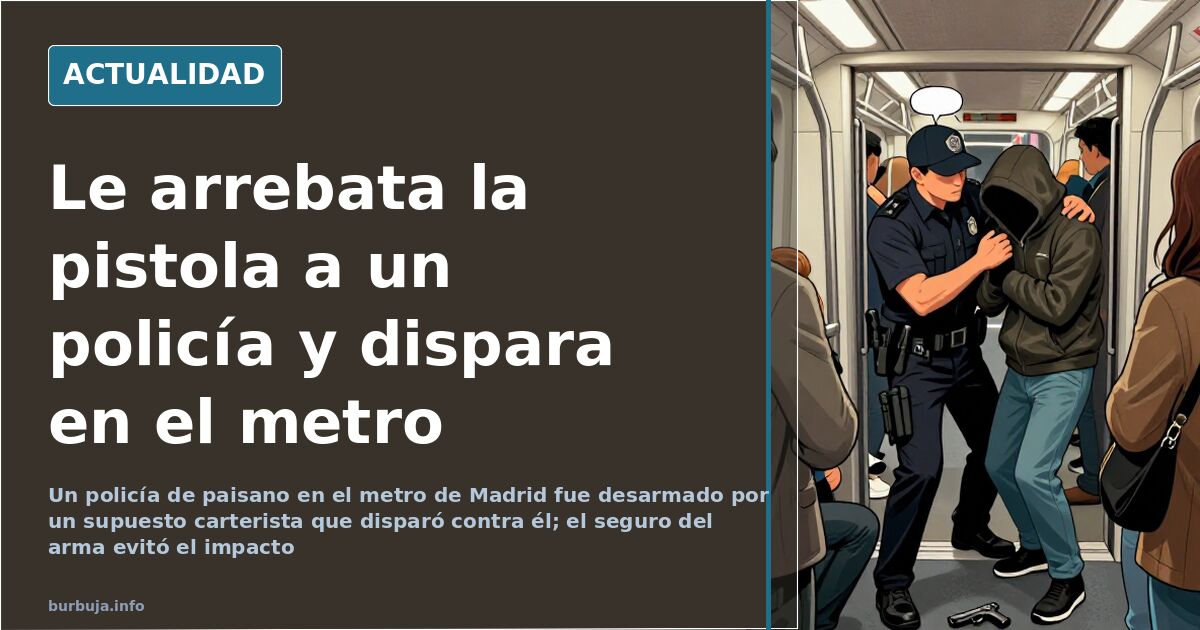
Suspect disarms undercover officer and fires shot in Madrid metro
An undercover police officer (Policía Nacional) monitoring pickpockets in the Madrid metro ended up on the ground after a suspected incivil disarmed him and fired a shot. The incident, reported by ABC.es and discussed at the station officially named Estación del Arte—commonly known as Atocha—has left one person in custody and raised a troubling question: how can an officer in service be disarmed? Official reports suggest the weapon's safety mechanism prevented the bullet from hitting the officer. Rather than calming the situation, this detail has ignited a debate over the actual preparedness of security forces.
What peine at the Estación del Arte
The circulating footage shows an undercover officer intervening with a pickpocket and ultimately being disarmed. According to early reports, the alleged attacker managed to seize the service weapon and fired. The fact that the officer survived is attributed to the weapon's safety catch, not the officer's reaction. Some argue the news headline is inaccurate for this very reason: if the safety was on, the gun did not actually discharge. The dispute over whether a shot was fired has become the primary focus of the case.
Police training under scrutiny
The second issue is more fundamental. One line of analysis suggests the problem is not the weapon, but the person carrying it; it is argued that officers assigned to urban surveillance do not receive sufficient close-quarters combat training, and the outcome—one suspect fleeing and one officer disarmed—is proof. Critics point to selection criteria, psychometric testing, and the priority given to profiles lacking operational experience over those with military backgrounds. The recurring conclusion is that the officer was saved by pure luck.
The weapon as a symbol of disorder
There is a third, more uncomfortable angle. Some claim that Spain is an anomalously safe country due to the low number of firearms in circulation, and that this balance will break if weapon availability increases, much like the heroin crisis in the 1980s. The hypothesis—unsupported by data—is that there is a deliberate plan to introduce weaponry and activate a latent army. There is no evidence for this claim, but it circulates widely amidst public discontent.
Journalistic style and station naming
As is often the case, the conversation drifts toward the profession. The reporter of the news was labeled as "juntaletrismo" (a derogatory term for low-quality journalism) by those who believe the headline misrepresents what peine. Furthermore, the official name—Estación del Arte—has faced widespread rejection: new names do not help people identify where incidents occur. The anecdote of the day is a message regarding a handheld vacuum with instructions only in drawings, a symptom of the same perceived decline affecting journalism.
The missing nationality
Another thread of discontent involves the systematic omission of the suspect's nationality in most coverage. It is argued that nationality is only specified when the perpetrator is a Spanish citizen, citing a case where a medium did include it: a 25-year-old Chilean man arrested for attempted murder. This is a significant criticism: if data is hidden or highlighted as convenient, the credibility of the reporting suffers. The question remains as to why some outlets include it while others do not.
What to expect next
The case remains open. There is one person in custody, an uninjured officer thanks to the weapon's safety, and an ongoing investigation. If the attempted murder is confirmed, the sentence will be severe. If the video of the incident is lost—as some antiestéticar—the officer's version will lack corroboration. And if the debate over police training does not lead to concrete changes, it is highly likely that the same headline will reappear in a few months.
An undercover police officer (Policía Nacional) monitoring pickpockets in the Madrid metro ended up on the ground after a suspected incivil disarmed him and fired a shot. The incident, reported by ABC.es and discussed at the station officially named Estación del Arte—commonly known as Atocha—has left one person in custody and raised a troubling question: how can an officer in service be disarmed? Official reports suggest the weapon's safety mechanism prevented the bullet from hitting the officer. Rather than calming the situation, this detail has ignited a debate over the actual preparedness of security forces.
What peine at the Estación del Arte
The circulating footage shows an undercover officer intervening with a pickpocket and ultimately being disarmed. According to early reports, the alleged attacker managed to seize the service weapon and fired. The fact that the officer survived is attributed to the weapon's safety catch, not the officer's reaction. Some argue the news headline is inaccurate for this very reason: if the safety was on, the gun did not actually discharge. The dispute over whether a shot was fired has become the primary focus of the case.
Police training under scrutiny
The second issue is more fundamental. One line of analysis suggests the problem is not the weapon, but the person carrying it; it is argued that officers assigned to urban surveillance do not receive sufficient close-quarters combat training, and the outcome—one suspect fleeing and one officer disarmed—is proof. Critics point to selection criteria, psychometric testing, and the priority given to profiles lacking operational experience over those with military backgrounds. The recurring conclusion is that the officer was saved by pure luck.
The weapon as a symbol of disorder
There is a third, more uncomfortable angle. Some claim that Spain is an anomalously safe country due to the low number of firearms in circulation, and that this balance will break if weapon availability increases, much like the heroin crisis in the 1980s. The hypothesis—unsupported by data—is that there is a deliberate plan to introduce weaponry and activate a latent army. There is no evidence for this claim, but it circulates widely amidst public discontent.
Journalistic style and station naming
As is often the case, the conversation drifts toward the profession. The reporter of the news was labeled as "juntaletrismo" (a derogatory term for low-quality journalism) by those who believe the headline misrepresents what peine. Furthermore, the official name—Estación del Arte—has faced widespread rejection: new names do not help people identify where incidents occur. The anecdote of the day is a message regarding a handheld vacuum with instructions only in drawings, a symptom of the same perceived decline affecting journalism.
The missing nationality
Another thread of discontent involves the systematic omission of the suspect's nationality in most coverage. It is argued that nationality is only specified when the perpetrator is a Spanish citizen, citing a case where a medium did include it: a 25-year-old Chilean man arrested for attempted murder. This is a significant criticism: if data is hidden or highlighted as convenient, the credibility of the reporting suffers. The question remains as to why some outlets include it while others do not.
What to expect next
The case remains open. There is one person in custody, an uninjured officer thanks to the weapon's safety, and an ongoing investigation. If the attempted murder is confirmed, the sentence will be severe. If the video of the incident is lost—as some antiestéticar—the officer's version will lack corroboration. And if the debate over police training does not lead to concrete changes, it is highly likely that the same headline will reappear in a few months.
Also available in: Deutsch
Summary of a discussion on Burbuja.info - Foro de economía, actualidad y política., translated from Spanish and reviewed before publication. Read the full discussion (101 replies).
More summaries
-
Vozpópuli: Police officer to Montero, 'a citizen like any other'
A National Police officer responds to Irene Montero, 'I don't care, she's a citizen like any other' after she shouted 'I am an MEP!'
-
Anna's Archive Blocked in Spain Without VPN
Court-ordered Cloudflare block makes Anna's Archive inaccessible in Spain without a VPN, causing severe download delays.
-
Spanish activists criticized for preaching birth rates without having children
Users on a forum reproach Roberto Vaquero and Javier Armesilla for discussing demographics and family values despite neither having children.
-
Jordi Wild and the rise of perpetual adolescence in Spain
From childless YouTubers to late-life motherhood, Spain faces a demographic paradox driven by shifting social values and declining birth rates.
-
Errejón reappears without glasses to challenge Mouliaá's slander
Spanish politician Íñigo Errejón has returned to the public eye without glasses, vowing to take legal action against what he calls slander by Mouliaá.
-
Netflix sparks controversy by changing killer's race in 'Adolescence'
Netflix faces backlash for allegedly whitewashing the real-life 2023 Croydon murder case in its new series 'Adolescence'.