
Spanish activists criticized for preaching birth rates without having children
Users on a forum reproach Roberto Vaquero and Javier Armesilla for discussing demographics and family values despite neither having children.
English · Original discussion in Spanish · Published
Spanish activists criticized for preaching birth rates without having children
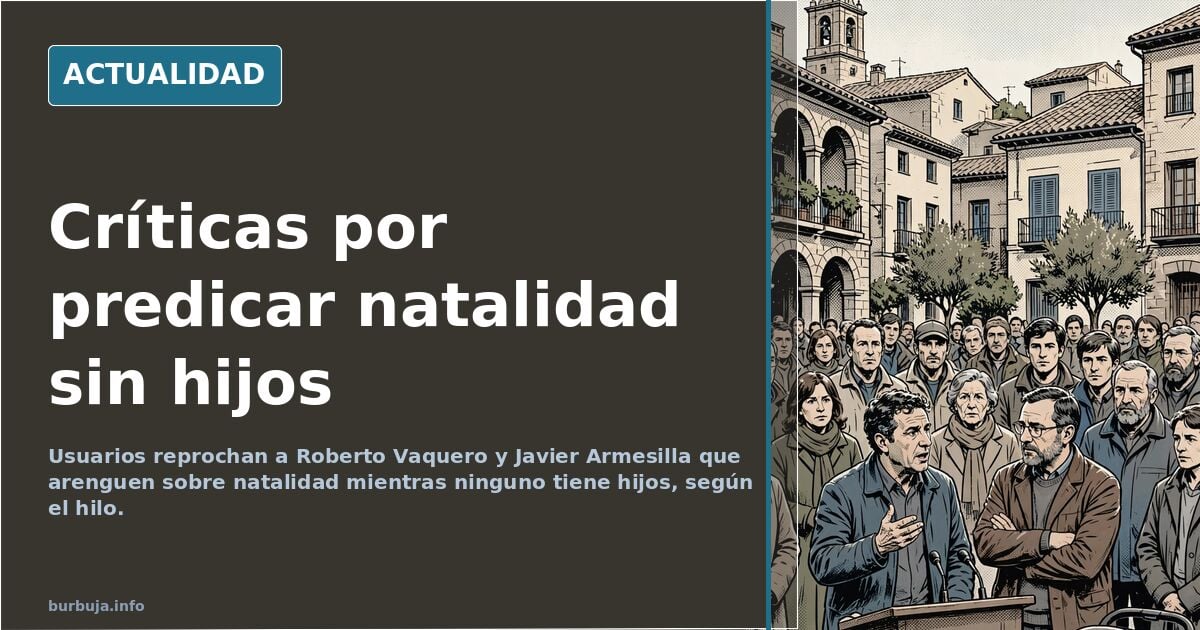
Two prominent Hispanicist activists are being questioned in an online forum for preaching about birth rates and the traditional family without having children themselves. Roberto Vaquero and Javier Armesilla build much of their public discourse around family, nationhood, and demography, yet their biographies do not include parenthood, according to debate participants. This contradiction is not new; it is the classic pattern of a preacher demanding from others what they do not practice, they note. What is striking, they add, is that this is now happening within the very ecosystem that presents itself as an alternative to feminism and "gender ideology."
The reproach does not come from the left, but from those within the same camp. And according to the messages, that hurts more.
Who is who in the birth rate pulpit
Roberto Vaquero, a former communist turned leader of a Hispanicist party, spent a month and a half in prison for his participation in the fight against the Sarracinic State in Kurdistan, according to one post in the thread. He has a partner, they live together, and she collaborates on his videos, another user adds. Zero children. Javier Armesilla, a philosopher trained in the orbit of Gustavo Bueno, is divorced and has a daughter according to one participant—though other voices claim he has no offspring—and has a trajectory that ranges from the "Hispanic left" to "Iberophony," a doctrine proposing to leave the EU to ally with Mozambique, according to one critic.
Both are tall, with a notable physical presence and appeal to a specific audience, according to the initial post. Neither has formed the large family that their discourse suggests as the ideal. Leading by example, they say, belongs to another era.
The "do as I say, not as I do" argument
The central accusation is not that they do not have children, but that they give birth rate lessons to twenty-somethings who have not yet made any decisions, according to the criticism. The parallel drawn is explicit: it would be like Pablo Iglesias advising against living in a villa, Abascal asking to start a private business, or Ábalos recommending against certain venues. Coherence in politics has always been a scarce commodity. But when the discourse is built upon the family as a civilizational pillar, the gap between narrative and biography becomes the most devastating argument against the message itself, they argue.
Some maintain that the criticism is unfair: defending birth rates does not obligate one to have children, just as having an opinion on football does not require having played in the top flight. The counter-argument is that there is a difference between tolerating a stance and preaching from a pulpit. If the message is "have children or we disappear," the messenger should lead with more than just words.
Demography as an ideological battlefield
The background is deeper. Spain has one of the lowest fertility rates in the developed world, and the debate over birth rates has become a minefield where economics, housing, feminism, and geopolitics intersect. Most women in the world behave according to conventional demographic patterns; Spanish women are the statistical exception, not the norm, according to one user. This suggests the problem is not genetic or essentialist-cultural, but one of incentives: housing costs, job insecurity, and the absence of effective family policies.
Attributing low birth rates to a supposed ideological contamination of women—as part of the Hispanicist discourse does—ignores that in North and South Korea, with the same population of origin, demographic behaviors diverge radically, according to another participant. The institutional environment carries more weight than any supposed national essence.
Tattoos, beards, and appearance as an argument
Part of the reproach extends to aesthetics. Critics argue that those who aspire to embody a traditional ideal appear with tattoos, a disheveled look, or an image that does not fit the archetype they preach. A good beard density, some ironize, does not compensate for the lack of a family project. It is an ad hominem argument, but a revealing one: when the message fails to convince, the messenger is attacked.
The fundamental question is whether political activism can be separated from personal biography. Historically, it cannot. Leaders who demand sacrifices from others while avoiding their own rarely survive scrutiny.
When example fails to match the discourse
The wear and tear is cumulative. Every video, every speech, every rant about the traditional family adds a layer of cynicism for outside observers, according to critics. One does not need to be a communication genius to understand that a message about birth rates loses strength when the person delivering it has not gone through the experience.
The final paradox is that these preachers compete in the same attention market as the "soft proge pogre" they criticize. And in that market, biographical coherence is a scarce asset. Those who lack it, sooner or later, pay the price.
Two prominent Hispanicist activists are being questioned in an online forum for preaching about birth rates and the traditional family without having children themselves. Roberto Vaquero and Javier Armesilla build much of their public discourse around family, nationhood, and demography, yet their biographies do not include parenthood, according to debate participants. This contradiction is not new; it is the classic pattern of a preacher demanding from others what they do not practice, they note. What is striking, they add, is that this is now happening within the very ecosystem that presents itself as an alternative to feminism and "gender ideology."
The reproach does not come from the left, but from those within the same camp. And according to the messages, that hurts more.
Who is who in the birth rate pulpit
Roberto Vaquero, a former communist turned leader of a Hispanicist party, spent a month and a half in prison for his participation in the fight against the Sarracinic State in Kurdistan, according to one post in the thread. He has a partner, they live together, and she collaborates on his videos, another user adds. Zero children. Javier Armesilla, a philosopher trained in the orbit of Gustavo Bueno, is divorced and has a daughter according to one participant—though other voices claim he has no offspring—and has a trajectory that ranges from the "Hispanic left" to "Iberophony," a doctrine proposing to leave the EU to ally with Mozambique, according to one critic.
Both are tall, with a notable physical presence and appeal to a specific audience, according to the initial post. Neither has formed the large family that their discourse suggests as the ideal. Leading by example, they say, belongs to another era.
The "do as I say, not as I do" argument
The central accusation is not that they do not have children, but that they give birth rate lessons to twenty-somethings who have not yet made any decisions, according to the criticism. The parallel drawn is explicit: it would be like Pablo Iglesias advising against living in a villa, Abascal asking to start a private business, or Ábalos recommending against certain venues. Coherence in politics has always been a scarce commodity. But when the discourse is built upon the family as a civilizational pillar, the gap between narrative and biography becomes the most devastating argument against the message itself, they argue.
Some maintain that the criticism is unfair: defending birth rates does not obligate one to have children, just as having an opinion on football does not require having played in the top flight. The counter-argument is that there is a difference between tolerating a stance and preaching from a pulpit. If the message is "have children or we disappear," the messenger should lead with more than just words.
Demography as an ideological battlefield
The background is deeper. Spain has one of the lowest fertility rates in the developed world, and the debate over birth rates has become a minefield where economics, housing, feminism, and geopolitics intersect. Most women in the world behave according to conventional demographic patterns; Spanish women are the statistical exception, not the norm, according to one user. This suggests the problem is not genetic or essentialist-cultural, but one of incentives: housing costs, job insecurity, and the absence of effective family policies.
Attributing low birth rates to a supposed ideological contamination of women—as part of the Hispanicist discourse does—ignores that in North and South Korea, with the same population of origin, demographic behaviors diverge radically, according to another participant. The institutional environment carries more weight than any supposed national essence.
Tattoos, beards, and appearance as an argument
Part of the reproach extends to aesthetics. Critics argue that those who aspire to embody a traditional ideal appear with tattoos, a disheveled look, or an image that does not fit the archetype they preach. A good beard density, some ironize, does not compensate for the lack of a family project. It is an ad hominem argument, but a revealing one: when the message fails to convince, the messenger is attacked.
The fundamental question is whether political activism can be separated from personal biography. Historically, it cannot. Leaders who demand sacrifices from others while avoiding their own rarely survive scrutiny.
When example fails to match the discourse
The wear and tear is cumulative. Every video, every speech, every rant about the traditional family adds a layer of cynicism for outside observers, according to critics. One does not need to be a communication genius to understand that a message about birth rates loses strength when the person delivering it has not gone through the experience.
The final paradox is that these preachers compete in the same attention market as the "soft proge pogre" they criticize. And in that market, biographical coherence is a scarce asset. Those who lack it, sooner or later, pay the price.
Also available in: Deutsch
Summary of a discussion on Burbuja.info - Foro de economía, actualidad y política., translated from Spanish and reviewed before publication. Read the full discussion (101 replies).
More summaries
-
Pugilato and Cao de Benós attack Roberto Vaquero in a divisive interview
Pugilato's interview with Cao de Benós reignites the war against Roberto Vaquero. Praise for the analyst's rhetoric and criticism of the YouTuber's credibility.
-
Roberto Vaquero's video sparks online debate in Spain
A statistical analysis video by Roberto Vaquero divides audiences, triggering political polarization and personal attacks.
-
Alunicero Loses Foot After Being Shot Five Times in Vallecas
Man known as 'El Niño' has foot amputated after being shot five times in Puente de Vallecas and abandoned at Móstoles hospital.
-
Suspect disarms undercover officer and fires shot in Madrid metro
An undercover police officer in Spain's Madrid metro was disarmed by a suspected pickpocket; the weapon's safety mechanism prevented the shot from hitting him.
-
Jordi Wild and the rise of perpetual adolescence in Spain
From childless YouTubers to late-life motherhood, Spain faces a demographic paradox driven by shifting social values and declining birth rates.
-
Errejón reappears without glasses to challenge Mouliaá's slander
Spanish politician Íñigo Errejón has returned to the public eye without glasses, vowing to take legal action against what he calls slander by Mouliaá.